X-Planes: Bell Textron X-76 SPRINT
Filed under: aerospace, history, engineering
This is the seventy-first article in the X-Planes series, following the X-1, the X-2, the X-3, the X-4, the X-5, the X-6, the X-7, the X-8, the X-9, the X-10, the X-11, the X-12, the X-13, the X-14, the X-15, the X-16, the X-17, the X-18, the X-19, the X-20, the X-21, the X-22, the X-23, the X-24, the X-25, the X-26, the X-27, the X-28, the X-29, the X-30, the X-31, the X-32, the X-33, the X-34, the X-35, the X-36, the X-37, the X-38, the X-39, the X-40, the X-41, the X-42, the X-43, the X-44, the X-45, the X-46, the X-47, the X-48, the X-49, the X-50, the X-51, the X-52, the X-53, the X-54, the X-55, the X-56, the X-57, the X-58, the X-59, the X-60, the X-61, the X-62, the X-63, the X-64, the X-65, the X-66, the X-67, the X-68, and the X-69 through X-75.
The X-76 carries two kinds of engine so that no one machine has to both lift it and push it fast. Two turboshafts lift it, a turbofan pushes it, and between those two modes its proprotors stop, fold and disappear [Parsch, DOD 4120.15-L Addendum] [The War Zone on the X-76]. Every engineering number this article can derive about the aeroplane follows from that division, and the most useful of them is that the turbofan’s certificated thrust sets a ceiling on how much drag the aircraft may carry at 400 knots, a ceiling that under the simplest model of how thrust falls with altitude is the same at every altitude, a result derived in The Jet Is a Drag Budget.
The X-76A designation was allocated on 20 October 2025 to Bell Textron for the Speed and Runway Independent Technologies programme, SPRINT, of the Defense Advanced Research Projects Agency, which is DARPA. Its row has an engine cell reading 2 GE CT7-8, PW308C+, a sponsor cell reading DARPA, and a description that the register marks as its compiler’s wording rather than as drawn from Department of Defense records [Parsch, DOD 4120.15-L Addendum]. The register is a compilation by Andreas Parsch published at designation-systems.net and not a Department of Defense publication.
Unmanned demonstrator for SPRINT (Speed and Runway Independent Technologies) program.
At this article’s date of 15 December 2025 that row was not public. It first appears in an archived copy of the register between 15 January and 1 February 2026 [Parsch, DOD 4120.15-L Addendum, as archived on 15 January 2026] [Parsch, DOD 4120.15-L Addendum, as archived on 1 February 2026], and DARPA announced the designation on 9 March 2026 [DARPA on the X-76]. The programme behind it was public, and in unusual depth. The solicitation of March 2023 is on the federal contracting portal with its proposers’ day slides, three budget justification books inside the date carry a programme entry, the federal award record holds three of the four first-phase contracts, and Bell’s patents describe stop-fold mechanisms of the kind the aircraft needs [SPRINT broad agency announcement] [SPRINT proposers day slides] [DARPA budget justification, fiscal year 2024] [DARPA budget justification, fiscal year 2025] [DARPA budget justification, fiscal year 2026] [Award HR001124C0325 to Aurora Flight Sciences] [Award HR001124C0326 to Piasecki Aircraft] [Award HR001124C0327 to Northrop Grumman] [US 10,526,068]. The article can therefore state the aeroplane’s envelope from the government’s documents and its engines from the register, and almost nothing else. The designation itself, and the founding-year reading of its number, are treated in the X-69 through X-75 article and are summarised here only where the aeroplane needs them.
This article treats the X-76 as an aircraft and not as a designation alone, because a vehicle exists and was being built after its critical design review. It has not flown and will not fly inside the dateline, so it is documentation-poor, and every section that would describe flight describes instead what the government asked for and what physics allows [DARPA on the X-76].
The Research Question
The programme states its question, and the solicitation and DARPA’s programme page state it in the same numbers. The solicitation asks for technologies that let an aircraft “cruise at speeds from 400 to 450 Knots, hover in austere environments, and transition between these modes of operation in a stable and time critical manner” [SPRINT broad agency announcement]. DARPA’s programme page, as it stood on 12 December 2025, gives the same pair of numbers, cruise from 400 to 450 knots at relevant altitudes and hover in austere environments from unprepared surfaces [DARPA SPRINT programme page, as archived on 12 December 2025].
The question is therefore runway independence at jet cruise speed, a hard one because the two halves want opposite rotors. Hover wants a large disk moving a large mass of air slowly, since the ideal power to hover falls as the square root of the disk area grows. High speed wants the opposite, a small, stiff propulsor whose blade tips stay subsonic when the aircraft’s speed is added to their rotation. A rotor big enough to hover efficiently is too big to cruise at 450 knots, and a propulsor fit for 450 knots is too small to hover efficiently. Bell’s 2025 paper states the same tension in one sentence, that hover requires significant power that can only be mitigated by larger diameter rotors, but that large diameter rotors become a detriment to achieving transonic flight [Schank et al 2025].
Momentum theory states the hover half of that tension exactly. An ideal rotor system of total disk area $A$ lifting a weight $W$ in air of density $\rho$ needs an induced power
\[P_{\mathrm{ideal}} = \frac{W^{3/2}}{\sqrt{2 \rho A}},\]so at fixed weight and density, doubling the disk area changes the ideal power by the factor
\[\frac{P_{\mathrm{ideal}}(2A)}{P_{\mathrm{ideal}}(A)} = \frac{1}{\sqrt{2}} = 0.707,\]a saving of 29 percent. The sizing section adds the figure of merit, the transmission loss and the wing download to this ideal, and quantifies the cruise half of the tension from the helical tip Mach number.
Two Propulsion Systems, Each Sized by One Flight Phase
The stop-fold answer is to stop asking one propulsor to do both jobs. The proprotors lift the aircraft in hover and pull it through conversion like those of any tiltrotor. At some airspeed the wing carries the weight, a separate jet takes over the thrust, and the proprotors are feathered, stopped, and folded back along their nacelles. The register’s engine cell is the physical form of that answer, two turboshafts and a turbofan. Engle and Sambell described the configuration in 1969 in terms that still fit, the rotors stopped in axial flow in a 120 to 200 knot range and the blades folded into streamlined pods, so that “the lift and propulsion systems can thus be optimized for their respective operating regimes” [Engle and Sambell 1969].
This article’s keystone is that sentence made quantitative. If each system is sized by one phase, then the turboshafts’ certificated power bounds what the aircraft can hover and the turbofan’s certificated thrust bounds what it can push at 400 knots. Neither bound needs the aircraft’s mass, wing or rotor diameter, which are not public, to be stated as an envelope. Both envelopes are derived below, and the most useful result is that the turbofan’s sea-level rating, with an assumed lapse factor, fixes the largest equivalent drag area the aircraft can carry at 400 knots, at every altitude in the solicitation’s band.
Why a Proprotor Cannot Simply Be Driven Faster
A conventional tiltrotor runs out of speed for two reasons that this article treats, and both are on the proprotor. The first is aeroelastic. A large, flexible proprotor on a flexible wing can couple its gyroscopic precession to the wing’s bending and torsion and go unstable, the instability called whirl flutter, and the speed at which it occurs falls as the wing is made thinner and less draggy [Acree et al 1999] [Johnson 1974]. The second is compressibility. A blade tip sees the aircraft’s forward speed and its own rotational speed combined, so the helical tip Mach number rises with airspeed even when the rotor turns no faster. A later subsection quantifies this second limit from the XV-15’s published rotor speed. The stop-fold configuration escapes both limits at once by removing the rotor from the airstream, and a 1972 full-scale wind tunnel test reported that effect, the stopped rotor eliminating the rotor, pylon and wing instability [The History of the XV-15 Tilt Rotor Research Aircraft].
The research question, then, is not whether a rotor can be stopped in flight, which was shown at full scale in a wind tunnel in 1972. It is whether an aircraft built around that idea, with existing engines and a flight control system that sequences the transition, can hover over an unprepared surface and then cruise at 400 knots, which no aircraft has done in the records this article consulted.
The Register Row and Its Engine Cell
The row has six cells and only the description is marked as the compiler’s. The date, the designation, the maker, the engines and the sponsor carry no mark and are, by the compiler’s scheme, drawn from Department of Defense records, while the whole description cell carries the class the compiler uses for wording that is not from Department records [Parsch, DOD 4120.15-L Addendum]. The engines are therefore the only configuration fact about this aeroplane in the public record that the compiler attributes to Department of Defense records, and they are engines of two kinds, two turboshafts and, on the reading taken below, one turbofan.
Two General Electric CT7-8 turboshafts are a helicopter powerplant. The CT7-8 series is the commercial member of the family whose military members are the T700 engines, the New Zealand regulator’s acceptance report recording that “the original CT7-1 turboshaft was a commercial derivative of the military T700 engine” [New Zealand type acceptance report for the CT7 series] and General Electric calling the line “the family of T700/CT7 turboshaft engines” [General Electric on the certification of new CT7-8 models, 2004]. In the copy of the register last updated on 23 August 2026, 23 other rows are powered by T700 or CT7 variants, and 20 of them are helicopters, two are the HC-144 transports with turboprop CT7s, and one is the X-49, a compound helicopter [Parsch, DOD 4120.15-L Addendum]. One PW308C is a business-jet turbofan of about 31 kilonewtons [Type-certificate data sheet for the PW308 series], and the New Zealand regulator’s acceptance report states that it “was developed for the Falcon 2000EX aircraft and is rated at 7002 lb. maximum takeoff thrust” [New Zealand type acceptance report for the PW308 series]. The two documents agree to within a pound, the European sheet’s 31.15 kilonewtons being 7,003 pounds. No other of its 539 rows pairs a turboshaft with a turbofan, every other cell naming more than one kind of engine or thruster belonging to a missile, a target or a satellite, and that pairing is what a stop-fold aircraft is [Parsch, DOD 4120.15-L Addendum].
The Plus Sign After the Turbofan Has Four Readings
The cell reads 2 GE CT7-8, PW308C+, and the trailing plus sign is not explained anywhere in the register. This article does not resolve it. It records the four readings that the evidence allows and the meaning of each.
The first reading is that the plus is part of a model name, and the register supports it. Two other rows end in a plus, the BQM-167A and the BQM-177A targets, both powered by a Microturbo Tri 60-5+ [Parsch, DOD 4120.15-L Addendum], and the Air Force’s fact sheet for the first gives its power plant as “1 MicroTurbo Tri 60-5+”, so in those rows the plus is part of the engine’s name [Air Force BQM-167A fact sheet, as archived on 11 November 2025]. Where the register combines two kinds of engine, a count and a second engine always follow the plus, as in 1 XJ400-CA-400 + 1 Solid Propellant and 1 Mark 104 Mod 3+ 1 Mark 72 Mod 1, and in this row nothing follows it.
The second reading is an improved PW308C. Pratt and Whitney Canada announced an enhanced PW308C in June 2011 for the Falcon 2000S, with changes to the combustor and fuel delivery [AviTrader on the enhanced PW308C]. A compiler or a source document might mark that variant with a plus, but none of the documents consulted does.
The third reading is the solicitation’s engine rule. The solicitation requires existing engines and permits off-the-shelf engines with minor upgrades that make no change to the engine core [SPRINT proposers day slides], and DARPA’s answers to proposers say that “modifications that include the engine core are not allowed” [SPRINT questions and answers]. A plus could mark such an upgrade. That is an inference from the rule’s existence and from nothing in the row.
The fourth reading is truncation. The plus could be the start of a combination whose second term was lost, an electrical machine or an auxiliary system for example. The register’s combination syntax makes this the least likely of the four, since every combination it prints continues after the plus with a count and a name.
Which engine count governs the turbofan is the same kind of question. The count 2 precedes the CT7-8 and nothing precedes the PW308C. The register’s other multi-type rows give a count for each type [Parsch, DOD 4120.15-L Addendum], so the cell, read literally, names two turboshafts and an unstated number of turbofans, and this article takes the turbofan count as one. That reading agrees with the published renderings. DARPA’s artist’s concept, released on 9 March 2026 and so after the dateline, shows one lit exhaust at the tail between two canted fins, with the folded blades lying along each wingtip nacelle [DARPA artist’s concept of the X-76], and a journalist’s description of the renderings agrees [The Aviationist on the X-76]. An artist’s concept is not an engineering drawing, and the reading depends on the register cell first and the picture second. The count matters, because the certificated PW308C is approved for multiple-engine installation only [Type-certificate data sheet for the PW308 series], a point taken up under Dependent Systems.
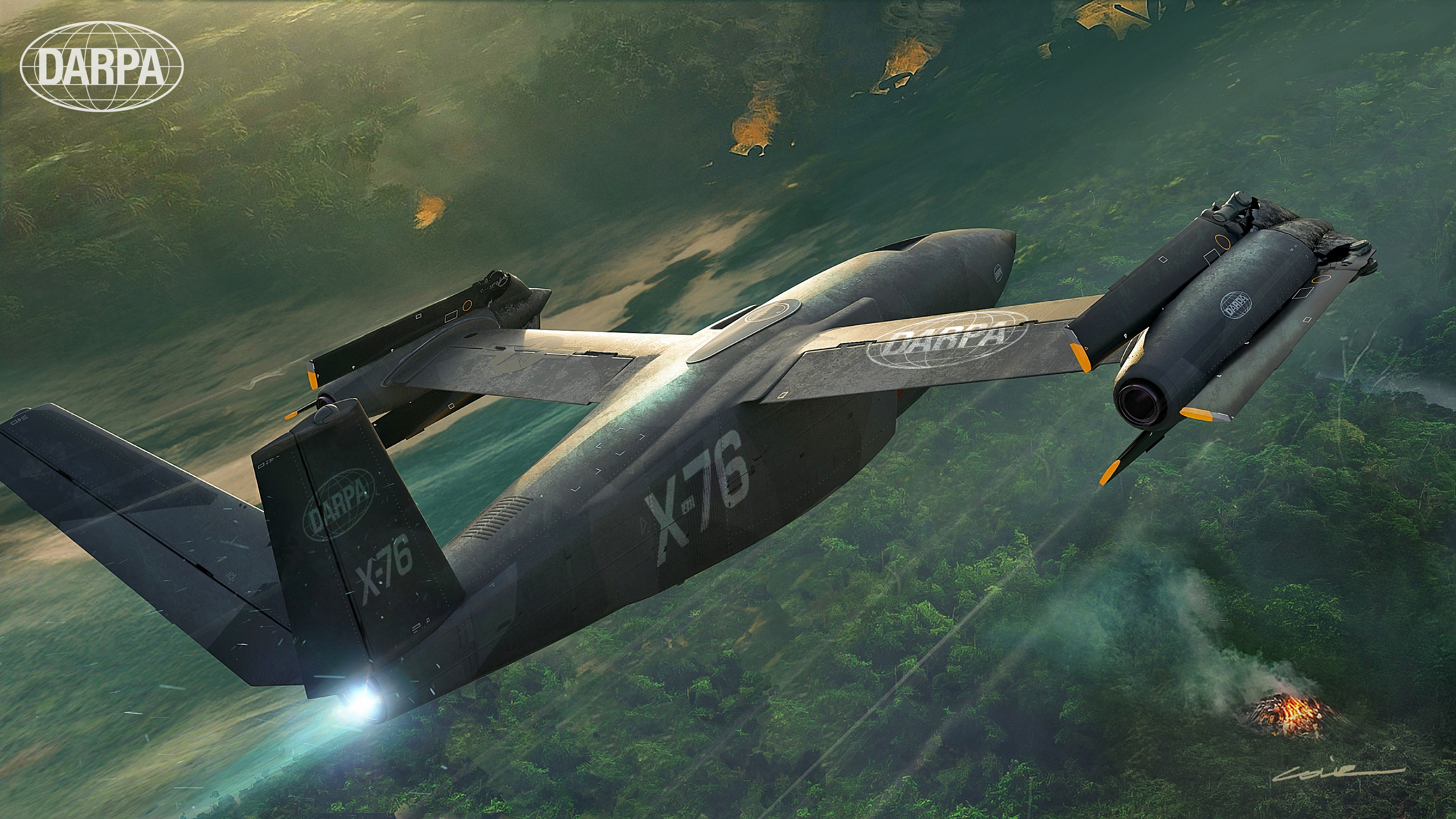
The Compiler’s Description Calls It Unmanned
The description calls the X-76 an unmanned demonstrator, and that word is not official. The solicitation explicitly left crewing to the proposer, saying that “the decision to have the SPRINT X-Plane as manned, unmanned, optionally piloted, etc. is left to the proposer” [SPRINT broad agency announcement]. Two documents inside the date are consistent with an uncrewed aircraft without saying so. The solicitation’s slides anticipate that “a flight termination system may be required if unmanned” [SPRINT proposers day slides], and the fiscal year 2026 budget book plans “ground station and human-machine interface development” [DARPA budget justification, fiscal year 2026]. A ground station is what an uncrewed aircraft is flown from, so the plans support the compiler’s word, as an inference. After the date, DARPA released one rendering of the X-76 that shows no cockpit glazing [DARPA artist’s concept of the X-76] and that journalists read as uncrewed and a second of a future operational aircraft described as optionally piloted [The War Zone on the X-76] [DARPA SPRINT programme page].
The Row Was Not Public at This Article’s Date
Three archived copies of the register bracket the row’s first public appearance. The copy of 10 December 2025 does not contain it [Parsch, DOD 4120.15-L Addendum, as archived on 10 December 2025], nor does the copy of 15 January 2026, and the copy of 1 February 2026 does. The row became public between 31 and 48 days after this article’s date, and 87 to 104 days after the allocation it records. Writing $t_{\mathrm{a}}$ for the allocation, $t_{\mathrm{d}}$ for this article’s date, $t_{\mathrm{pub}}$ for the row’s first public appearance and $t_{\mathrm{DARPA}}$ for the announcement,
\[t_{\mathrm{pub}} - t_{\mathrm{d}} \in [\,31,\ 48\,]\ \text{days}, \qquad t_{\mathrm{pub}} - t_{\mathrm{a}} \in [\,87,\ 104\,]\ \text{days}, \qquad t_{\mathrm{DARPA}} - t_{\mathrm{d}} = 84\ \text{days}.\]The compiler’s note on the row, read in the current copy, quotes DARPA’s statement that the out-of-sequence number is “a deliberate nod to the revolutionary spirit of 1776” [Parsch, DOD 4120.15-L Addendum], which is 84 days after this article’s date. This article uses the row as a fact about the aeroplane and dates every use of it. The X-69 through X-75 article measured this lag and treats the number’s meaning, and neither is revisited here.
Programme Origin, From the Solicitation to the Critical Design Review
The programme’s history can be told almost entirely from government documents, which is unusual for a vehicle that has not flown, and the documents disagree with each other and with the contractor in ways worth recording.
The Solicitation Set the Aeroplane’s Envelope Before Any Design Existed
DARPA’s Tactical Technology Office posted solicitation HR001123S0031 on Friday 10 March 2023, held a proposers’ day on 23 March, took abstracts until 31 March and proposals until 5 May, and expected to announce awards in September with work beginning in October [SPRINT proposers day slides]. The programme was joint from the first slide, with Headquarters, United States Special Operations Command, and its Special Operations Forces Acquisition, Technology and Logistics Center as partner, and the contracting officer’s representative to be that center’s deputy programme manager. The programme manager at the proposers’ day was Dr. Andrew Baker [SPRINT proposers day slides]. The programme page by December 2024 named Ian Higgins [DARPA SPRINT programme page, as archived on 24 December 2024], and the announcement of March 2026 gives his rank as commander, United States Navy [DARPA on the X-76].
The solicitation asked for two designs, not one. Each proposer had to size an Operational System to a representative mission and a Demonstrator X-Plane traceable to it, and only the demonstrator was to be built [SPRINT broad agency announcement]. The operational mission is specific. It carries a 5,000 pound payload in a notional cargo bay 30 feet long, 8 feet wide and 7 feet high, hovers out of ground effect at sea level on a 102 degree Fahrenheit day for take-off and at 4,000 feet on a 95 degree day mid-mission and for landing, flies two legs of 350 nautical miles at best-range speed, and dashes at maximum continuous power at 400 knots true airspeed as a threshold and 450 as an objective [SPRINT proposers day slides].
The demonstrator guidance is the closest thing to a specification of the X-76 that is public. It reads as follows in the slides.
| Attribute | Guidance |
|---|---|
| Gross take-off weight | 8,000 to 15,000 pounds, “weight range is not limiting” |
| Sustained speed | at least 400 knots true airspeed between 15,000 and 30,000 feet |
| Useful payload | at least 1,000 pounds, mainly for flight test instrumentation |
| Flight test endurance | 1.5 hours |
| Radius | at least 200 nautical miles |
| Load margins | minus 0.5 to plus 2 g |
| Design life | 500 hours, with DARPA’s demonstration expected to use 200 or fewer |
| Landing | 12 feet per second sink rate with no damage |
Three further rules shaped the configuration as much as any number. The X-plane had to use existing engines, and the government would not supply them. There was no disk loading, downwash or surface hardness limit, the proposer being asked instead to explain how the design meets the goal of runway independence. And the goal was first flight of the demonstrator no more than 42 months from contract award [SPRINT broad agency announcement]. The solicitation budgeted Phase 1A at the order of 15 million dollars, with 75 million dollars available for Phase 1 in total, and it allowed either a procurement contract or an other transaction. The answers DARPA posted on 30 March 2023 sharpen four of these rules [SPRINT questions and answers]. The Phase 1 money was 15 million dollars for Phase 1A and 60 million for Phase 1B, “a total split among performers”, matching the solicitation’s 75 million,
\[15 + 60 = 75\ \text{million dollars}.\]Engine modifications were allowed, but “modifications that include the engine core are not allowed”. A proposer could switch instruments between phases, an other transaction for Phase 1 and a regulation-based contract for Phase 2 being given as the example. And “the SPRINT X-Plane is not intended to transition to an operational system” [SPRINT questions and answers], which the budget books, describing a demonstrator that transitions for further risk reduction flight testing, do not contradict, since that transition is of the test aircraft and not to production [DARPA budget justification, fiscal year 2026].
Thirteen Offers and Four Awards, Three of Them in the Contract Record
The federal award record holds three first-phase contracts and states that each was competed with thirteen offers received. All three are cost-plus-fixed-fee research contracts under the solicitation’s number, described as Speed and Runway Independent Technologies, and the award notices posted to the contracting portal on 2 and 7 November 2023 [Award HR001124C0325 to Aurora Flight Sciences] [Award HR001124C0326 to Piasecki Aircraft] [Award HR001124C0327 to Northrop Grumman] [Award notice for HR001124C0326] [Award notice for HR001124C0325] [Award notice for HR001124C0327].
| Award | Recipient | Start | Obligated to date |
|---|---|---|---|
| HR001124C0326 | Piasecki Aircraft | 31 October 2023 | 4,944,700 dollars |
| HR001124C0325 | Aurora Flight Sciences | 1 November 2023 | 33,301,718 dollars |
| HR001124C0327 | Northrop Grumman | 1 November 2023 | 5,406,094 dollars |
DARPA’s programme page dates the programme’s entry into Phase 1 to 1 November 2023, which agrees with two of the three start dates [DARPA SPRINT programme page, as archived on 12 December 2025]. Bell announced its selection for Phase 1A on 27 November 2023 [Bell selected for SPRINT Phase 1A]. The Piasecki and Northrop Grumman contracts’ periods of performance end on 30 April 2024 [Award HR001124C0326 to Piasecki Aircraft] [Award HR001124C0327 to Northrop Grumman], the point at which the record shows their participation stopping.
Bell’s Instrument Is Not in the Contract Record
No contract, grant or indefinite-delivery vehicle from DARPA to any Bell entity for this programme appears in the award record, searched by programme name, by the phrases speed and runway and runway independent, and by recipient. The solicitation allowed an other transaction, and its answers allowed a different instrument in each phase [SPRINT broad agency announcement] [SPRINT questions and answers]. An other transaction is not a procurement contract, and no document read here states whether or how DARPA reports one to the award record, so the absence is consistent with Bell holding one. The point is inferred. Bell’s instrument, its value and its date are named in none of them, and the article’s statements about money are confined to what the record holds.
Phase 1B, and the Money the Record Allows Bell
Aurora’s contract carries both phases, and its modifications date the Phase 1B decision. The obligations before 24 May 2024 total 4,843,311 dollars, and modification P00006 on 24 May 2024 obligates 12,974,331 dollars, after which a further 15,484,076 dollars follow through February 2025 [Award HR001124C0325 to Aurora Flight Sciences]. That date agrees with DARPA’s statement that Aurora and Bell were awarded Phase 1B in May 2024 [DARPA SPRINT programme page, as archived on 12 December 2025] and with Bell’s release of 28 May 2024 [Bell awarded funding for SPRINT Phase 1B]. The contract’s total decomposes exactly into the three periods,
\[4{,}843{,}311 + 12{,}974{,}331 + 15{,}484{,}076 = 33{,}301{,}718\ \text{dollars}.\]The three recorded Phase 1A obligations sum to 15,194,105 dollars, Aurora’s pre-option figure with Piasecki’s and Northrop Grumman’s totals,
\[4{,}843{,}311 + 4{,}944{,}700 + 5{,}406{,}094 = 15{,}194{,}105 = 15{,}000{,}000 + 194{,}105\ \text{dollars},\]which already exceeds the solicitation’s Phase 1A figure by 194,105 dollars before Bell’s share is counted. So the planning figure for Phase 1A was not a cap on what was obligated, and a figure that was not a cap for one sub-phase is weak evidence of a cap for the phase. The three recorded contracts together total 43,652,512 dollars, and if the solicitation’s 75 million dollars for Phase 1 had held as a ceiling,
\[B_{\mathrm{Bell}} \le 75{,}000{,}000 - (33{,}301{,}718 + 4{,}944{,}700 + 5{,}406{,}094) = 31{,}347{,}488\ \text{dollars}.\]Bell’s Phase 1 instrument could then not have exceeded 31,347,488 dollars, but the Phase 1A overrun shows that the premise of that bound did not hold for the first sub-phase, so it is stated as the bound the planning figure implies and not as an estimate of what Bell received.
Aurora’s contract has one more feature that this article records without interpreting. Its last modification, on 27 August 2025, carries the description DARPA RESEARCH PROJECT in place of the programme’s name, and its period of performance ends on 21 October 2025, the day after the X-76A allocation [Award HR001124C0325 to Aurora Flight Sciences].
The Other Finalist Also Chose Two Kinds of Engine
Aurora’s releases describe the design Bell beat, and it shares the X-76’s propulsion answer while differing in everything else. Aurora’s release of 20 May 2024 describes a “low-drag, fan-in-wing demonstrator that integrates a blended wing body platform” with three lift fans and “an uncrewed cockpit”, capable of 450 knots and using “existing engine solutions” [Aurora on its SPRINT design, May 2024]. Its release of 8 October 2024 is more specific. The demonstrator was uncrewed, with a 45-foot wingspan and a 1,000 pound payload, and “the propulsion system includes off-the-shelf turbofan and turboshaft engines that would power the vehicle to a maximum of 450 knots true airspeed” [Aurora on its SPRINT design, October 2024].
Both Phase 1B designs carried a turbofan and a turboshaft [Aurora on its SPRINT design, October 2024] [Parsch, DOD 4120.15-L Addendum]. One buried its lift fans in a blended wing and the other folded its rotors, and both answered the solicitation’s existing-engine rule with two kinds of engine rather than one convertible machine. It is the strongest evidence in the record that the separate-engine choice came from the rule rather than from Bell, evidence drawn from the competitor’s documents. The October 2024 release also gives the schedule as it then stood, with preliminary design review “scheduled for April 2025”, the phase running “through May 2025”, and “flight testing for the program is planned for 2027” [Aurora on its SPRINT design, October 2024].
Phase 2 Began in May, June or July 2025, Depending on Who Is Asked
Three sources inside or near the date give three months for the same decision. DARPA’s programme page reports that in June 2025 Bell “was awarded a contract for Phases 2 and 3” [DARPA SPRINT programme page, as archived on 12 December 2025]. Bell announced its selection for Phase 2 on 9 July 2025 [Bell to build the SPRINT X-plane]. DARPA’s announcement of March 2026 states that the programme began its second phase in May 2025 “following the downselect to Bell” [DARPA on the X-76]. These can all be true at once, a selection in May, an award in June and an announcement in July, but no document read here identifies which event each date names, and the article does not choose.
The contractor’s account of what Phase 2 includes changed between its releases. The release of July 2025 describes Phase 2 as “design, construction, ground testing and certification of an X-plane demonstrator” [Bell to build the SPRINT X-plane], while the solicitation had placed Phase 2 as critical design, build and ground test and Phase 3 as flight test [SPRINT broad agency announcement]. The certification in that sentence is airworthiness certification for an experimental aircraft, which the solicitation also placed in Phase 2, following a DARPA flight release tailored from the airworthiness handbook MIL-HDBK-516C [SPRINT broad agency announcement].
Two Contractor Datelines Are a Year Early on One Mirror
Textron’s investor-relations copies of two Bell releases carry datelines a year earlier than the releases themselves. The Phase 1B release, listed under 2024 and describing events of late 2023, is datelined “May 28, 2023” in its body [Textron copy of the Phase 1B release]. The Phase 2 release, listed under 2025, is datelined “July 9, 2024” [Textron copy of the Phase 2 release]. Bell’s own newsroom carries the correct dates, 28 May 2024 for the first and 9 July 2025 for the second [Bell awarded funding for SPRINT Phase 1B] [Bell to build the SPRINT X-plane], so the error lies in the mirror and not in the contractor’s record. It is recorded because a reader who took either dateline from the mirror would place Phase 1B before Phase 1A existed, and a chronology built from mirrored releases would be wrong by exactly a year in two places.
The Schedule Has Moved by at Least Eight Months
The solicitation’s goal of first flight within 42 months of contract award puts first flight by 1 May 2027 for an award on 1 November 2023. The slides’ notional schedule draws first flight in fiscal year 2027 for each notional performer [SPRINT proposers day slides]. As late as October 2024 the programme planned flight testing for 2027, by Aurora’s account of the schedule it was working to [Aurora on its SPRINT design, October 2024]. By July 2025 it planned flight testing in 2028, so the slip arose between those two dates, across the preliminary design review. Inside this article’s date, a DARPA spokesperson told Breaking Defense in July 2025 that the agency expected a completed demonstrator in 2027 and flight testing in 2028 [Breaking Defense on the Phase 2 selection], and DARPA’s March 2026 announcement, after it, gives early 2028 [DARPA on the X-76]. Taking early 2028 as 1 January 2028, the slip is at least eight months, and first flight would come at least 50 months after the Phase 1 award. Counting calendar months from the award,
\[t_{\mathrm{ff}}^{\mathrm{goal}} = t_{\mathrm{award}} + 42\ \text{months} = 1\ \text{May}\ 2027, \qquad t_{\mathrm{ff}}^{\mathrm{plan}} - t_{\mathrm{ff}}^{\mathrm{goal}} \ge 8\ \text{months}, \qquad t_{\mathrm{ff}}^{\mathrm{plan}} - t_{\mathrm{award}} \ge 50\ \text{months},\]and the 42-month goal is 1,277 days. The programme’s other intervals set the pace against which that slip is measured, 236 days from the solicitation’s posting to the first award, and 719 days from that award to the designation’s allocation,
\[t_{\mathrm{award}} - t_{\mathrm{BAA}} = 236\ \text{days}, \qquad t_{\mathrm{a}} - t_{\mathrm{award}} = 719\ \text{days}.\]The comparison is between a goal and a plan, both of them documents, and implies no engineering difficulty, since no source read for this article describes one.
What Four Budget Books Said
DARPA’s research, development, test and evaluation budget justification books carry a programme entry for this programme in fiscal years 2024 through 2027, three of them published before 15 December 2025 and the fourth, of April 2026, after it [DARPA budget justification, fiscal year 2024] [DARPA budget justification, fiscal year 2025] [DARPA budget justification, fiscal year 2026] [DARPA budget justification, fiscal year 2027]. The entry sits in programme element 0603286E, Advanced Aerospace Systems, until fiscal year 2026, when it moves to programme element 0603468E, Advanced Complex Systems, project ACX-01, along with other programmes of the same project, among them the X-planes of the X-65 and X-68 articles.
The Same Year Reported Three Ways
Each book restates the earlier years, and the restatements are large. Figures are millions of dollars.
| Book for fiscal year, and its date | 2024 | 2025 | 2026 | 2027 |
|---|---|---|---|---|
| 2024, March 2023 | 22.663 | |||
| 2025, March 2024 | 22.663 | 36.866 | ||
| 2026, June 2025 | 13.024 | 41.998 | 55.200 | |
| 2027, April 2026, outside the date | 47.000 | 47.524 | 62.113 |
Fiscal year 2024 was requested at 22.663 million and executed at 13.024 million, a shortfall of 9.639 million in the programme’s first year [DARPA budget justification, fiscal year 2024] [DARPA budget justification, fiscal year 2026]. Fiscal year 2025 grew from a request of 36.866 million to an actual of 47.000 million in the latest book, about 27.5 percent more [DARPA budget justification, fiscal year 2025] [DARPA budget justification, fiscal year 2027]. Fiscal year 2026 was requested at 55.200 million and the latest book carries 47.524 million, about 13.9 percent less, though that figure is the current-year column of the latest book rather than an execution [DARPA budget justification, fiscal year 2026] [DARPA budget justification, fiscal year 2027]. The latest figures for fiscal years 2024 through 2027 sum to 169.661 million dollars. In millions,
\[22.663 - 13.024 = 9.639, \qquad \frac{47.000}{36.866} - 1 = 0.275, \qquad 1 - \frac{47.524}{55.200} = 0.139, \qquad 13.024 + 47.000 + 47.524 + 62.113 = 169.661.\]None of these figures is a contract value, and none of them can be reconciled with the award record’s 43.65 million without Bell’s missing instrument.
A Scaled Demonstrator Became a Demonstrator
The fiscal year 2024 book describes a programme that “culminates in the fabrication and flight test of a scaled demonstrator.” [DARPA budget justification, fiscal year 2024] The fiscal year 2025 book, a year later, drops the word scaled, and every later book follows it [DARPA budget justification, fiscal year 2025]. The solicitation itself had asked for “a scaled X-Plane demonstrator to validate the enabling technologies at a relevant size” [SPRINT broad agency announcement]. This article reads the change as vocabulary rather than concept, since the demonstrator guidance of 8,000 to 15,000 pounds was already a scale relative to the operational system and nothing in the plans changes, but it records the change because the word scaled is the only statement in any budget book about the aircraft’s size relative to anything.
The Transition Partner Changed Its Name Four Times
Each book names who the demonstrator transitions to, and each names it differently. The fiscal year 2024 book reads “military service members”, the 2025 book “military services”, the 2026 book “a DoD component” and the 2027 book “a Services component” [DARPA budget justification, fiscal year 2024] [DARPA budget justification, fiscal year 2025] [DARPA budget justification, fiscal year 2026] [DARPA budget justification, fiscal year 2027]. The 2027 book also rewrites the missions, adding contested logistics under attack and electronic warfare and dropping logistics support and the sentence that “the thresholds for speed and range have evolved with military strategy and mission needs” [DARPA budget justification, fiscal year 2027]. Special Operations Command is not named anywhere in the programme’s entries in any book, its only appearance being the books’ tables of contents, although it is named as the joint partner on every DARPA page and in the solicitation.
The Plans Describe an Aircraft Flown From a Ground Station
The plans lists are the closest thing to a schedule the books hold, and they read in sequence. The 2024 book plans conceptual design review “for multiple concepts” [DARPA budget justification, fiscal year 2024]. The 2025 book plans preliminary design review and the start of limited detailed and critical design [DARPA budget justification, fiscal year 2025]. The 2026 book, dated June 2025 and inside the date, plans the subsystems by name, “propulsion system, thermal management system, hydraulics, electrical system”, along with control law development, engineering drawing release, airworthiness certification, integration with the flight test facility, manufacture of the demonstrator, and “ground station and human-machine interface development” [DARPA budget justification, fiscal year 2026]. The 2027 book, outside the date, adds a structural proof load test, final software integration laboratory testing with simulated failures, and ground checkouts “including engine runs” [DARPA budget justification, fiscal year 2027].
A thermal management system appears by name in the subsystem list. This article cannot say why, and records only that an aircraft carrying at least three gas turbines, two of which may idle or shut down in cruise, has more than one heat source to manage.
Sizing From First Principles
Nothing about the X-76’s mass, wing, rotor diameter or drag is public at this article’s date, nor in any later document read for it. What is public is the solicitation’s envelope and the certificated ratings of the engines the register names, taken as two turboshafts and one turbofan. This section does not estimate the aeroplane. It derives what those engines can do for any aeroplane inside the envelope, which bounds the X-76 from both ends.
Every input is one of three kinds and the text names which. Engine ratings and masses are certificated figures from the type-certificate data sheets. The weight range, speed band and altitude band are the solicitation’s. Everything else is a named assumption, swept where a result depends on it, and the assumptions are the hover figure of merit, the transmission efficiency, the wing download, the thrust lapse factor, the helical tip Mach limit and the maximum lift coefficient. Results that depend on an assumption say so where they are stated.
The Symbols This Article Uses
| Symbol | Meaning | Unit |
|---|---|---|
| $W$ | gross weight | N |
| $m_0$ | gross mass, with $W = m_0 g$ | kg |
| $g$ | standard gravitational acceleration, 9.80665 | m/s² |
| $m_e$ | dry mass of the three engines together | kg |
| $\mu_e$ | engine mass fraction, $m_e / m_0$ | none |
| $P$ | installed shaft power of the two turboshafts at a stated rating | W |
| $P_h$ | shaft power required to hover out of ground effect | W |
| $P_{\mathrm{ideal}}$ | induced power of an ideal rotor system in hover | W |
| $P_F$ | thrust power of the turbofan, $F V$ | W |
| $\mathrm{FM}$ | rotor figure of merit in hover, assumed 0.75 | none |
| $\eta$ | transmission and accessory efficiency in hover, assumed 0.90 | none |
| $d$ | wing download as a fraction of weight, assumed 0.10 | none |
| $A$ | total disk area of the two proprotors | m² |
| $w$ | disk loading, $W / A$ | Pa |
| $r$ | radius of one proprotor | m |
| $v_h$ | induced velocity at the disk in hover | m/s |
| $\rho$ | air density | kg/m³ |
| $\rho_0$ | sea-level standard density, 1.225 | kg/m³ |
| $\sigma$ | density ratio, $\rho / \rho_0$ | none |
| $T$ | air temperature | K |
| $T_0$ | sea-level standard temperature, 288.15 | K |
| $p$ | air pressure | Pa |
| $p_0$ | sea-level standard pressure, 101,325 | Pa |
| $\Lambda$ | tropospheric temperature lapse rate, 0.0065 | K/m |
| $h$ | geopotential altitude | m |
| $R$ | specific gas constant of air, 287.05 | J/(kg·K) |
| $\gamma$ | ratio of specific heats of air, 1.4 | none |
| $a$ | speed of sound | m/s |
| $F$ | turbofan thrust at altitude and speed | N |
| $F_0$ | turbofan sea-level static thrust at a stated rating | N |
| $\varphi$ | the turbofan’s thrust lapse factor at cruise Mach number, swept 0.5 to 0.7 | none |
| $q$ | dynamic pressure, $\tfrac{1}{2} \rho V^2$ | Pa |
| $V$ | true airspeed | m/s |
| $f$ | equivalent flat-plate drag area | m² |
| $L$, $D$ | lift and drag | N |
| $M$ | flight Mach number, $V / a$ | none |
| $M_h$ | helical tip Mach number of a proprotor in axial flight | none |
| $\Omega$ | proprotor rotational speed | rad/s |
| $V_t$ | proprotor tip speed, $\Omega r$ | m/s |
| $V_s$ | wing stall speed | m/s |
| $S$ | wing reference area | m² |
| $C_L$ | lift coefficient, with $C_{L}^{\max}$ its maximum, assumed 1.6 | none |
| $E$ | lift-to-drag ratio, $L / D$ | none |
| $q_w$ | dynamic pressure of the fully developed hover wake | Pa |
| $\kappa$ | proprotor tip speed as a fraction of the XV-15’s airplane-mode tip speed | none |
| $\lambda$ | proprotor advance ratio in axial flight, $V / V_t$ | none |
| $N_e$, $N_r$ | turboshaft output speed and proprotor speed | rev/min |
| $\mathcal{G}$ | speed reduction from turboshaft output to proprotor, $N_e / N_r$ | none |
| $n_F$ | number of turbofans fitted | none |
| $t$ | a date, with $t_{\mathrm{a}}$ the allocation, $t_{\mathrm{d}}$ this article’s date, $t_{\mathrm{pub}}$ the row’s first public appearance, $t_{\mathrm{DARPA}}$ the announcement, $t_{\mathrm{BAA}}$ the solicitation, $t_{\mathrm{award}}$ the first Phase 1A award and $t_{\mathrm{ff}}$ first flight, goal or plan | date |
| $B_{\mathrm{Bell}}$ | the value of Bell’s Phase 1 instrument | dollars |
The Atmosphere
Every density and speed of sound below comes from the standard troposphere, the 1976 standard’s constants applied with the hydrostatic relation [U.S. Standard Atmosphere, 1976]. Below 11 kilometres,
\[T = T_0 - \Lambda h, \qquad p = p_0 \left( \frac{T}{T_0} \right)^{g / (\Lambda R)}, \qquad \rho = \frac{p}{R T}, \qquad a = \sqrt{\gamma R T}.\]The solicitation’s hover condition is 4,000 feet on a 95 degree Fahrenheit day [SPRINT proposers day slides], which the slides give as an altitude and a temperature without naming the kind of altitude, and which this article reads as a pressure altitude. Holding pressure on the standard profile and raising temperature to 308.15 kelvin gives a density of 0.9893 kilograms per cubic metre, a density ratio of 0.8076. Since induced power at fixed weight and disk area scales as the inverse square root of density, the hot-day condition costs
\[\sqrt{\frac{\rho_0}{\rho_{\mathrm{hot}}}} = \sqrt{\frac{1.225}{0.9893}} = 1.113,\]an 11.3 percent increase in induced power, before any loss of engine power with temperature, which this article does not model. The turboshafts’ hot-day lapse appears in none of the sources, so every hot-day result below is optimistic by that unmodelled amount.
The Installed Power and What It Hovers
The certificated CT7-8 delivers 1,879 kilowatts, 2,520 shaft horsepower, at its five-minute take-off rating and 1,523 kilowatts at maximum continuous, with a dry mass of 243.6 kilograms [Type-certificate data sheet for the CT7 series]. The register names the model as CT7-8 without a suffix [Parsch, DOD 4120.15-L Addendum]. The same data sheet lists the suffixed CT7-8 models from 1,845 to 2,009 kilowatts at take-off, so if the register’s name stands for the family rather than the base model, the installed power lies between about 2 percent below and 7 percent above the base figure,
Two engines give
\[P = 2 \times 1879\ \text{kW} = 3758\ \text{kW}\]at take-off and 3,046 kilowatts at maximum continuous.
Momentum theory gives the power to hover in terms of disk loading alone. An ideal rotor producing thrust $W(1+d)$ through a disk of area $A$ needs an induced power equal to that thrust times the induced velocity, and a real one needs that power divided by its figure of merit and by the drive system’s efficiency. With $w = W / A$,
\[P_h = \frac{W (1 + d)^{3/2}}{\mathrm{FM}\, \eta} \sqrt{\frac{w}{2 \rho}}.\]Setting $P_h$ equal to the installed power and solving for weight gives the heaviest aeroplane the two turboshafts can hover at a chosen disk loading,
\[W_{\max} = \frac{P\, \mathrm{FM}\, \eta}{(1 + d)^{3/2}} \sqrt{\frac{2 \rho}{w}},\]and solving instead for disk loading at the solicitation’s heaviest weight gives the highest disk loading at which that weight can still hover,
\[w_{\max} = 2 \rho \left( \frac{P\, \mathrm{FM}\, \eta}{W (1 + d)^{3/2}} \right)^{2}.\]These depend on the three hover assumptions, and the table states them at the assumed values. None of the three is taken from a measurement of the X-76 or quoted from a report. The figure of merit of full-scale tiltrotor proprotors was measured at Ames Research Center’s outdoor facility in the 1980s, for the XV-15’s metal and composite blades and a model of the V-22’s [Felker et al 1986] [Felker et al 1985], and the magnitude of the wing download for typical tiltrotor configurations is the subject of a review of that research [Felker 1988]. This article read those reports’ abstracts and one report’s text, and it does not quote a figure from them, because the measured values sit in plotted and tabulated data whose extracted text is not reliable. The assumed values are typical of that literature’s subject and are labelled as assumptions throughout. Weights are in pounds, disk loadings in pounds per square foot, and the power fraction is the share of the two engines’ take-off power needed to hover 15,000 pounds at sea level.
| Disk loading | Heaviest hover weight, sea level | Heaviest hover weight, 4,000 ft and 95 °F | Power fraction at 15,000 lb | Radius of each rotor at 15,000 lb |
|---|---|---|---|---|
| 10 | 35,358 | 31,775 | 0.424 | 4.71 m |
| 13.2, the XV-15’s | 30,775 | 27,657 | 0.487 | 4.10 m |
| 15 | 28,870 | 25,944 | 0.520 | 3.85 m |
| 20 | 25,002 | 22,469 | 0.600 | 3.33 m |
| 30 | 20,414 | 18,345 | 0.735 | 2.72 m |
| 60 | 14,435 | 12,972 | 1.039 | 1.92 m |
The XV-15’s disk loading of 13.2 pounds per square foot is its published figure, at a design gross weight of 13,000 pounds on two 25-foot proprotors [The History of the XV-15 Tilt Rotor Research Aircraft]. Each rotor’s radius follows from the total disk area shared by two equal rotors,
\[r = \sqrt{\frac{W}{2 \pi w}}.\]Two CT7-8s hover 15,000 pounds at sea level at any disk loading up to about 55.6 pounds per square foot, which corresponds to rotors of about 4.0 metres diameter each. Since the limit is proportional to density, on the solicitation’s hot day before engine lapse it falls to
\[w_{\max}^{\mathrm{hot}} = \sigma_{\mathrm{hot}}\, w_{\max} = 0.8076 \times 55.6\ \text{psf} = 44.9\ \text{psf}.\]At the XV-15’s disk loading they would hover about 30,800 pounds at sea level, twice the solicitation’s heaviest figure,
\[\frac{W_{\max}(w = 13.2\ \text{psf})}{15{,}000\ \text{lb}} = \frac{30{,}775}{15{,}000} = 2.05.\]Every hot-day weight in the table is the same fraction of its sea-level neighbour, because the heaviest hover weight scales as the square root of density at fixed power and disk loading,
\[\frac{W_{\max}(\rho_{\mathrm{hot}})}{W_{\max}(\rho_0)} = \sqrt{\frac{\rho_{\mathrm{hot}}}{\rho_0}} = \sqrt{0.8076} = 0.899,\]the hot day’s 10 percent penalty on hover weight before any engine lapse. The turboshafts are not the constraint on the X-76’s weight at any conventional tiltrotor disk loading. Either the aircraft is heavier than the solicitation’s guidance, which the guidance explicitly permits, or it hovers with a large power margin, or it hovers at a disk loading well above a conventional tiltrotor’s, and the engines alone cannot say which. Two observations favour the third. Folded blades must lie along their nacelles, and Bell’s patent on a stowed-blade clamp describes a blade “foldable to a stowed position extending substantially parallel to the pylon” [US 2021/0078695], so blade length is bounded by nacelle length. And the solicitation set no disk loading limit [SPRINT broad agency announcement]. Both are inferences about the X-76, not facts about it.
Disk Loading Is the Price of Runway Independence
The solicitation asks for hover over unprepared surfaces with personnel nearby and then declines to limit disk loading, downwash or surface hardness, asking the proposer to explain how the design meets the goal instead [SPRINT broad agency announcement]. Momentum theory makes the trade explicit. The induced velocity at the disk is
\[v_h = \sqrt{\frac{(1 + d)\, w}{2 \rho}},\]and the fully developed wake below an ideal rotor moves at twice that. At sea level, the XV-15’s disk loading gives 16.8 metres per second at the disk and 33.7 in the wake. A disk loading of 20 gives 20.7 and 41.5, and a disk loading of 60 gives 35.9 and 71.8. The wake speed rises with the square root of disk loading. What the ground and a person standing on it feel is the wake’s dynamic pressure, and that has a cleaner form, since squaring twice the induced velocity cancels the density,
\[q_w = \tfrac{1}{2} \rho \left( 2 v_h \right)^2 = \tfrac{1}{2} \rho \cdot \frac{4 (1 + d)\, w}{2 \rho} = (1 + d)\, w.\]The fully developed wake’s dynamic pressure equals the rotor’s thrust per unit disk area, at any altitude and on any day. At the XV-15’s disk loading it is 695 pascals, 14.5 pounds per square foot, at a disk loading of 20 it is 1,053 pascals, and at 60 it is 3,160 pascals, 66 pounds per square foot. A stop-fold aircraft that shortens its blades to stow them pays for cruise speed in downwash, in exact proportion to the disk loading it accepts, and downwash is the quantity runway independence is about. The literature on outwash and its effect on people standing near a hovering aircraft is cited in the survey below, and one of its studies is titled for that question [Calvert and Wenren 2019], which this article cites for its title only.
The Jet Is a Drag Budget
The certificated PW308C produces 31.15 kilonewtons at its five-minute take-off rating and 31.13 kilonewtons at maximum continuous, at sea-level static conditions, with a dry mass of 623.5 kilograms [Type-certificate data sheet for the PW308 series]. How that thrust falls with altitude and speed is not in the data sheet or in any other source this article found. This article therefore models it in the simplest form consistent with turbofan behaviour, thrust falling with density at a fixed Mach factor,
\[F = F_0\, \sigma\, \varphi,\]and sweeps the factor $\varphi$ from 0.5 to 0.7 at cruise Mach numbers. That range is an assumption, not a measurement of this engine, and the results are stated across it.
In steady level flight thrust equals drag. Writing the aircraft’s total drag as the dynamic pressure times an equivalent flat-plate area, $D = q f$, and noting that the thrust available is an upper bound on the drag that can be carried,
\[f_{\max} = \frac{F}{q} = \frac{F_0\, \sigma\, \varphi}{\tfrac{1}{2} \sigma \rho_0 V^2} = \frac{2 F_0\, \varphi}{\rho_0 V^2}.\]The density ratio cancels, so the largest drag area the jet can push at a given true airspeed is the same at every altitude, to the extent that the lapse factor is. At 400 knots true airspeed the coefficient $2 F_0 / (\rho_0 V^2)$ is 1.200 square metres and at 450 knots it is 0.948. Across the swept lapse factor, the X-76 can carry at most 0.60 to 0.84 square metres of equivalent drag area at 400 knots, 6.5 to 9.0 square feet, and 0.47 to 0.66 square metres at 450 knots. That budget includes the induced drag of lifting the aircraft, so the parasite budget is smaller still. It must hold the fuselage, the wing, two nacelles with their folded blades, the tails and the inlet, which explains why the folded configuration has to be clean and why Bell has patented a chined spinner and blade fairings for the folded rotor, the abstract describing blades “folded down” in forward flight against fairings that cover them [US 12,030,623].
The same model gives the lift-to-drag ratio the aircraft must reach. Thrust equal to drag and lift equal to weight require
\[\left( \frac{L}{D} \right)_{\mathrm{req}} = \frac{W}{F} = \frac{W}{F_0\, \sigma\, \varphi}.\]At 15,000 pounds and the middle of the lapse range, the required ratio is 5.68 at 15,000 feet, 6.70 at 20,000, 7.97 at 25,000 and 9.55 at 30,000. At 8,000 pounds it is 3.03 at 15,000 feet and 5.09 at 30,000. The requirement rises with altitude because thrust falls with density while weight does not, so the bottom of the solicitation’s altitude band is where the turbofan most easily meets the speed requirement, and a heavy X-76 would most plausibly demonstrate 400 knots near 15,000 feet. The claim follows from the model alone. Turned around, the same relation gives the highest altitude at which a given lift-to-drag ratio still allows 400 knots, since level flight needs the density ratio to be at least
\[\sigma_{\min} = \frac{W}{F_0\, \varphi\, E},\]which at 15,000 pounds and the middle of the lapse range is 0.595 for $E = 6$, 0.447 for $E = 8$ and 0.357 for $E = 10$, standard-atmosphere altitudes of about 16,700, 25,100 and 31,200 feet. A lift-to-drag ratio near 6 in the folded cruise configuration would confine a 15,000 pound X-76 to the bottom of the solicitation’s band, and the band’s top needs a ratio near 10.
The turbofan’s thrust power is comparable to the turboshafts’ shaft power. At 400 knots and 15,000 feet, at the middle of the lapse range,
\[P_F = F V = 31.13\ \text{kN} \times 0.6292 \times 0.6 \times 205.8\ \text{m/s} = 2.42\ \text{MW},\]against 3.05 megawatts of maximum continuous shaft power from the two CT7-8s,
\[\frac{P_F}{P_{\mathrm{mcp}}} = \frac{2.42\ \text{MW}}{3.05\ \text{MW}} = 0.79.\]The aircraft thus carries two power sources of the same order and uses one at a time, the cost of having two propulsion systems and the reason Bell’s patents describe drive systems that let an otherwise idle lift engine contribute thrust in cruise through a pylon-mounted ducted fan [US 11,325,719], or that couple and decouple rotors and thrust fans through clutches in one gearbox [US 11,577,831]. Whether the X-76 does either has not been disclosed.
The Proprotor’s Speed Limit Forces the Rotor to Stop
A proprotor in axial flight sees its blade tip moving at its own tip speed and the aircraft’s speed at right angles, so the helical tip Mach number, the variable against which the advanced high-speed propeller programme measured its noise [Dittmar and Hall 1991], is
\[M_h = \frac{\sqrt{V^2 + V_t^2}}{a}.\]The XV-15 turned its 25-foot proprotors at 517 revolutions per minute in airplane mode and 589 in helicopter mode, tip speeds of 206.3 and 235.0 metres per second [The History of the XV-15 Tilt Rotor Research Aircraft]. The hover figure can be checked against a measurement. At sea level 235.0 metres per second is a tip Mach number of 0.69, inside the range of 0.60 to 0.73 over which a full-scale XV-15 rotor’s hover performance was measured, a range across which that test found “very little effect on rotor performance due to tip Mach number variations” [Felker et al 1985]. The height-velocity envelope in that history’s appendix reaches about 300 knots true at 16,000 feet [The History of the XV-15 Tilt Rotor Research Aircraft], where its airplane-mode helical tip Mach number is 0.80. At the X-76’s speeds the same tip speed is no longer workable. At 400 knots and 15,000 feet it gives 0.90, and at 450 knots and 25,000 feet it gives 1.00, a tip that is sonic.
Holding the helical tip Mach number to a limit fixes the largest tip speed a proprotor may turn at,
\[V_t \le a \sqrt{M_{h,\max}^2 - M^2},\]and taking 0.85 as that limit, which is an assumption, the XV-15’s airplane-mode tip speed is exceeded above 350 knots at 15,000 feet and above 318 knots at 25,000. To hold the limit at 450 knots and 25,000 feet the rotor would have to turn at about 61 percent of that tip speed, and at 400 knots and 15,000 feet at about 88 percent. And at an airspeed equal to the limit times the speed of sound no tip speed at all satisfies it,
\[V_{\mathrm{wall}} = M_{h,\max}\, a,\]which is 532 knots at 15,000 feet and 512 knots at 25,000. The objective of 450 knots is therefore not beyond the compressibility wall, but it is in the region where a proprotor must be slowed so far that its advance ratio is high and its thrust per unit of tip speed is poor. The two quantities make that concrete. The tip speed allowed as a fraction of the XV-15’s, and the advance ratio that results, are
\[\kappa = \frac{a \sqrt{M_{h,\max}^2 - M^2}}{V_t^{\mathrm{XV15}}}, \qquad \lambda = \frac{V}{\kappa\, V_t^{\mathrm{XV15}}},\]which give $\kappa = 0.877$ and $\lambda = 1.14$ at 400 knots and 15,000 feet, and $\kappa = 0.607$ and $\lambda = 1.85$ at 450 knots and 25,000 feet. The XV-15 at its 300 knots ran at an advance ratio of 0.75, so the X-76’s objective asks a proprotor for two and a half times the advance ratio of the aircraft that proved the configuration. That, with whirl flutter, is the case for stopping the rotor rather than slowing it. Bell’s paper states the conclusion and not this arithmetic, that the stop-fold configuration can “make the rotor disappear” in cruise [Schank et al 2025].
The Conversion Must Happen Where the Wing Can Fly
The rotor can only be stopped once the wing is carrying the whole weight and the jet the whole drag. The lower bound on the speed at which that is possible is the wing’s stall speed,
\[V_s = \sqrt{\frac{2\, (W/S)}{\rho_0\, C_{L}^{\max}}},\]which at sea level, taking a maximum lift coefficient of 1.6, is 105 knots at a wing loading of 60 pounds per square foot, 122 at 80 and 136 at 100. The wing loading of the X-76 is not public and those three values are illustrative. The historical literature puts the stopping speed in the range that result implies. Engle and Sambell placed rotor stopping “in the 120 to 200-knot speed range” in 1969 [Engle and Sambell 1969], and the full-scale folding rotor tested in 1972 completed more than forty start and stop sequences at tunnel speeds up to 175 knots, making “smooth start/stop transitions” in about two seconds [Cr-114464 1972]. The conversion corridor of a stop-fold aircraft is therefore a band bounded below by the wing, at the illustrative stall speeds between 105 and 136 knots, and above by the loads on a rotor being stopped and on blades being folded in a moving airstream, which the historical tests put between 175 and 200 knots, and a stopped blade at the wrong angle can go unstable in a way a turning blade does not, a full-scale test having found “violent dynamic instabilities” of a stopped blade that its author concluded were a type of stall flutter [White 1969].
The Engines Alone Are a Sixth of the Heaviest Aeroplane
On the one-turbofan reading, the three engines’ dry masses sum to 1,110.7 kilograms, 2,449 pounds, 487.2 kilograms of turboshaft and 623.5 of turbofan,
\[m_e = 2 \times 243.6 + 623.5 = 1110.7\ \text{kg}.\]As a fraction of gross mass,
\[\mu_e = \frac{m_e}{m_0} = \frac{1110.7\ \text{kg}}{6803.9\ \text{kg}} = 0.163 \quad \text{at 15,000 lb}, \qquad \frac{1110.7\ \text{kg}}{3628.7\ \text{kg}} = 0.306 \quad \text{at 8,000 lb}.\]Bare engines at 16 percent of gross mass, before transmissions, shafts, the fold mechanism, inlets and nacelles, put the X-76 at the heavy end of the solicitation’s range or above it. At the light end the bare engines alone would be almost a third of the aircraft. This is the article’s one line of evidence that the demonstrator is heavier than 15,000 pounds or close to it, an inference from certificated engine data and not a statement about the aircraft. The hover power margin is not a second line, because the section on installed power found that it is equally consistent with a heavier aircraft, a large power margin or a high disk loading, and that two observations favour the high disk loading. The turboshafts’ specific power and the turbofan’s static thrust-to-weight ratio are
\[\frac{1879\ \text{kW}}{243.6\ \text{kg}} = 7.7\ \text{kW/kg}, \qquad \frac{31.15\ \text{kN}}{623.5\ \text{kg} \times g} = 5.1,\]so the turbofan is the heavier of the two systems for the job it does, carrying the aircraft only in the one flight phase that a proprotor cannot reach. And the turbofan alone could not lift the aircraft. Its static thrust is a fraction of the weight at both ends of the solicitation’s range,
\[\frac{F_0}{W} = \frac{31.15\ \text{kN}}{66.72\ \text{kN}} = 0.47 \quad \text{at 15,000 lb}, \qquad \frac{31.15\ \text{kN}}{35.59\ \text{kN}} = 0.88 \quad \text{at 8,000 lb},\]so even a jet vectored downward could not hover the X-76. The hover must be the rotors’, and the conversion is a hand-over between two systems rather than a change of attitude of one.
The Concept Is Older Than the Programme
Bell’s July 2025 release calls the aircraft that became the X-76 “a brand-new aircraft with the first-ever stop/fold technology” [Bell to build the SPRINT X-plane]. The aircraft is new, and the idea is at least sixty years older in the open literature, where a 1964 paper considered stopping a rotor in forward flight [Celniker et al 1964] and a 1965 paper described a stowed-rotor concept for vertical and short take-off and landing [Leoni and Kaplita 1965], and the programme’s design choices make most sense read against what that literature found.
Bell Stopped and Folded a Full-Scale Rotor in 1972
The configuration was studied as a family of aircraft from the late 1960s. Engle and Sambell’s 1969 paper on folding-proprotor performance describes “moderate disc loading for efficient vertical lift and cruise speeds of 400 knots and beyond” [Engle and Sambell 1969]. DeTore and Gaffey’s paper on the stopped-rotor variant of the proprotor aircraft was presented in 1969 and published in 1970 [Detore and Gaffey 1969] [DeTore and Gaffey 1970], and a paper on the stability and control of a tilt-fold-proprotor aircraft followed the same path in 1970 and 1971 [Nicholson and Tiller 1970] [Tiller and Nicholson 1971], all cited here for their titles only. A wind tunnel test of the conversion process of a folding tilt rotor, using an unpowered semispan model, is also from 1971 [Magee and Taylor 1971], again cited for its title.
In February 1972 a folding version of Bell’s 25-foot proprotor was tested in the 40 by 80 foot wind tunnel at Ames Research Center, in a programme jointly funded by the National Aeronautics and Space Administration, the Army and the Air Force with Bell as hardware contractor. The XV-15’s official history records that the stop-fold tilt rotor “eliminated the rotor/pylon/wing aeroelastic instability by stopping the rotor while in the airplane configuration”, that the blades were folded back along the nacelle to cut their drag, and that “a convertible engine was used to produce the jet thrust” [The History of the XV-15 Tilt Rotor Research Aircraft]. The test report records more than forty start and stop sequences, with smooth transitions in about two seconds at tunnel speeds up to 175 knots [Cr-114464 1972].
And the history records why the idea was then shelved. The stop-fold tilt rotor “had the additional penalties of the increased complexity and increased weight of the stop/fold mechanism, and, with the lack of a developed convertible engine, it was put aside as a potentially feasible concept that would require further advancements to be an effective contender” [The History of the XV-15 Tilt Rotor Research Aircraft]. Two of the three obstacles named in that sentence are obstacles the X-76 accepts, weight and complexity, and the third is one it goes around.
The Convertible Engine Was the Missing Piece and the X-76 Does Without It
For two decades after 1972 the folding tiltrotor’s literature was largely a propulsion literature, because a single engine that could drive proprotors in hover and produce jet thrust in cruise was what the concept was thought to need. DARPA was in it from the start. A DARPA and National Aeronautics and Space Administration programme to demonstrate a convertible turbofan-turboshaft engine began on 13 May 1981, using a modified TF34-GE-400, for an engine able to power a rotorcraft “in vertical flight and in horizontal flight up to approximately .85 Mach number” [Bellin and Brooks 1983]. A study of the same period found that the fold tilt rotor needed a convertible engine giving thrust to Mach 0.75 and shaft power to proprotors in hover, and identified a torque converter as the coupling that would let the fan be engaged and disengaged smoothly [Gill and Sauer 1983].
The engine was built and run. A report of 1988 describes a convertible engine with variable inlet guide vanes that ran stably and smoothly in turbofan, turboshaft and dual modes, the last combining fan and shaft power, with fuel consumption in turboshaft mode higher than a dedicated turboshaft’s because of fan-tip churning [McArdle 1988]. Its conclusion bears most directly on the X-76. Its revised mission analyses for a 400-knot rotorcraft concluded that convertible engines, rather than separate lift and cruise engines, would give a smaller, lighter craft with lower fuel use and lower direct operating cost.
The X-76 uses separate lift and cruise engines, the configuration that analysis judged heavier. The solicitation explains why, as far as a document can. It required the demonstrator to “be based on existing engine(s)/propulsion system”, allowed only minor upgrades without core changes, and gave its reason, “to ensure the engine or propulsion system development does not delay the overall X-Plane flight demonstration” [SPRINT broad agency announcement]. No convertible engine of this class is in production in any record read here, so the rule excluded the configuration the earlier literature preferred. The competitor’s documents support this reading. Aurora’s Phase 1B design was a fan-in-wing aircraft, a configuration unlike Bell’s in every structural respect, and it too carried “off-the-shelf turbofan and turboshaft engines” [Aurora on its SPRINT design, October 2024], so both finalists answered the rule the same way. The engine mass fraction derived above is the price, and the solicitation accepted it for schedule. That causal reading is this article’s inference, and the solicitation also states that the operational system “may include an engine/propulsion system that is envisioned in the future”, which leaves the convertible engine open for the aircraft the X-76 is meant to inform.
Folding Tiltrotor Demonstrators Were Proposed in 1985 and 1986
A folding tiltrotor demonstrator was proposed twice in the mid-1980s and never built. Gleiter’s 1985 paper argued that the folding tiltrotor offered advantages “for missions requiring long endurance combined with a speed capability in excess of 400 knots”, reported that development had begun in 1967 with “no significant technical obstacles”, and proposed a demonstrator on either the V-22 or the S-3A powered by the convertible CTFS-34 engine [Gleiter 1985]. A study a year later at the National Aeronautics and Space Administration considered three demonstrator candidates, the V-22 with a convertible TF34, a modified S-3A with the same engines, and the XV-15 with a conceptual turbofan coupled through a torque converter [Eisenberg and Bowles 1986]. Every one of those proposals depended on a convertible engine. The X-76 is the first folding tiltrotor demonstrator in the records read here to be funded through to manufacture, and it is being built without one [DARPA budget justification, fiscal year 2026] [DARPA on the X-76].
DARPA Paid for a Stop-Fold Study in 2008
The federal award record holds a DARPA contract titled STOP FOLD TILT ROTOR STUDY, awarded on 30 May 2008 to the Bell Boeing Joint Project Office for 584,557.50 dollars on a cost-sharing basis, extended at no cost to 31 March 2009, with one offer received [Award HR001108C0077 for a stop fold tilt rotor study]. No report from that study was found. It sits between the 1980s demonstrator proposals and Bell’s earliest stop-fold patent filings, and it shows that the agency now sponsoring the X-76 had paid for the configuration’s study almost fifteen years before its solicitation.
Bell’s patent record dates the company’s sustained work. The earliest Bell filing found on in-flight blade folding has a priority date of 15 June 2010 and describes a foldable rotor system with a blade fold actuator and a swashplate that changes blade pitch [CA 2802389]. A cluster of filings with a priority date of 2 December 2014 describes the transition mechanism itself, a gimbal lock that enables and disables the rotor’s gimballing freedom and a blade stop assembly whose arms extend in non-rotary flight [US 10,526,068], a cam that locks the gimbal and the blade cuff together [US 10,336,447], and a fold mechanism driven through the swashplate and pitch links [US 11,235,858]. The dates are consistent with Bell’s July 2025 release, in which its engineering vice president calls the stop-fold aircraft an achievement Bell had been working towards for over 10 years [Bell to build the SPRINT X-plane].
Dependent Systems
Every subsystem below is described from a certificate, a solicitation, a patent or a contractor’s paper, and none from a description of the X-76 itself, because none is public.
The Turboshafts
The CT7-8 was approved by the Federal Aviation Administration on 29 September 2000 under type certificate E8NE [New Zealand type acceptance report for the CT7 series], General Electric announcing the certificate on 10 October 2000 for an engine selected for the 25,000-pound-class Sikorsky S-92 [General Electric on the CT7-8 certificate, 2000]. The European Union Aviation Safety Agency’s data sheet gives its certification date as 20 January 2003, a date taken over from a national approval that preceded the agency, with its basis in that American certificate, and the data sheet gives its output shaft speed as 21,945 revolutions per minute at its principal ratings [Type-certificate data sheet for the CT7 series]. That speed fixes the size of the reduction the drive system must make, since a proprotor of radius $r$ turning at tip speed $V_t$ runs at
\[N_r = \frac{60\, V_t}{2 \pi r}, \qquad \mathcal{G} = \frac{N_e}{N_r} = \frac{2 \pi r\, N_e}{60\, V_t}.\]At the XV-15’s own rotor speeds the reduction would be 37.3 in hover and 42.4 in airplane mode. For a 15,000 pound X-76 at the XV-15’s hover tip speed of 235 metres per second, the rotor radii of the hover table give a proprotor speed of 547 revolutions per minute and a reduction of 40.1 at the XV-15’s disk loading, 674 and 32.6 at a disk loading of 20, and 1,167 and 18.8 at a disk loading of 60. A small stowable rotor needs a smaller reduction, a weight saving in the gearbox that partly offsets the weight of the fold, and like every statement here about the X-76’s rotor it depends on a disk loading that is not public. The data sheet read is issue 10, dated 19 December 2025, four days after the article’s date, and the base model’s ratings and mass quoted here are those of that issue. A turboshaft of this family is a natural choice for the solicitation’s existing-engine rule, being the commercial counterpart of the T700 engines, which with the CT7 power 20 of the 47 rows whose basic mission symbol is H in the copy of the register last updated on 23 August 2026. Whether the X-76’s two turboshafts run in cruise, idle, or shut down is not public, and the answer matters for fuel, for restart reliability before the rotors are unfolded, and for the thermal management system the budget book names.
The Turbofan, and a Certificate That Requires Two of It
The PW308C’s primary certificate is Transport Canada’s E-31, which the New Zealand regulator validated on 18 October 2007 [New Zealand type acceptance report for the PW308 series], and the European data sheet read here is that agency’s validation. That sheet states that “the PW308A and PW308C engines are approved for multiple engine installation only” [Type-certificate data sheet for the PW308 series]. It also records that the PW308C is normally used at a reduced take-off thrust of 3,113 decanewtons with an automatic increase to its full rating if the other engine fails. Both are features of a certificate written for a twin-engine business jet. If the X-76 carries one PW308C, as the register cell read literally and the renderings suggest, its installation lies outside an assumption underlying the civil certificate. The mismatch is not a defect, because the X-76 is an experimental aircraft flown under a DARPA flight release and not a civil type, and DARPA told proposers that engine certification “whether commercial or military does not matter as long as certification documents are available to substantiate whatever airworthiness method is chosen” [SPRINT questions and answers]. But it means the engine’s certification basis does not cover its installation, and whatever the civil certificate takes for granted about a second engine has to be substantiated another way. This reading is inferred from the data sheet and the cell, and no document consulted states the number of turbofans fitted.
The Drive System in Bell’s Patents
The budget book’s subsystem list names a propulsion system, a thermal management system, hydraulics and an electrical system, and no drive system [DARPA budget justification, fiscal year 2026]. Bell’s patents describe several. One couples one or more rotor systems and one or more thrust fans through a combined gearbox with clutches, so that rotors and fans can be engaged in sequence through the transition [US 11,577,831]. One lets a normally idle lift engine drive a pylon-mounted ducted fan for extra thrust once the blades are folded [US 11,325,719]. One routes drive shafts through the wing to the rotor on the pylon [US 2023/0331393]. A patent describes an embodiment and claims a right, and it does not say what was built. Whether the X-76 has a drive system of any of these kinds is not public.
The Fold Mechanism
The transition has more locked states than a conventional tiltrotor has, and Bell’s filings describe each lock. A rotor-blade assembly in a 2023 filing has “a lock system to enable and disable a folding degree of freedom and a pitching degree of freedom” [US 2025/0100674], and a companion filing describes a blade position control system that selectively restricts pitch and fold through a multilobe component moved by an actuator [US 2025/0100680]. A 2018 method folds the blades of a tiltrotor from an inverted-Y rotor position, unlocking and restraining each blade in turn [US 10,858,094], and a 2019 filing clamps the stowed blade pneumatically along the pylon [US 2021/0078695]. A 2020 filing shapes the blade tip to cut drag when folded [US 11,643,195], and a 2020 filing applies the stop-fold rotor to a tail-sitter instead of a tiltrotor [US 2021/0253239]. Taken together the filings show a decade of work on the locks, the stow and the folded drag, which are the three things the 1972 test showed were possible and did not make light.
Control Through Conversion
The solicitation’s flight test checkouts require the transition in both directions to be controlled at maximum design gross weight, with handling qualities to Level 1 desired and Level 2 required by the military flying qualities handbook and hover manoeuvres judged against the rotorcraft handling qualities specification’s mission task elements [SPRINT proposers day slides], those being MIL-HDBK-1797 [MIL-HDBK-1797, Flying Qualities of Piloted Aircraft] and ADS-33E-PRF [ADS-33E-PRF, Handling Qualities Requirements for Military Rotorcraft]. The slides write the latter as “ADS-PRF-33”, which this article reads as the same Army specification. The airworthiness basis is MIL-HDBK-516C [MIL-HDBK-516C, Airworthiness Certification Criteria]. Bell’s paper on the sled test describes fly-by-wire transition controls that automatically manage each step of the transition from proprotor flight to jet flight and back [Schank et al 2025]. The conversion of a stop-fold aircraft is a sequence of discrete events, feathering, stopping, indexing, locking and folding, and its reverse, each of which changes the aircraft’s mass distribution and drag. Such a sequence is a control problem for software and not for a pilot’s hands, which is consistent with an uncrewed demonstrator, as an inference.
The structural guidance is modest because the demonstrator is not a fighter. The solicitation asks for load margins from minus 0.5 to plus 2 g, a 500-hour design life, and a 12 feet per second sink rate at landing without damage [SPRINT broad agency announcement]. The fiscal year 2027 book adds a structural proof load test to verify that the built aircraft matches its structural design predictions [DARPA budget justification, fiscal year 2027], a plan published after the dateline.
The Contractor Overstates Bell’s Designation History
Bell’s March 2026 release claims that the company “has pushed the known boundaries of flight through pioneering high speed and vertical lift aircraft from the X-1 to the XV-3 and XV-15” [Bell on the X-76], and its Phase 1A release of November 2023 called the X-1 and the XV-15 “memorable X-planes” [Bell selected for SPRINT Phase 1A]. The XV-3 and XV-15 are not research designations. They belong to the convertiplane sequence, mission letter V with the experimental status prefix X, and the designating instruction states that a design number “identifies major design changes within the same basic mission” and stands to the right of “the basic mission or vehicle type symbols” [Department of the Air Force Instruction 16-401, 2020]. Under that rule, which the X-67 article examined, the V sequence is a different count from the research series. Bell’s research designations are eight, the X-1, X-2, X-5, X-9, X-14, X-16, X-22 and now the X-76. The X-76 is Bell’s first research designation since the X-22, and its only research designation for a rotorcraft that converts by stopping its rotors [Wikipedia, List of X-planes]. The releases’ framing is a heritage claim, and on its own terms a fair one, since the XV-3 made the first full in-flight conversion from helicopter to airplane mode on 18 December 1958 [The History of the XV-15 Tilt Rotor Research Aircraft]. It is recorded here only because it uses X-plane for a designation the series does not count.
The Flight Test Record Is Empty
Nothing has flown. At the article’s date Bell had been selected for Phase 2, which the solicitation placed after a preliminary design review, the fiscal year 2026 plans placed the programme in critical design, and a DARPA spokesperson had told the press that the agency expected a completed demonstrator in 2027 and flight testing in 2028 [Breaking Defense on the Phase 2 selection].
The Sled Test and the Wind Tunnel Are Ground Tests
Bell’s two risk reduction tests are the only test data the programme has reported, and both are ground tests. In late 2023 a track-guided test vehicle ran on the 10-mile High Speed Test Track at Holloman Air Force Base, integrating “multi-mode propulsion, folding proprotors, and fly-by-wire transition controls” [Schank et al 2025] [Bell awarded funding for SPRINT Phase 1B]. Bell’s paper on it claims “the first known powered prop-to-jet and jet-to-prop transition”, a narrower and more defensible claim than first-ever stop-fold technology, since the 1972 test stopped and folded a rotor in a tunnel but did not carry a whole powered vehicle through the transition. In 2024 a wind tunnel programme at the National Institute for Aviation Research at Wichita State University “validated the stability and control of the aircraft through the rotor fold and unfold sequence in flight” [Bell completes stop-fold wind tunnel testing], the release being dated 4 December 2024. Neither result is published in numbers in any document consulted.
Comparison With Ground Prediction
There is no flight result to set beside any ground prediction, because the X-76 had not flown by 15 December 2025. What the record holds is prediction of three kinds. The first is the government’s specification, which asks for at least 400 knots true airspeed between 15,000 and 30,000 feet, a gross take-off weight of 8,000 to 15,000 pounds, and hover out of ground effect at 4,000 feet on a 95 degree Fahrenheit day [SPRINT proposers day slides]. The second is the contractor’s ground testing, the sled run at Holloman Air Force Base and the wind tunnel programme at Wichita State University, described above and not reported in numbers. The third is this article’s derivation from certificated engine ratings and the solicitation’s envelope, set out in Sizing From First Principles.
The nearest thing to a comparison of prediction with result is historical, and it was made on the ground. Engle and Sambell placed rotor stopping in the 120 to 200 knot speed range in 1969 [Engle and Sambell 1969], and the full-scale folding rotor tested in 1972 was stopped and started at tunnel speeds up to 175 knots [Cr-114464 1972], inside that range. Both are analytical or wind tunnel results, and neither involved a whole aircraft in flight. Bell’s sled test carried a powered vehicle through the transition on rails [Schank et al 2025], a step closer to flight and still a ground test.
The predictions this article makes are stated so that flight could check them. They are a drag-area ceiling of 0.60 to 0.84 square metres at 400 knots, from the relation for $f_{\max}$, a heaviest hover weight of about 30,800 pounds at sea level at the XV-15’s disk loading, from the relation for $W_{\max}$, and a conversion band bounded by illustrative stall speeds of 105 to 136 knots, from the stall relation, and by the 175 to 200 knots of the historical tests. Each depends on assumptions listed under Where the Framing Breaks Down, and none has been tested against the aircraft. The fiscal year 2027 budget book plans a structural proof load test to verify that the built aircraft matches its structural design predictions [DARPA budget justification, fiscal year 2027], which postdates the article and is itself a ground test. The comparisons a first flight would make possible follow.
What Would Be Compared With What
When the X-76 flies, four of this article’s derivations become testable. Its hover gross weight and rotor diameter fix its disk loading, which can be set against the hover envelope above. Its demonstrated cruise speed and altitude, with its weight, fix a required lift-to-drag ratio, and its level-flight thrust setting, if published, fixes its equivalent drag area against the ceiling of 0.60 to 0.84 square metres at 400 knots that the relation for $f_{\max}$ gives. Its conversion speed can be set against the band from wing stall to between 175 and 200 knots that the historical tests and the stall relation together suggest. And its maximum demonstrated speed can be set against the solicitation’s threshold of 400 and objective of 450 knots, the gap between which is the gap between a proprotor that must be slowed and one that must be stopped.
What the Data Changed Awaits a First Flight
If the X-76 meets its threshold, the first thing it settles is not speed but the conversion. That a proprotor aircraft can hover and that a jet can push a clean airframe to 400 knots are both established separately. No record consulted shows the sequence between them in flight, with a real wing, a real jet, and blades being stopped and folded in a real airstream at the low end of the conversion band, where the stopped-blade instabilities of the 1960s tests were found. A clean conversion in both directions would retire the risk that shelved the concept in 1972 other than the convertible engine, and the convertible engine would then become the remaining argument for the operational aircraft.
If it meets the objective of 450 knots, it would show that the folded configuration is clean enough to fit the drag budget a single business-jet turbofan sets, 0.47 to 0.66 square metres of equivalent drag area at 450 knots by the relation for $f_{\max}$, the article’s quantitative claim about the configuration and the one most sensitive to how well the folded blades are faired.
What it may fail to influence is the procurement it is meant to inform. The budget books’ transition partner moved from service members to services to a component, and Special Operations Command, the joint partner on every DARPA page, is named as transition partner in none of them. The literature records two folding tiltrotor demonstrators proposed in the 1980s and neither built, and the configuration’s history is one of feasibility repeatedly shown and repeatedly not bought. The X-76 changes that history only if someone buys what it demonstrates, a decision no flight test makes.
The Contemporary Literature
| Cluster | Records |
|---|---|
| Stopped, folded and stowed rotors | 93 |
| The tiltrotor and its relatives | 1,198 |
| Proprotor whirl flutter and tiltrotor aeroelasticity | 130 |
| High-speed propellers and tip compressibility | 191 |
| High-speed vertical lift as a class | 882 |
| Hover, wake, downwash and the surface | 277 |
| Conversion between hover and forward flight | 42 |
| Turboshafts, turbofans and the convertible engine | 383 |
| Rotorcraft conceptual design and sizing | 73 |
| The missions the solicitation names | 44 |
| Research aircraft and their flight test | 99 |
| Total | 3,412 |
There is almost no literature on the X-76 itself, and the one paper on its direct ancestor is the contractor’s. Bell’s 2025 paper on the stop-fold sled test is the only technical publication in the survey about the programme’s hardware [Schank et al 2025]. What the survey maps is the large literature the X-76 sits in, being the stopped and folding rotor, the tiltrotor and its aeroelastic and compressibility limits, high-speed vertical lift as a class, hover physics and the downwash at the surface, conversion between modes, the propulsion families and the convertible engine, rotorcraft conceptual design, the missions the solicitation names, and the practice of research aircraft and their flight test.
The survey cites 3,412 research records, 17 of them the research primaries described in The Source Base and 3,395 drawn from a bibliographic index of the journal and conference literature and from the National Aeronautics and Space Administration’s reports server. Each record appears in one cluster only. 714 of them, 20.9 percent, are report primaries under the identifier rule set out under The Definition of Primary, and the 3,371 records that carry a year run from 1949 to 2027 with a median of 2007.
The clusters are uneven and the unevenness is informative. The tiltrotor literature is the largest and the conversion literature the smallest. The configuration the X-76 embodies has a literature with a gap in the middle. Of the 50 titles in the survey that name a folded, folding, stopped or stowed rotor, blade or propeller, 35 date from 1965 to 1999, none from the 2000s, and 15 from 2010 on, 10 of them from 2021 on. Titles that join a folded or stowed rotor to a tiltrotor or proprotor number 15, 14 of them from 1969 to 1992, a span that holds the convertible engine programmes and the V-22’s blade fold for stowage, and one from 2011, and the stopped-rotor revival of the 2020s is led by the high-speed vertical take-off and landing work this programme belongs to [Young 2024].
What the Literature Establishes, and Where It Is Moving
Read as a whole rather than cluster by cluster, the literature makes four points that bear on the X-76, and it is silent on a fifth.
First, the stopped rotor has an experimental base from the 1960s and 1970s and a revival in the 2020s, and the revival is divided. The early work found that a stopped blade can go violently unstable at some combinations of shaft and pitch angle [White 1969], and that a full-scale folding proprotor could be stopped and started in about two seconds [Cr-114464 1972]. The contemporary reassessment by Brown and Ahuja reviews why the historical stopped-rotor experiments were not successful and argues that “with modern technologies, materials, and analysis tools” a low disc-loading rotor can be used “not only for efficient VTOL but also for efficient cruise” [Brown and Ahuja 2023], where VTOL is vertical take-off and landing. Young’s survey of novel concepts for flight at 400 knots or more, written at the National Aeronautics and Space Administration, discusses “two stopped-rotor concepts and two non-stopped-rotor concepts” [Young 2024]. So the current literature splits between keeping the stopped rotor in the airstream as a lifting surface and removing it from the airstream altogether, and the X-76 belongs to the second branch, as the contractor’s sled-test paper states [Schank et al 2025]. Work on the flight dynamics of stopped-rotor aircraft continues at small scale, judging by one paper’s title [He et al 2022].
Second, whirl flutter is a large and recent experimental subject, and every result cited here is about making a turning proprotor survive at higher speed. Of the 209 titles in the survey that name whirl flutter, 105 are dated 2020 or later. The Maryland Tiltrotor Rig is a Froude-scaled, 4.75-foot, semispan flutter rig first tested to 100 knots in the Navy’s Carderock tunnel [Tsai et al 2024]. Its swept-tip blades, swept 20 degrees aft from 80 percent of radius, showed “higher wing chord damping using swept-tip blades in freewheel conditions” [Sutherland et al 2024], and the comprehensive analysis matched wing beam damping well while underpredicting chord damping and missing the effect of powered operation [Gul and Datta 2024]. Run to 200 knots in freewheeling airplane mode, the model “remained flutter-free up to 200 knots”, but its “chord damping showed signs of a sudden drop after 175 knots” [Akinwale and Datta 2023], and a 2026 analysis of the same rig’s free decays found that damping falls with response amplitude, “a trend missed by conventional linear estimation methods” [Simmons and Riso 2026]. The European Advanced Testbed for Tiltrotor Aeroelastics, called ATTILA, a Froude-scale semispan model of a civil tiltrotor’s wing and proprotor, found the wing torsion mode “displaying a sharp trend towards negative damping at higher speeds” and an unexpected contribution from stiction in the blade pitch mechanism [van ‘t Hoff et al 2024], which a 2026 analysis could reproduce only by modelling friction in the joints [De Vita et al 2026]. A design study found that replacing one large wingtip rotor with two of half the disk area “pushed the instability speed by more than 100%” [Gul and Yeo 2025]. The standing reviews are Reed’s of 1965 [Reed 1965] and Kunz’s of 2002 and 2005 [Kunz 2002] [Kunz 2005], the latter cited for their titles. This literature is the measure of what the X-76 avoids. The stop-fold configuration’s premise is that removing the rotor from the airstream is easier than making it stable there, and a body of current work in which a scaled rig is flutter-free to 200 knots but losing chord damping above 175 is the evidence for that premise. Scaled speeds do not transfer to full-scale speeds without the rig’s scaling laws, and this article does not attempt the transfer.
Third, the convertible engine, the missing piece of 1972, has had almost no new literature in the survey since the 1990s. The DARPA and National Aeronautics and Space Administration programme of 1981 [Bellin and Brooks 1983], the 1988 stand test and mission analysis [McArdle 1988] and a 1996 report whose title concerns the engine’s dynamic and transient performance [McArdle et al 1996] are the field’s last substantial entries before a gap of more than twenty years. Of the 33 titles in the survey that name a convertible or turboshaft-turbofan engine, 31 date from 1967 to 1998, and the other two are from 2025 and 2026, on the performance and the mode-transition control of a turboshaft-turbofan engine [Jia et al 2025] [Li et al 2026]. Both SPRINT finalists then answered the existing-engine rule with separate engines [Aurora on its SPRINT design, October 2024], so the current programme could not use the literature’s preferred solution.
Fourth, the hover side of runway independence rests on measurements that are decades old. The full-scale tiltrotor hover data are the Ames tests of the 1980s [Felker et al 1985] [Felker et al 1986], and a 2017 report set out to widen that experimental base because computational work had concentrated on only two successful tiltrotors, the XV-15 and the MV-22B [Harris 2017]. The title of one study places it most directly on people standing in a rotor’s outwash [Calvert and Wenren 2019]. The contemporary high-speed vertical take-off and landing design studies, including a 2024 preliminary design study and a student design competition winner, are cited for their titles [Yang et al 2024] [O’Brien and Delgado 2024].
And the literature is silent on the X-76’s keystone. No title in the survey reports a stop-fold conversion in flight. Bell’s sled test is the only powered prop-to-jet transition of a whole vehicle in the survey, the first known by its authors’ account, and it was on rails [Schank et al 2025]. The X-76’s flight test would fill that gap, and it lies after the dateline.
Stopped, folded and stowed rotors
This is the X-76’s own lineage. It holds the rotor-stopping and stowed-rotor studies of the mid-1960s, the folding-proprotor studies of the late 1960s and 1970s, the full-scale folding rotor test of 1972, the stopped-rotor and rotor/wing concepts including the X-50’s canard rotor/wing, the X-wing’s stopped-rotor dynamics, and the stopped-rotor revival of the 2020s.
93 records. [Schank et al 2025] [Engle and Sambell 1969] [Cr-114464 1972] [Eisenberg and Bowles 1986] [Gleiter 1985] [White 1969] [Young 2024] [Brown and Ahuja 2023] [Husseyin and Warmbrodt 2016] [Husseyin and Warmbrodt 2016] [Pandya and Aftosmis 2000] [Lawrence and Gold 1990] [Woods et al 1989] [Schwartz and Rogers 1987] [Dopher and Duh 1987] [Mosher 1983] [Soule 1973] [Sharma et al 2026] [Zhao et al 2026] [Zhang et al 2026] [Hilby et al 2025] [Hilby et al 2025] [Zhu et al 2023] [Wang et al 2023] [Zhang et al 2023] [Gong et al 2023] [Hu et al 2023] [Brown and Ahuja 2023] [Gao 2022] [He et al 2022] [Nelson and Shen 2021] [Chao and Zhenghong 2019] [Deng and Mi 2019] [Gao et al 2019] [Gao et al 2019] [Dong et al 2014] [Gai et al 2014] [Slaby and Smith 2011] [Wendong Gai et al 2011] [Tengfei Guo et al 2011] [Demott et al 2010] [Rotor Performance Optimization of 2008] [Kim and Lee 2007] [Lee et al 2006] [Kong et al 2005] [Design and Optimization Study 2005] [Lopez and Wells 2004] [Kong et al 2004] [The Boeing Canard rotor/wing 2004] [Mitchell and Vogel 2003] [Pandya and Aftosmis 2001] [Helwani et al 2001] [Pande 1999] [Tai et al 1997] [Tai et al 1996] [Tai et al 1995] [Bass et al 1995] [Crossley and Rutherford 1995] [Mavris et al 1994] [Rutherford et al 1993] [Bass et al 1993] [Bass and Rutherford 1993] [Swanson and Stroub 1992] [Olson 1992] [Craig et al 1991] [Olson and Rumberger 1991] [Gilbert and Silva 1989] [Gilbert and Silva 1987] [Willshire and Martin 1984] [Matthys and Scroggs Jr. 1984] [Gimmestad 1981] [Magee and Taylor 1971] [Briardy et al 1970] [Nicholson and Tiller 1970] [Rodden and Liu 1969] [Carlson and Maopolski 1969] [Detore and Gaffey 1969] [Cheeseman 1968] [Deckert and McCloud 1968] [Smith 1968] [Cheeseman 1967] [Amer et al 1967] [Head 1966] [Harned and Head 1965] [Osder] [Leoni and Kaplita 1965] [Jepson and Carlson 1968] [Donham and Harvick 1967] [Donham and Prouty 1967] [Celniker et al 1964] [Yillikci et al 1993] [Niemiec et al 2014] [Niemiec et al 2014]
The tiltrotor and its relatives
The largest cluster, and the configuration the X-76 is in hover and conversion. It runs from the XV-3 and XV-15 research programmes through the V-22 and the civil tiltrotor studies to tilt-wing and electric tiltrotor work, and 274 of its records are on the National Aeronautics and Space Administration’s reports server.
1,198 records. [Simmons 2026] [Stutz et al 2026] [Thurman and Wang 2025] [Horton et al 2025] [Jensen et al 2025] [Perez et al 2025] [Blaesser 2024] [Kreshock and Thornburgh 2024] [Acree 2024] [Perez et al 2024] [Blake et al 2023] [Pollard et al 2023] [Ivanco et al 2023] [Zawodny et al 2023] [Kreshock et al 2023] [Young 2023] [Ingraham 2023] [Radotich 2022] [Pei and Roithmayr 2022] [Lopes et al 2022] [Acree 2022] [Acree et al 2022] [Whiteside et al 2021] [Kratz and Culley 2021] [Shelts and Schatzman 2020] [Geuther et al 2020] [Kottapalli 2020] [Acree 2020] [Schatzman and Malpica 2019] [Kottapalli and Acree 2018] [Acree and Sheikman 2018] [Russell and Acree 2018] [Young 2018] [Persson and Lawrence 2017] [Harris 2017] [Malpica 2017] [Harris 2017] [Grima 2016] [Acree 2016] [Solis and Meyn 2016] [Theodore et al 2016] [Koning et al 2016] [Koning 2016] [Koning 2015] [Acree 2014] [Snyder 2013] [Robuck et al 2013] [Costa 2012] [Kaul 2012] [Robuck et al 2012] [Suchezky and Cruzen 2012] [Malpica et al 2011] [Malcipa et al 2010] [Veres and Thurman 2010] [Snyder and Thurman 2010] [Acree 2010] [Snyder et al 2010] [Germanowski et al 2010] [Veres 2009] [Romander et al 2007] [Romander 2006] [Kvaternil 2006] [Acree 2006] [Acree and Johnson 2006] [Eames 2006] [Acree 2005] [Betzina and Nguyen 2004] [D’Angelo 2004] [Acree 2004] [Masarati et al 2004] [Acree et al 2004] [Johnson 2003] [Harris 2003] [Acree 2003] [Yamauchi et al 2003] [Betzina and Nguyen 2003] [Edwards and Conner 2003] [Edwards and Conner 2003] [Abrego et al 2002] [Yamauchi et al 2002] [Boyd and Burley 2001] [Johnson 2001] [Acree and Rutkowski 2001] [Johnson et al 2001] [Nixon et al 2001] [Brand et al 2001] [McCluer et al 2001] [Johnson 2001] [Young et al 2001] [Edwards et al 2001] [Acree et al 2001] [Wadcock et al 2001] [Kitaplioglu et al 2000] [Acree 2000] [Kvaternik et al 2000] [Acree et al 2000] [Maisel et al 2000] [Tadghighi and Rajagopalan 1999] [Wang et al 1999] [Booth et al 1999] [Ghiringhelli et al 1999] [Burley et al 1999] [Howard 1999] [Atencio and Banda 1998] [Young et al 1998] [Edwards 1998] [Conner et al 1998] [Lyle et al 1997] [Kitaplioglu et al 1997] [Dugan and Hindson 1997] [Nixon et al 1997] [Ghiringhelli et al 1997] [Kozapalli and Warmbrodt 1997] [Lyle 1997] [McCarthy 1996] [Wells 1996] [Meakin 1996] [Harris 1996] [Calise and Rysdyk 1996] [Brender et al 1996] [George 1996] [Meakin 1996] [Sternfeld et al 1995] [Vadyak et al 1995] [Wechsler and Rutherford 1995] [Studebaker and Abrego 1994] [Decker et al 1994] [Birckelbaw et al 1994] [Mosher and Light 1994] [Rais-Rohani 1994] [Matuska et al 1994] [Rais-Rohani 1994] [Felker 1993] [Nixon 1993] [Acree 1993] [Rogers and Reisdorfer 1993] [Schleicher et al 1993] [Acree and Tischler 1993] [Conner and Wellman 1993] [Fejtek 1993] [Hindson et al 1993] [Rais-Rohani 1993] [Totah 1992] [Hoad et al 1992] [Coffen 1992] [Felker 1992] [Rutledge et al 1991] [Vanaken 1991] [Conner and Wellman 1991] [Coffen et al 1991] [Guerrero and Corliss 1991] [Guerrero and Corliss 1991] [Unger and Alexander 1991] [Totah and Madden 1991] [Bridgeman et al 1991] [SantaMaria et al 1991] [Jumper et al 1991] [XV-15 Tiltrotor 1991] [Coffen and George 1990] [Coffen and George 1990] [Totah and Madden 1990] [Golub and Weir 1990] [Felker et al 1990] [Decker et al 1989] [Wolkovitch et al 1989] [Schroers 1989] [Acree and Tischler 1989] [Acree and Tischler 1989] [George et al 1989] [Wilkerson 1988] [Miller and Ham 1988] [Acree and Tischler 1988] [Faye et al 1987] [Johnson et al 1987] [Clay et al 1987] [Tischler 1987] [Tischler and Kaletka 1987] [Felker et al 1987] [Acree and Tischler 1987] [Bartie et al 1986] [Tischler et al 1986] [Tischler and Kaletka 1986] [Felker et al 1986] [Alexander et al 1986] [Nasu 1986] [Bondi 1986] [Morlok and Schoendorfer 1985] [McCroskey et al 1985] [Smith et al 1985] [Tischler et al 1985] [Tischler et al 1985] [Dugan 1985] [Churchill and Gerdes 1984] [Tischler et al 1984] [Ferguson et al 1984] [McCroskey et al 1983] [Magee 1983] [Magee 1983] [Schroers 1982] [Churchill and Dugan 1982] [Meuleners 1981] [Johnson 1980] [NASA/HAA Advanced Rotorcraft Technology 1980] [NASA/HAA Advanced Rotorcraft Technology 1980] [NASA/HAA Advanced Rotorcraft Technology 1980] [Preliminary design study of 1980] [Dugan et al 1980] [Kimbell and Whitener 1980] [V/STOL tilt rotor research 1980] [Liden 1980] [Weiberg and Maisel 1980] [Alexander et al 1979] [Curtiss et al 1979] [Wernicke and Magee 1979] [Magee and Alexander 1978] [Hofmann et al 1978] [Shovlin and Gambucci 1978] [Brown et al 1978] [Tilt rotor research aircraft 1978] [V/STOL tilt rotor research 1978] [V/STOL tilt rotor research 1978] [Soohoo et al 1977] [Kvaternik and Kohn 1977] [Amos and Alexander 1977] [Johnson 1977] [Few and Edenborough 1977] [Wilson et al 1976] [Hall and Buenz 1976] [Sambell 1976] [Radford et al 1976] [Johnson 1976] [McVeigh 1976] [Marr 1976] [Johnson 1975] [Detore and Sambell 1975] [NASA/Army XV-15 tilt rotor 1975] [Johnson 1975] [Johnson 1975] [Whitaker and Cheng 1975] [Marr et al 1974] [Johnson 1974] [Kvaternik 1974] [Gaffey and Maisel 1974] [Frick and Johnson 1974] [Faulkner 1974] [Johnson 1974] [Poisson-Quinton and Cook 1973] [Gibs et al 1973] [Kvaternik 1973] [Kvaternik 1973] [Rosenstein et al 1973] [Soule and Badri-Nath 1973] [Magee and Alexander 1973] [Harendra et al 1973] [Marr et al 1973] [Poisson-Quinton and Cook 1972] [V/STOL tilt rotor aircraft 1972] [V/STOL tilt rotor aircraft 1972] [V/STOL tilt-rotor study, task 1972] [Advancement of proprotor technology 1971] [Chambers and Grafton 1970] [Advancement of proprotor technology 1969] [Goodson 1966] [Biggers et al 1966] [Chambers and Grafton 1966] [Kirby and Newsom 1964] [Kirby et al 1963] [Quigley and Koenig 1961] [Grunwald 1961] [Koenig and Quigley 1960] [Hickey 1956] [Ye et al 2026] [Wang et al 2026] [Zhao et al 2026] [Natelson and Rauleder 2026] [Wang et al 2026] [Simmons and Riso 2026] [Stutz et al 2026] [Zhang et al 2026] [Miao et al 2026] [mao et al 2026] [Yang et al 2026] [Cheng et al 2026] [Zinjarde et al 2026] [Kim et al 2026] [Lade and Guérin 2026] [Liu et al 2026] [Ogle et al 2026] [Simmons et al 2026] [Semelka and Rauleder 2026] [Rovedatti et al 2026] [Yu et al 2026] [Comer et al 2026] [An and Kim 2026] [Villanueva-Aguado and Bronz 2026] [Immersion and Invariance Adaptive 2026] [May et al 2026] [Kim et al 2026] [Sun et al 2026] [Kim 2026] [Sridhar and Smith 2026] [Critchfield and Ning 2026] [O’Brien and Datta 2026] [Lovera et al 2026] [Hospodář and Kulhánek 2026] [Ibrahim et al 2026] [Monnier and Litherland 2026] [Ouyang et al 2026] [De Vita et al 2026] [Chen 2026] [Bhandari and Chakraborty 2026] [Cui 2026] [Delgado and Datta 2026] [Oh et al 2026] [Sridhar and Smith 2026] [Yu and Zhao 2026] [Zheng et al 2026] [Shin et al 2026] [Peng et al 2026] [Wright and Silva 2026] [Husain et al 2026] [Choi et al 2026] [Ahmed et al 2026] [Sawron 2026] [Simmons and Ackerman 2026] [Wu et al 2026] [Adeyemi et al 2026] [Burton et al 2026] [May et al 2026] [Yue et al 2026] [Delgado et al 2026] [O’Brien and Datta 2026] [Acree 2026] [Acree 2026] [Chakraborty et al 2025] [Guan et al 2025] [Yue et al 2025] [Vinicius Rodrigues de Lima and Antônio dos Santos 2025] [Li and Yang 2025] [van ‘t Hoff et al 2025] [Feng et al 2025] [Bowen et al 2025] [Zheng et al 2025] [Kim et al 2025] [Thornburgh et al 2025] [Yu et al 2025] [Hong et al 2025] [Kim and Jo 2025] [Xia et al 2025] [Puchuela and Sankar 2025] [Cook 2025] [Lira Sassett et al 2025] [Wang et al 2025] [Doff-Sotta et al 2025] [Choi et al 2025] [Ma et al 2025] [Cook et al 2025] [Wang et al 2025] [Design and Simulation of 2025] [Gong et al 2025] [Wang et al 2025] [Rosas Cordova et al 2025] [Park and Roh 2025] [Zulkafli et al 2025] [Chen and Guo 2025] [Gainutdinov and Gainutdinova 2025] [Wang et al 2025] [Kong et al 2025] [Zhu et al 2025] [Kang et al 2025] [Simmons et al 2025] [Zhu et al 2025] [Huang and German 2025] [Tang et al 2025] [Hou et al 2025] [Cheng et al 2025] [Delgado and Datta 2025] [Stanzione 2025] [Zhao et al 2025] [Ruan et al 2025] [Son et al 2025] [Lim and Jung 2025] [Sagan et al 2025] [Li et al 2025] [Xing et al 2025] [Schmid et al 2025] [Savino 2025] [Thurman and Wang 2025] [Yuan and Xian 2025] [Nunes et al 2025] [De Vita et al 2025] [Goodarzi et al 2025] [Sridhar et al 2025] [Zhang et al 2025] [Zhu and Wang 2025] [Zhu and Wang 2025] [Gao et al 2025] [Chen et al 2025] [Guo et al 2025] [Guan and Xian 2025] [Passarelli D’Onofrio and Pecoraro 2025] [Kang et al 2025] [Nabiyev et al 2025] [Simmons et al 2025] [Park and Younus 2025] [Akinwale and Datta 2025] [Hong et al 2025] [Yamazaki et al 2025] [DiMaggio et al 2025] [Liang et al 2025] [May et al 2025] [Guo et al 2025] [Akinwale and Datta 2025] [Ivanco et al 2025] [Son et al 2025] [Gul and Yeo 2025] [Punzi et al 2024] [Shinozuka et al 2024] [Liu et al 2024] [Hu et al 2024] [Jia et al 2024] [Henríquez and Kilikevičius 2024] [Li et al 2024] [van der Meulen et al 2024] [Hu et al 2024] [Shen and Baggett 2024] [Hwang et al 2024] [Radotich 2024] [Oyama et al 2024] [Gul and Yeo 2024] [Lim et al 2024] [Rojo-Rodriguez et al 2024] [Jeong et al 2024] [He 2024] [Ram Rohit 2024] [Tsai et al 2024] [Sánchez Meza et al 2024] [Anantha et al 2024] [Salahudden et al 2024] [Wang et al 2024] [Comer and Chakraborty 2024] [Hu et al 2024] [Nie et al 2024] [Delgado and Datta 2024] [Carlson and Papachristos 2024] [Liao et al 2024] [Moushegian et al 2024] [Zhao et al 2024] [O’Brien and Datta 2024] [Zhang et al 2024] [Kang et al 2024] [Qu et al 2024] [Biggi et al 2024] [Song et al 2024] [Santos Martins Nunes and Su 2024] [Huang et al 2024] [Du and Zha 2024] [Nabiyev 2024] [Beretta et al 2024] [Shahjahan et al 2024] [Gali and Riso 2024] [Roiati et al 2024] [Burton et al 2024] [Berger et al 2024] [Horn et al 2024] [Gul and Datta 2024] [Zhang et al 2024] [Wang et al 2024] [Kaballo and Arogeti 2024] [Thornburgh and Kreshock 2024] [Li 2024] [Belardo et al 2024] [Liu and Zhang 2024] [Yang et al 2024] [Saetti and Buğday 2024] [Cocco and Savino 2024] [Ingraham and Kinney 2024] [May et al 2024] [Yang et al 2024] [May et al 2024] [Marano et al 2024] [Sutherland et al 2024] [van ‘t Hoff et al 2024] [Daud Filho and Belo 2023] [Gul and Datta 2023] [Zawodny et al 2023] [Porcacchia et al 2023] [Lovell-Prescod et al 2023] [Juhasz et al 2023] [Bucciaglia et al 2023] [Kang et al 2023] [Murugan and Lm 2023] [Gebril and Kamal 2023] [Jin et al 2023] [van ‘t Hoff et al 2023] [Zhao et al 2023] [Albuck et al 2023] [Rostami et al 2023] [Adebimpe 2023] [Cassinelli et al 2023] [Pei et al 2023] [Akinwale and Datta 2023] [Gul and Yeo 2023] [Wen et al 2023] [Primatesta et al 2023] [Bath et al 2023] [Kreshock et al 2023] [Bucciaglia et al 2023] [Chen et al 2023] [Bachelder et al 2023] [Zhao et al 2023] [Pricker and Armanini 2023] [Belák and Hromčík 2023] [Panish et al 2023] [Lin et al 2023] [Huang et al 2023] [Henkenjohann et al 2023] [Bao et al 2023] [Muscarello and Quaranta 2023] [Taubert et al 2023] [Yan et al 2023] [Zhang et al 2023] [An and Shao 2023] [Kang et al 2023] [Chakraborty and Mishra 2023] [Marano et al 2023] [Cho et al 2023] [Appleton 2023] [Cassoni 2023] [Comer and Chakraborty 2023] [Tran et al 2023] [Wen et al 2023] [Burton et al 2023] [Tran and Yeo 2023] [Hyun et al 2023] [Liao and Bang 2023] [Krimphove et al 2023] [Khurana et al 2023] [Yeo et al 2023] [Belák and Hromčík 2023] [Lichota 2023] [Wang et al 2022] [Osa et al 2022] [Soemarwoto et al 2022] [Simmons and Murphy 2022] [Huang et al 2022] [Zhou et al 2022] [Yuan et al 2022] [Marano et al 2022] [Galles et al 2022] [Lu et al 2022] [Savino et al 2022] [Yang et al 2022] [Pei and Roithmayr 2022] [Yuan et al 2022] [Wu et al 2022] [Juhasz et al 2022] [DeNicola et al 2022] [Qing et al 2022] [Shen and Tsuchiya 2022] [Ivanco et al 2022] [Tran and Lim 2022] [Chen and Chen 2022] [Sheng et al 2022] [Zhang et al 2022] [Rogers et al 2022] [Fan et al 2022] [Cocco et al 2022] [Kreshock et al 2022] [Xu et al 2022] [Bath et al 2022] [Ma et al 2022] [Nabiyev and Abdullayev 2022] [Aбдуллаев 2022] [Chakraborty et al 2022] [Milz and Looye 2022] [Berger et al 2022] [Tran and Yeo 2022] [Panish and Bacic 2022] [Lombaerts et al 2022] [Wang et al 2022] [Dong and Li 2022] [Tsai et al 2022] [Gul and Datta 2022] [Sutherland et al 2022] [Su et al 2021] [Osa et al 2021] [Aбдуллаев 2021] [Haidar et al 2021] [Chen and Chen 2021] [Wu and Chen 2021] [Leng et al 2021] [Hegde et al 2021] [Huan et al 2021] [Baggett et al 2021] [Chen et al 2021] [Cocco et al 2021] [Annamalai and Thunaipragasam 2021] [Sutherland and Datta 2021] [Yang and Morales 2021] [Gul and Datta 2021] [Appleton et al 2021] [Bachmaier and Anderson 2021] [Ma et al 2021] [Yeo et al 2021] [Alvaro D. H. Arroyo et al 2021] [Zhao et al 2021] [Yokota et al 2021] [Taubert et al 2021] [Corle et al 2021] [Içke et al 2021] [Aбдуллаев 2021] [Bachelder et al 2021] [Zou et al 2021] [Carlson and Papachristos 2021] [Lu et al 2021] [Bath et al 2021] [Yeo and Saberi 2021] [Thirumaleshwar Hegde et al 2021] [Wang et al 2021] [Yuan et al 2021] [Bachmaier and Anderson 2021] [Busan et al 2021] [Simmons and Murphy 2021] [Belardo et al 2021] [Barra et al 2020] [Yatsun et al 2020] [Xu et al 2020] [Yuan et al 2020] [Zeng et al 2020] [Wilson and Prazenica 2020] [Chen et al 2020] [Nabiyev et al 2020] [Jatsun et al 2020] [Zheng et al 2020] [Hegde 2020] [Jatsun et al 2020] [Yuan et al 2020] [Bauersfeld and Ducard 2020] [Shimizu and Miwa 2020] [Tran and Lim 2020] [Wang et al 2020] [Quackenbush et al 2020] [Asalani et al 2020] [Belardo et al 2020] [Berger et al 2020] [Kreshock et al 2020] [Chauhan and Martins 2020] [Yeo and Saberi 2020] [Sanchez-Rivera et al 2020] [Thirumaleshwar Hegde et al 2020] [Yeo and Kreshock 2020] [Cummings et al 2020] [Nabi et al 2019] [Muscarello et al 2019] [Kottapalli et al 2019] [Li et al 2019] [Zhang et al 2019] [Kottapalli and Cecil 2019] [Wakefield et al 2019] [Warren et al 2019] [Tsai and Datta 2019] [Chen et al 2019] [Autenrieb et al 2019] [Kreshock et al 2019] [Rigo et al 2019] [Lu et al 2019] [Aoki and Muraoka 2019] [Lim 2019] [Staruk and Datta 2019] [Sheikman and Norman 2019] [Muscarello 2019] [Chiappinelli et al 2019] [Chapman 2019] [Chen 2019] [Wu et al 2019] [Tan et al 2019] [Muscarello and Quaranta 2019] [Sanchez-Rivera et al 2019] [Kandath et al 2019] [Kang et al 2019] [Corle et al 2019] [Shimizu and Miwa 2019] [Yeo and Kreshock 2019] [Zhang et al 2019] [Osa et al 2018] [Pagano 2018] [Li and Xia 2018] [Li and Xia 2018] [Ho and Yeo 2018] [Apkarian 2018] [Corle et al 2018] [Yeo et al 2018] [Bowen-Davies 2018] [Sheng et al 2018] [Zhang et al 2018] [Xiao et al 2018] [Bushgens et al 2018] [Paiva et al 2018] [Umer et al 2018] [Xiao et al 2018] [Helicopter and Tiltrotor Flight 2018] [Hong and Ansell 2018] [Introduction to the Flight 2018] [Avital et al 2018] [Pan et al 2018] [Wang et al 2018] [Gires 2018] [Robert 2018] [Tiltrotor Aircraft Modelling and 2018] [Zhang et al 2018] [Shimizu and Miwa 2018] [Yeo and Liu 2018] [Cao and Qi 2018] [V-22 and AW609 Tiltrotors 2018] [Hegedűs 2017] [Mascarello et al 2017] [Yin et al 2017] [Bevan et al 2017] [Kambampati and Smith 2017] [Li and Xia 2017] [Shen and Kang 2017] [Yeo et al 2017] [Description of XV-15 Design 2017] [Lu et al 2017] [Brewer et al 2017] [Cao et al 2017] [Staruk and Datta 2017] [Dreier 2017] [Righetti et al 2017] [Staruk et al 2017] [Sasongko and Muhammad 2017] [Bautista et al 2017] [Liang et al 2017] [Lichota and Szulczyk 2017] [Malpica 2017] [Osa et al 2017] [Hoover et al 2017] [Zhang et al 2017] [Dehaeze et al 2017] [Emelyanova et al 2017] [Jimenez-Garcia et al 2017] [Floros and Kang 2017] [Kreshock and Yeo 2017] [Hartmann et al 2017] [Kang et al 2017] [Kim et al 2016] [Jimenez-Garcia and Barakos 2016] [Kim and Choi 2016] [Hadytama and Sasongko 2016] [Cai et al 2016] [Lee and Lee 2016] [Lu et al 2016] [Di Francesco and Mattei 2016] [Lu et al 2016] [Zhen Pan et al 2016] [Kang et al 2016] [Droandi et al 2016] [Alam et al 2016] [Osa et al 2016] [Ji et al 2016] [Zhao and Wang 2016] [Udartsev et al 2015] [Droandi and Gibertini 2015] [Droandi and Gibertini 2015] [Staruk et al 2015] [Cetinsoy 2015] [Mikami and Uchiyama 2015] [Costa et al 2015] [Murphy and Landman 2015] [Wang and Cai 2015] [Krüger 2015] [Song et al 2015] [Lindqvist et al 2015] [Kahvecioglu and Alemdaroglu 2015] [Hu-Sheng Wu et al 2015] [Young 2015] [Bevan et al 2015] [Hernandez-Garcia and Rodriguez-Cortes 2015] [Robinson 2015] [Flores et al 2014] [Zhang et al 2014] [Ke et al 2014] [Snyder 2014] [Qi and Wenhai 2014] [Rothhaar et al 2014] [Zhang et al 2014] [Sunkara et al 2014] [Oktay 2014] [Zhao et al 2014] [Cao et al 2014] [Osa et al 2014] [Tan et al 2014] [Huangzhong et al 2014] [Li and Xia 2014] [Newman et al 2014] [Ying and Liang 2013] [Cole et al 2013] [Russell and Johnson 2013] [Ibrahim and Bil 2013] [Peng et al 2013] [Ferrarese et al 2013] [Simioni et al 2013] [Lee and Lee 2013] [Young and Rajagopalan 2013] [Kim et al 2013] [Snyder et al 2013] [Judas and Deligiannidis 2013] [Chen et al 2013] [Sunkara et al 2013] [Papachristos et al 2013] [Miyamoto et al 2012] [Scott and Schrage 2012] [Duffy et al 2012] [Fang et al 2012] [Syzdykov et al 2012] [Gibson et al 2012] [Juhasz et al 2012] [Malpica et al 2012] [Stagliano and Hornung 2012] [Kim et al 2012] [Mattaboni et al 2012] [Snyder and Acree 2012] [Howard 2012] [Kaul and Ahmad 2012] [Colella et al 2012] [Papachristos et al 2012] [Krishnamurthy and Khorrami 2011] [Yang and Xia 2011] [Young et al 2011] [Lawrence et al 2011] [Kim and Choi 2011] [Kim et al 2011] [McVeigh et al 2011] [Papachristos et al 2011] [Mattaboni et al 2011] [Park et al 2011] [Abras and Narducci 2010] [Welch 2010] [Paik and Gandhi 2010] [Zhu et al 2010] [Park et al 2010] [Choi et al 2010] [Choi and Kim 2010] [Notarstefano and Hauser 2010] [Haixu et al 2010] [Gennaretti et al 2010] [Strand 2010] [Yue and Xia 2009] [Leishman 2009] [Kim et al 2009] [Narducci et al 2009] [Cooper et al 2009] [Yanguo and Huanjin 2009] [Yomchinda et al 2009] [Yeo and Johnson 2009] [Muraoka et al 2009] [Sun et al 2009] [Lee-Rausch and Biedron 2009] [Vorwald 2009] [Johnson and Maddali 2008] [Hassan 2008] [Kim and Shin 2008] [Padfield 2008] [Youngshin Kang et al 2008] [Acree 2008] [Isaac 2008] [Voskuijl and Walker 2007] [Paik et al 2007] [Lancaster et al 2007] [Hathaway and Gandhi 2007] [Gandhi and Paik 2007] [Charnov 2007] [Dreier 2007] [Introduction to the Flight 2007] [Walker and Perfect 2007] [Kim and Lee 2007] [Cullen and Schaeffer 2007] [Johnson and Yeo 2007] [Mitchell 2007] [Kim et al 2007] [Baldwin 2007] [Vibration Control of Composite 2007] [Charnov 2006] [Mueller et al 2006] [Ananthan and Leishman 2006] [Yonghua and Jun 2006] [Bailey et al 2006] [Barla et al 2006] [Yu et al 2006] [Acree Jr. 2006] [Silva et al 2006] [Manimala et al 2006] [Song et al 2006] [Radhakrishnan and Schmitz 2006] [Mayer and Wozniak 2006] [Hassan 2006] [Schank 2006] [Hathaway and Gandhi 2006] [Kim et al 2006] [Orr and Hajela 2005] [Singh et al 2005] [Aerodynamic Design of the 2005] [Kunz 2005] [Potsdam and Strawn 2005] [Acree 2005] [Singh and Chopra 2005] [Ferguson and Dreier 2005] [Crane et al 2005] [Min et al 2005] [Gervais and Schmitz 2005] [Bi et al 2005] [Preator et al 2005] [Radhakrishnan and Schmitz 2005] [Tiltrotor Aircraft SCAS Design 2005] [Leishman et al 2004] [McVeigh et al 2004] [Model Predictive Control of 2004] [Carlson and Zhao 2004] [Hassan 2004] [Gervais and Schmitz 2004] [Hathaway and Gandhi 2004] [Mix et al 2004] [Stalker et al 2004] [Singh and Chopra 2003] [Brown et al 2003] [Radhakrishnan and Schmitz 2003] [Masarati et al 2003] [Alli 2003] [Foster 2003] [Fosnaugh and Carl J. 2003] [Hathaway and Gandhi 2003] [Carlson and Zhao 2003] [Nixon et al 2003] [Darabi and Wygnanski 2003] [Gervais and Schmitz 2003] [deBrun et al 2003] [Lee and Baeder 2003] [Singh and Chopra 2003] [Johnson et al 2003] [Piatak et al 2002] [Yassini and Syrovy 2002] [Kvaternik et al 2002] [Sitaraman and Baeder 2002] [Duello 2002] [Potsdam and Strawn 2002] [Frost et al 2002] [Meyer and Padfield 2002] [Bi and Haas 2002] [Gupta and Baeder 2002] [Hathaway and Gandhi 2002] [Conner et al 2002] [Carlson and Zhao 2002] [Baeder and Gupta 2002] [Gervais and Schmitz 2002] [Singh and Chopra 2002] [Bennett et al 2001] [Nixon et al 2001] [Bennett et al 2001] [Altman et al 2001] [Mehra et al 2001] [Acree et al 2001] [Gervais 2001] [Nixon et al 2000] [Settle and Wise 2000] [Betzina et al 2000] [Fenny and Hart 2000] [Corso et al 2000] [Prichard 2000] [Morino et al 2000] [Conner et al 2000] [Soykasap and Hodges 2000] [Song et al 2000] [Corso et al 1999] [Liu et al 1999] [Bauer et al 1999] [Carlson et al 1999] [Botha et al 1999] [Liu and Tadghighi 1999] [Rand and Peyran 1999] [Ford 1999] [Edwards et al 1999] [Calise and Rysdyk 1998] [Srinivas et al 1998] [Liardon et al 1998] [Polak and George 1998] [Srinivas and Chopra 1998] [Faass 1998] [Brieger et al 1998] [Kottapalli 1998] [Chen et al 1998] [Barkai and Rand 1998] [Poling et al 1998] [Srinivas and Chopra 1998] [Calise et al 1997] [Corso et al 1997] [Nixon and Ben Settle 1997] [Chattopadhyay et al 1997] [Rysdyk et al 1997] [Popelka et al 1997] [Nixon et al 1997] [McVeigh et al 1997] [Brieger et al 1997] [Brunson and Rais-Rohani 1996] [Smith 1996] [Spencer et al 1996] [Srinivas and Chopra 1996] [Bagai and Leishman 1996] [Marcolini et al 1996] [Tai 1996] [Tai 1996] [Poling et al 1996] [Chopra and Srinivas 1996] [Gerald-Yamasaki 1996] [Wood et al 1995] [Srinivas et al 1995] [Quackenbush et al 1995] [Builta et al 1995] [Bagai and Leishman 1995] [Brieger et al 1995] [Berry et al 1995] [Wood and Peryea 1995] [Egolf et al 1995] [Tai 1995] [Bray 1995] [Carico and Garcia-Otero 1995] [Meakin 1995] [Farrell et al 1994] [Liu et al 1994] [Smith et al 1994] [Dadone et al 1994] [Doman and Andrisani 1994] [Rais-Rohani and Baker 1994] [Schleicher 1993] [Reber 1993] [Kimball 1993] [Meakin 1993] [Okuno and Kawachi 1993] [Nixon 1993] [Peryea and Wood 1993] [Sullivan 1993] [Chana and Sullivan 1993] [Coffen and George 1993] [Khader and Abu-Mallouh 1992] [Wellman 1992] [Rutherford and Bass 1992] [Stettner and Schrage 1992] [Kottapalli and Meza 1992] [Sedivy 1992] [Riley Jr. 1992] [Curtiss and Warburton 1992] [Fejtek and Roberts 1992] [Fejtek and Roberts 1992] [Decker 1992] [Nixon 1992] [VanderVliet 1992] [Chana and Sullivan 1992] [Magnuson et al 1992] [Uppaluri and Douglass 1991] [van Aken 1991] [Liu and McVeigh 1991] [Rangacharyulu and Moore 1991] [Joglekar et al 1991] [Vorwald and Chopra 1991] [Miller et al 1991] [Chambers 1991] [Application of Computational Fluid 1990] [Branum and Tung 1990] [McVeigh et al 1990] [Golub et al 1990] [Hirsh et al 1990] [Thomason 1990] [NASA National Civil Tiltrotor 1989] [Huston et al 1989] [Ward 1989] [Narramore and Vermeland 1989] [V-22 Osprey Tilt-Rotor flies 1989] [Martin and Ostlund 1989] [Taylor and Wilkerson 1988] [Bennett et al 1988] [Grauer et al 1988] [Ford CEng MRAes 1988] [Honaker 1987] [Brieger et al 1987] [Arnold et al 1987] [Dooley et al 1987] [Rosenstein and Clark 1986] [Batra et al 1986] [Gass et al 1986] [Batra et al 1986] [Dabundo and Neary 1985] [Clark 1985] [McVeigh et al 1983] [Thomason 1983] [Tischler et al 1983] [Thomason 1983] [Bilger et al 1982] [Bilger et al 1982] [Thomason 1982] [Narramore 1981] [Maisel and Harris 1981] [Bilger et al 1981] [Wernicke 1981] [Bilger et al 1981] [Wernicke 1980] [Pruynn and Shannon 1980] [Wernicke et al 1980] [Erhart et al 1980] [Lee and Mosher 1979] [Beser 1979] [Schroers et al 1979] [Magee and Wernicke 1979] [Beser 1978] [Morris and Alexander 1978] [Thomason 1978] [Johnson 1977] [Wernicke 1977] [Brown and Edenborough 1977] [Brown et al 1977] [Kvaternik 1976] [Gibs et al 1976] [Marr et al 1976] [Gibs et al 1975] [Marr and Roderick 1975] [Gold and Walchli 1974] [Alexander et al 1974] [Marr and Roderick 1974] [Edenborough et al 1972] [Marr and Neal 1972] [Fraga and Liiva 1972] [Wernicke and Edenborough 1972] [Baird et al 1972] [Sambell 1972] [Michaelsen 1971] [Sambell 1971] [Edenborough and Wernicke 1971] [Champine 1971] [Tiller and Nicholson 1971] [Pruyn and Taylor 1970] [DeTore and Gaffey 1970] [Wernicke 1969] [Edenborough 1968] [Borst 1968] [Brown and Fischer 1967] [Edenborough 1967] [Longhurst 1966] [Beppu et al 1966] [Fry 1965] [Breul 1963] [Nichols 1963] [Martin 1963] [Martin 1963] [Liu 1962] [Hargraves 1961] [Putman 1961] [Convertiplane described 1959] [Convertiplane” A dual-purpose 1959] [Dancik et al 1958] [Davis and Mertens 1958] [Woods 1957] [Marks 1957] [Mazzitelli 1957] [Stepniewski 1957] [McCormick and Mallen 1956] [Marks 1956] [Hohenemser 1955] [Cobey 1953] [Doetsch and Mark 1953] [Barnes] [Daud Filho] [Rysdyk and Calise] [Mohd Zawawi] [Botelho] [Lockhart] [O’Hara] [Dousis] [Zhong Chen et al] [Arroyo] [Carico] [Schmalzel et al] [Carico] [Dousis] [Mehra et al] [Chattopadhyay et al 1995] [McCarthy and Chattopadhyay 1996] [Melo] [Colli et al 2026] [Jordon et al 1985] [Raghavan et al 1990] [Saetti 2025] [Droandi et al 2015] [Rais-Rohani 1999] [Whitt and Gandhi 2023] [Chen 2025] [Light and Swanson 1992] [Smith et al 2023] [Huang et al 2020] [Russo 2026]
Proprotor whirl flutter and tiltrotor aeroelasticity
The first of the two limits the stop-fold configuration escapes. The cluster runs from the propeller-nacelle whirl flutter work of the early 1960s through the tiltrotor aeroelastic analyses of the 1970s to the current whirl flutter test rigs.
130 records. [Johnson 1974] [Acree et al 1999] [Nelson et al 2023] [Waite et al 2023] [Heeg et al 2019] [Miller and Truax 2018] [Acree and Hoffman 2004] [Reed 1967] [Reed 1965] [Bennett and Bland 1964] [Bennett and Reed 1963] [Bland and Bennett 1963] [Chang and Cesnik 2026] [Haramura Bastos and de Vasconcellos 2026] [Kreshock et al 2026] [Kher et al 2026] [Magliocco et al 2026] [dos Santos et al 2026] [Reveles et al 2026] [Song et al 2026] [Magliocco 2026] [McKechnie and Barakos 2025] [Chang and Cesnik 2025] [Böhnisch et al 2025] [D’Alessandro et al 2025] [Song et al 2025] [Riso 2025] [Čečrdle et al 2025] [Kreshock et al 2025] [Kreshock et al 2025] [de Gaudemaris et al 2025] [Santos et al 2025] [Tavares Pereira dos Santos et al 2025] [Wang et al 2025] [Koch 2025] [da Luz et al 2025] [Velo et al 2025] [Kantzidis et al 2024] [Böhnisch et al 2024] [Reveles et al 2024] [Reveles and Rajagopal 2024] [Koch et al 2024] [Muscarello and Quaranta 2024] [Haramura Bastos and de Vasconcellos 2024] [Riso 2024] [Koch and Koert 2024] [Gali et al 2024] [Čečrdle et al 2024] [Riso 2024] [Haramura Bastos and de Vasconcellos 2024] [Gatlin and Riso 2024] [Warren and Riso 2024] [Gaudemaris et al 2024] [Chang et al 2024] [Yildiz et al 2023] [čečrdle 2023] [čečrdle 2023] [Gali et al 2023] [Koch and Koert 2023] [čečrdle 2023] [Nelson and Shen 2023] [Gali et al 2023] [Quintana et al 2023] [čečrdle 2023] [Whirl Flutter of Turboprop 2023] [čečrdle 2023] [Haramura Bastos and Grombone de Vasconcellos 2023] [Haramura Bastos and de Vasconcellos 2023] [Suenai Haramura Bastos and Grombone de Vasconcellos 2022] [Aplicação de transdutores piezoelétricos 2022] [Quintana et al 2022] [Gagliardi et al 2022] [Nelson and Shen 2022] [Böhnisch et al 2022] [Quintana et al 2021] [Koch 2021] [Mair et al 2021] [Muscarello and Quaranta 2021] [Quintana et al 2020] [Higgins et al 2019] [Kreshock et al 2019] [Guruswamy 2019] [Hoover and Shen 2019] [Mair et al 2019] [Corle et al 2019] [Reveles et al 2019] [Hoover and Shen 2019] [Čečrdle 2018] [Mair et al 2018] [Hoover and Shen 2018] [Hoover and Shen 2018] [Hoover et al 2018] [Hoover and Shen 2018] [Hoover et al 2017] [Whirl flutter optimisation-based solution 2017] [Cecrdle et al 2017] [Cecrdle 2016] [Cecrdle et al 2016] [Rath et al 2016] [Yang et al 2015] [Zhang and Smith 2015] [Čečrdle 2015] [Čečrdle 2015] [Čečrdle 2015] [Richter et al 2015] [Cecrdle et al 2015] [Čečrdle 2015] [Wang and Chen 2015] [Whirl Flutter of Turboprop 2015] [Čečrdle 2015] [Cecrdle and Malecek 2014] [Cecrdle and Malecek 2014] [Cecrdle 2012] [Gennaretti and Greco 2008] [Kunz 2002] [Rand and Peyran 2000] [Nitzsche 1994] [Nitzsche and Rodrigues 1992] [Nitzsche 1991] [Nitzsche and Rodrigues 1990] [Nitzsche 1989] [Nitzsche 1989] [Nitzsche 1988] [Kaza 1973] [Johns 1972] [Reed 1966] [Araki 1963] [Houbolt and Reed 1962] [De Gaudemaris] [Etemadi]
High-speed propellers and tip compressibility
The second limit. It holds the high-speed propeller and propfan literature, the advanced turboprop programme, and the work on tip Mach number effects and noise, which is where the helical tip Mach number of the sizing section is a working quantity.
191 records. [Dittmar and Hall 1991] [Sim and George 1993] [Envia 1992] [Boldman et al 1991] [Graber 1990] [Jou 1989] [Kaza 1988] [Carlson and Pendergraft 1987] [Dittmar and Stang 1987] [Graber 1987] [Dittmar 1985] [Dittmar 1985] [Stefko and Jeracki 1985] [Johnson 1983] [Rohrbach et al 1982] [Mackall et al 1982] [Dittmar and Rice 1981] [Mehmed et al 1981] [Jeracki and Mitchell 1981] [Dittmar et al 1978] [Kurbjun 1959] [Hubbard and Lassiter 1954] [Fabri and Siestrunck 1953] [Stack et al 1950] [Platt and Gilman 1949] [Diehl et al 2026] [Jerominek 2026] [Popa et al 2025] [Ristea et al 2025] [Su et al 2025] [Glegg and Devenport 2024] [Zhao et al 2024] [Pham et al 2023] [Lefevre et al 2022] [Lefevre et al 2022] [Boisard 2022] [Boulkeraa et al 2022] [Soundararajan and Jothi 2021] [Niskorodnov and Shvetc 2020] [Patrao et al 2019] [Capitao Patrao et al 2018] [DeLorenzo et al 2018] [Hambrey et al 2017] [Moffitt et al 2017] [Hambrey et al 2017] [Barnes 2017] [Park 2016] [Slaboch et al 2016] [Guo and Thomas 2016] [Morizawa et al 2016] [El-Sayed 2016] [Guo et al 2015] [Guo and Thomas 2015] [Guo and Thomas 2015] [Ghenaiet and Halimi 2014] [Müller et al 2014] [Marinus 2014] [Thomas et al 2014] [Fuentes et al 2013] [Deng et al 2012] [Marinus 2012] [Kong et al 2012] [Peters and Spakovszky 2010] [Marinus et al 2009] [Black et al 2006] [Bousquet and Gardarein 2003] [Polacsek et al 2000] [Boyle et al 1999] [Wallscheid et al 1998] [Leth et al 1998] [Ohman and Nguyen 1995] [Maass 1995] [Helming 1994] [Helming 1994] [Maass et al 1994] [Sim and George 1993] [Petrov 1993] [Mehmed and Kurkov 1993] [Shattuck and Young 1993] [Kuznetsov 1993] [Dunn and Farassat 1992] [Kodama and Namba 1992] [Yamamoto 1992] [Melake 1992] [Nallasamy 1992] [Nallasamy 1992] [Gazzaniga and Rose 1992] [Coe and Perkins 1991] [Takallu and Lessard 1991] [Naik 1990] [Hall and Delaney 1990] [Kim 1990] [Miller and Podboy 1990] [Coe and Perkins 1990] [Farassat et al 1990] [Kirker 1990] [Dunn and Farassat 1990] [McCurdy 1989] [Lindblad 1989] [Anderson and Wagner 1989] [Swift and Bartel 1989] [Nallasamy et al 1989] [Reddy et al 1989] [Chambers et al 1989] [Arakawa et al 1989] [Bartel and Swift 1989] [Chen 1989] [Battezzato and Pias 1989] [Chapman et al 1989] [McCurdy 1988] [Gee and Novick 1988] [Zickwolf and Cole 1988] [Miller 1988] [Mehmed and Murthy 1988] [Nallasamy et al 1988] [Nallasamy et al 1988] [Whitlow and Sievers 1988] [Matsuo et al 1988] [Yoon and Schetz 1988] [Chapman et al 1988] [Farassat et al 1987] [Heidelberg and Woodward 1987] [Kaza et al 1987] [Berman 1987] [Dittmar and Stang 1987] [Anderson et al 1987] [Peacock 1987] [Nallasamy et al 1987] [Nallasamy et al 1987] [Woodward 1987] [Saito et al 1987] [Snyder 1987] [Chapman et al 1987] [Reynolds et al 1987] [Weslet and Sutherland 1987] [Aljabri 1987] [Lange 1986] [McCurdy et al 1986] [Awker 1986] [Lyman and Hancock 1986] [Yamamoto et al 1986] [Yoon and Schetz 1986] [Propfan Propulsion System Tested 1986] [Bradlaugh-Dredge 1986] [Grieb and Eckardt 1986] [Kordan et al 1985] [Anderson et al 1985] [McCurdy 1985] [Carlson et al 1985] [Novick et al 1985] [Dittmar 1985] [Barton et al 1985] [Sagerser and Ludemann 1985] [Padula and Block 1985] [Schmidt 1985] [Stefko and Jeracki 1985] [Anderson et al 1984] [Magliozzi 1984] [Hinson 1984] [McAninch and Rawls 1984] [Brooks and Mackall 1984] [Padula and Block 1984] [McCurdy 1984] [Chi 1984] [Coe et al 1984] [Narain 1983] [Anderson et al 1983] [Bennett et al 1983] [Muehlbauer and Morris 1983] [Aljabri 1983] [McCurdy 1983] [Gilchrist 1983] [Chandrasekaran and Bartlett 1983] [Johnson 1983] [Bober et al 1983] [Godston and Reynolds 1983] [Bauer 1983] [Hirschkron and Davis 1982] [Mitchell and Mikkelson 1982] [Muehlbauer and Morris 1981] [Serafini et al 1981] [Smith and Levin 1981] [Goldsmith and Bowles 1980] [Bober and Mitchell 1980] [Stolp 1979] [Dugan et al 1977] [Nelson 1964] [Clark 1953] [Imray] [Propeller/Propfan In-Flight Thrust Determination] [Blandeau and Joseph 2010]
High-speed vertical lift as a class
The configurations the X-76 competes with, compound helicopters, slowed rotors, lift fans and the vertical and short take-off and landing literature, the electric and hybrid vertical take-off and landing designs of the 2020s, and the recent high-speed vertical take-off and landing work this programme belongs to.
882 records. [Liu and Wang 2024] [Liu et al 2023] [Cook and Gregory 2021] [Doo et al 2021] [Johnson et al 2016] [Malpica et al 2015] [Dugan 2014] [Fredericks et al 2013] [DeSmidt et al 2013] [Russell and Johnson 2012] [Kottapalli and Harris 2012] [Kottapalli and Harris 2010] [Silva et al 2010] [Johnson et al 2007] [Floros and Johnson 2007] [Yeo and Johnson 2006] [Franklin 2000] [Anderson and Lebacqz 1997] [Albers and Zuk 1992] [Farassat et al 1991] [Stroub 1991] [Scott 1991] [Detore and Conway 1991] [Rutherford et al 1991] [Wilkerson et al 1991] [Albers and Zuk 1990] [Anderson 1990] [Eisenberg 1990] [Franklin and Stortz 1989] [Wang and Talbot 1989] [Eskey and Wilson 1989] [Albers and Zuk 1988] [McNally and Bach 1988] [Hoad et al 1988] [McArdle 1988] [Albers and Zuk 1988] [Wang and Talbot 1987] [Albers and Zuk 1987] [Kuhn 1987] [Franklin 1986] [Lord 1985] [White et al 1985] [Beatty and Worthey 1984] [Sutton and Bennett 1984] [Hwang 1984] [Boles et al 1984] [Nelms 1984] [Joppa and Parikh 1984] [Eskey et al 1984] [Koenig 1984] [Hwang 1983] [Bailey et al 1983] [Cheatham and Creason 1983] [Margason 1982] [Roberts and Deckert 1982] [Driggers et al 1982] [Hwang and Diedrich 1981] [Wilson et al 1981] [Luidens et al 1981] [Henderson and Walters 1981] [Aulehla and Kissel 1981] [Reber 1981] [Anderson 1981] [Williams and Ybarra 1981] [Williams and Ybarra 1981] [Miller et al 1981] [Roberts et al 1981] [Gerdes 1981] [Adelt 1981] [Roberts and Anderson 1981] [Brown 1981] [Lewis and Lewis 1981] [Lampkin 1980] [Roth et al 1980] [Betzina and Falarski 1979] [Lowry 1979] [Deckert 1979] [Stockman 1979] [Whittely 1979] [V/STOL flight simulation 1979] [Falarski 1979] [Lewis et al 1978] [Gerdes 1977] [Aiken et al 1977] [Koenig et al 1977] [Hoad and Gentry 1977] [Deckert 1977] [Preliminary design of propulsion 1977] [Olson 1977] [Willis and Genever-Watling 1977] [Aiken 1977] [Roberts and Anderson 1977] [V/STOL Conference, Palo Alto 1977] [Sulkoske et al 1977] [McCormick 1976] [Wilcox and Shovlin 1975] [Kefford and Munch 1975] [Newsom and Anglin 1975] [Grafton and Anglin 1975] [Hoad and Gentry 1975] [Stockman 1975] [Deckert and Rolls 1974] [Stockman 1974] [Toney 1974] [Deckert and Holzhauser 1973] [Rae 1973] [Holzhauser et al 1972] [Feistel et al 1972] [Lowson 1972] [Androsky et al 1972] [Holzhauser et al 1971] [Heyson 1971] [Auer et al 1971] [Swaim 1971] [Grafton and Newsom 1971] [Clough et al 1971] [Chambers 1971] [Diedrich et al 1971] [Jones 1971] [Deal and Jenkins 1970] [Lieblein 1970] [Barrack and Kirk 1970] [Margason 1970] [Heyson 1970] [Rae and Shindo 1969] [Bryson and Mehra 1969] [Carter 1969] [Deal and Jenkins 1969] [McKinney and Newsom 1968] [Barrack and Kirk 1968] [Kenyon 1968] [Fry 1968] [Wright 1968] [Campbell 1968] [Marsh 1967] [Hall et al 1967] [Cook and Hickey 1967] [Bryson and Mehra 1967] [McKinney and Newsom 1967] [Fry and Zabinsky 1967] [Deal et al 1967] [Hammond and McLemore 1967] [Hall et al 1967] [Study on the feasibility 1967] [Deckert and Hickey 1967] [Kuhn 1967] [Campbell 1967] [Reeder 1967] [Newsom 1967] [English et al 1966] [McKinney et al 1966] [Scientific and Technical Information Division 1966] [Anderson 1966] [Alford and Harris 1966] [Joppa 1966] [Dicarlo et al 1966] [Freeman and Newsom 1966] [Garren and Kelly 1966] [Harper 1966] [Heyson and Grunwald 1966] [Joppa and Shindo 1965] [Cook and Hickey 1965] [Kuhn 1965] [Campbell 1965] [Maggitti 1965] [Kuhn et al 1964] [Garren et al 1964] [Quigley 1964] [Campbell 1964] [Kirby and Parlett 1964] [Drinkwater et al 1964] [Goldsmith and Hickey 1963] [Goldsmith and Hickey 1963] [Alford et al 1963] [Campbell 1963] [Turner and Drinkwater 1963] [Zimmermann 1963] [Huston et al 1963] [McKinney and Newsom 1962] [Kelley 1962] [Kirby 1961] [O’Bryan 1961] [Luoma 1961] [Louma 1961] [Foster and Morris 1961] [Foster and Morris 1960] [Anderson 1960] [Tapscott 1960] [Conference on V/Stol Aircraft 1960] [Anderson 1960] [NASA Conference on V/STOL 1960] [Hilton et al 1960] [Holzhauser and Innis 1960] [Whitten 1960] [Drinkwater 1960] [Alford and Luoma 1960] [Kuhn 1960] [Zimmerman 1960] [Zheng et al 2026] [Comer 2026] [Sarker et al 2026] [Qiao and Zhou 2026] [Cao and Wang 2026] [Uppoor et al 2026] [Healy et al 2026] [Panayotov and Zikyamov 2026] [Petrotto et al 2026] [Abdullah and Husi 2026] [Uppoor and Chopra 2026] [Scaramal et al 2026] [Dragos Daniel et al 2026] [Jun et al 2026] [Comer et al 2026] [Yang et al 2026] [Wang et al 2026] [Das Biswas et al 2026] [Bhandari and Chakraborty 2026] [Wang et al 2026] [Gainutdinov et al 2026] [Liu et al 2026] [Teodorescu et al 2026] [Elena 2026] [Žerajić et al 2026] [Park and Park 2026] [Hu et al 2026] [Uppoor et al 2026] [Zhu et al 2025] [Habana et al 2025] [Cheng et al 2025] [Ajaj et al 2025] [Zhang et al 2025] [Jiang et al 2025] [Neogi et al 2025] [Wang et al 2025] [Wang et al 2025] [Jeong and Park 2025] [Riccardi et al 2025] [Uppoor et al 2025] [Wang et al 2025] [Waśniewska et al 2025] [Moustafa et al 2025] [Wang et al 2025] [Shubert and Jones 2025] [Teodorescu and Chopra 2025] [Saetti 2025] [Zhao et al 2025] [Prabhakar et al 2025] [Li et al 2025] [Park and Park 2025] [Bhandari et al 2025] [Kim et al 2025] [Zhu et al 2025] [Giurca 2025] [Cheng et al 2025] [Zheng and Chopra 2025] [O’Brien and Delgado 2024] [Abdullayev 2024] [Lympany and Page 2024] [Yang et al 2024] [Zhu et al 2024] [Wei et al 2024] [Uppoor et al 2024] [Zhang and Qi 2024] [Yin et al 2024] [Yang and Deng 2024] [Basgall et al 2024] [Bennink and Langelaan 2024] [Lang et al 2024] [Scheu et al 2024] [Adesh and Arun 2024] [Raamesh et al 2024] [Mishra and Chakraborty 2024] [Muraoka et al 2024] [Kai 2024] [Halder et al 2024] [Liu et al 2024] [Weiand et al 2024] [Lang et al 2024] [Mishra and Chakraborty 2024] [Song et al 2024] [Wang et al 2024] [Lang et al 2024] [Lee and Yee 2024] [Zhao et al 2024] [Sugawara et al 2024] [Mohamed Ali et al 2024] [Lou et al 2024] [Uppoor et al 2024] [Colli et al 2024] [Panish and Bacic 2023] [Yin et al 2023] [Lu et al 2023] [Yang 2023] [Kim and Park 2023] [Yin et al 2023] [Lykyanov and Adler 2023] [Wang et al 2023] [Mohd Ali et al 2023] [Obertino et al 2023] [Lampl and Armanini 2023] [Bhandari et al 2023] [Kosyanchuk et al 2023] [Berger et al 2023] [Zhao et al 2023] [Rehman et al 2023] [Arco et al 2023] [Kim and Park 2023] [Chapman et al 2023] [Yin et al 2023] [Botre et al 2023] [Escobar and Yeo 2023] [Zafi and Chakraborty 2023] [Deng et al 2023] [Zhao et al 2023] [Wang et al 2023] [Zhang et al 2023] [Zhao et al 2023] [Delash 2023] [Qin 2023] [Virasak 2022] [Angelov and Holzapfel 2022] [Frey et al 2022] [Berger et al 2022] [DiPalma et al 2022] [Likhite 2022] [Valentine 2022] [Dikshit et al 2022] [Zosimovych 2022] [Zhu et al 2022] [Lee et al 2022] [Zheng et al 2022] [Ugwueze et al 2022] [Escobar and Yeo 2022] [Seznec and Ivanoff 2022] [Chakraborty and Mishra 2022] [Zong et al 2022] [Yang et al 2022] [Nadell et al 2022] [Sims 2022] [Palaia et al 2021] [Yan et al 2021] [Costandin et al 2021] [Öhrle et al 2021] [Dollinger et al 2021] [Marvakov and Holzapfel 2021] [Umapathy et al 2021] [Wei et al 2021] [Sugawara et al 2021] [Vayalali et al 2021] [Berger et al 2021] [Govindarajan and Sridharan 2021] [Zheng et al 2021] [Maurya et al 2021] [Faust et al 2021] [Makkar et al 2021] [Batrakov 2021] [Rodrigues et al 2021] [Pölzlbauer et al 2021] [Silva and Johnson 2021] [Wang et al 2021] [Jiang and Zhang 2021] [Hayama et al 2021] [Mrusek 2021] [Maurya et al 2021] [Boling et al 2020] [Habibnia et al 2020] [Frey et al 2020] [Zhou et al 2020] [Wang et al 2020] [Stokkermans et al 2020] [Klimchenko and Baeder 2020] [Jacobellis et al 2020] [Zhang and Barakos 2020] [Chiariello et al 2020] [Quackenbush et al 2020] [Stanisławski 2020] [Gao et al 2020] [Zheng et al 2020] [Cakin et al 2020] [Fatima et al 2020] [Ye et al 2020] [Ha et al 2020] [Rodrigues et al 2020] [Vayalali et al 2020] [Wang et al 2020] [Greene 2020] [Maurya et al 2020] [Zha et al 2019] [Ernst et al 2019] [Sushereba et al 2019] [Quackenbush et al 2019] [Frey et al 2019] [Ondra et al 2019] [Chan 2019] [Zaludin and Gires 2019] [Cornes 2019] [Sirica and Staubach 2019] [Öhrle et al 2019] [Park and Schlaich 2019] [Ma et al 2019] [Berger et al 2019] [Uehara et al 2019] [Suder 2019] [Myers et al 2019] [Snyder and Tong 2019] [Joshi et al 2019] [Wu and Chen 2019] [Pölzlbauer et al 2019] [Makarov 2019] [Avera 2019] [Yuan et al 2019] [Schrage and Patel 2019] [Wang et al 2019] [Schrage et al 2018] [Sargent and Anemaat 2018] [Wang et al 2018] [Darmstadt and Robuck 2018] [Jacobellis et al 2018] [Ng and Datta 2018] [Ma et al 2018] [Öhrle et al 2018] [Jiang and Zhang 2018] [DiPalma et al 2018] [Bowen-Davies and Yeo 2018] [Cao et al 2018] [Reddinger et al 2018] [Cao et al 2017] [Yang and Wang 2017] [Ward et al 2017] [Seung et al 2017] [Drezner et al 2017] [Ferguson et al 2017] [Reddinger and Gandhi 2017] [Bowen-Davies and Yeo 2017] [Horn et al 2017] [Reddinger and Gandhi 2017] [Park 2017] [Prasad and Choi 2017] [Pavlov 2016] [Thorsen and Horn 2016] [Lee et al 2016] [Feil et al 2016] [Udroiu and Blaj 2016] [Potsdam et al 2016] [Kuvshinov 2016] [Thorsen and Horn 2016] [Haviland et al 2016] [Ferguson and Thomson 2016] [Schrage and Arterburn 2016] [Wang et al 2016] [Ferguson and Thomson 2016] [Jiang and Zhang 2016] [Jiang and Zhang 2016] [Lim et al 2016] [Szulc et al 2016] [Reddinger and Gandhi 2016] [Ormiston 2016] [Ormiston 2016] [Olcott 2016] [Schrage and Van 2015] [Silva-Martinez et al 2015] [Thorsen and Horn 2015] [Bowen-Davies and Chopra 2015] [Zhang et al 2015] [Jiang et al 2015] [Coaxial compound helicopter transition 2015] [Rand and Khromov 2015] [Herbst et al 2015] [Anikin et al 2015] [Lim et al 2015] [Ferguson and Thomson 2015] [Chase 2015] [Demers Bouchard et al 2015] [Bentley and Sission 2015] [Sinsay and Alonso 2015] [Reddinger et al 2015] [Ferguson and Thomson 2015] [Reddinger and Gandhi 2015] [Brown et al 2015] [Ferguson and Thomson 2014] [Reddinger and Gandhi 2014] [Durbin et al 2014] [Russell and Johnson 2014] [Paris et al 2014] [Jehangir 2014] [Mesec 2014] [Giurca 2014] [Streich 2013] [Ferguson and Thomson 2013] [Rand and Khromov 2013] [Datta et al 2013] [Russell and Johnson 2013] [Yeo 2013] [Bowen-Davies and Chopra 2013] [Hasbestan and Farsadi 2013] [Wang and Chen 2012] [Potsdam et al 2012] [Moodie and Yeo 2012] [Berry and Chopra 2012] [Bastian et al 2012] [Moodie and Yeo 2011] [Datta et al 2011] [Coleman 2011] [Hall and Hall 2010] [Bevilaqua et al 2010] [Girfanov and Pavlov 2010] [Moore 2010] [Transition Dynamics of VTOL 2010] [VTOL Aircraft Control Design 2010] [Ashok et al 2010] [Ailon 2009] [Zhao et al 2009] [Allan et al 2009] [Yeo and Johnson 2009] [Floros and Johnson 2009] [Guo and Horn 2009] [Horn and Guo 2008] [Kinzer 2008] [Yeo and Johnson 2007] [Floros and Johnson 2007] [Córdoba 2007] [Yeo and Johnson 2006] [Syrovy and Yassini 2005] [Huanjin and Zheng 2004] [Floros and Johnson 2004] [Carter Jr. 2004] [Gress 2003] [Aaron et al 2003] [Samar et al 2003] [Huang et al 2003] [Floros and Johnson 2003] [LaBiche 2003] [Cioc et al 2002] [Ashby et al 2002] [Chana 2002] [Ashby and Eadie 2002] [Representative Operations of V/STOL 2002] [Newman and Orchard 2000] [Lyrintzis et al 2000] [Orchard and Newman 1999] [Farassat and Brentner 1998] [Peters et al 1997] [Hirschberg 1997] [Newman 1997] [Bühler and Newman 1996] [Strawn et al 1995] [Kopra et al 1994] [Rutherford et al 1993] [Oliver and Stanzione 1993] [Gerdes 1993] [Talbot et al 1993] [Benger et al 1993] [Strawn et al 1993] [Soistmann 1992] [Bettner et al 1992] [Stroub 1992] [Birckelbaw and Nelson 1992] [Conway 1991] [Talbot 1991] [Bettner et al 1991] [Rutherford and Fitzpatrick 1991] [Low-speed aerodynamics of the 1991] [Scott 1991] [Schneider and Wilkerson 1990] [Hirschkron and Hull 1990] [Talbot et al 1990] [The Bell X-22A V/STOL 1990] [Yoo and Strash 1990] [Yoo and Strash 1989] [Schneider 1989] [Green and Andrews 1989] [Rosenstein 1989] [Niwa et al 1989] [Lewis 1989] [Rosenthal et al 1988] [Raymer 1988] [Hamilton and Richardson 1988] [Niwa and Sugiura 1987] [Albers and Zuk 1987] [McArdle 1987] [Peterson and Sutter 1987] [Binkley 1986] [Sheridan 1986] [Mitchell and Hoh 1985] [Eshlemen 1985] [Bodson and Athans 1985] [Neitzel et al 1985] [Sheridan 1985] [Moller 1985] [Green and Zanine 1984] [Neitzel et al 1984] [De Melo and Singh 1984] [Chu et al 1983] [Anderson 1983] [Durston and Schreiner 1983] [Tam 1983] [Griffin 1983] [Ray 1983] [Adelt 1983] [Kalemaris 1983] [Glasgow et al 1983] [Calise and Kramer 1982] [Durbin and McGeer 1982] [Kuhn 1982] [Digital Engine Control for 1982] [Arcidiacono et al 1982] [Clark 1982] [Goldstein 1982] [Design concepts for minimizing 1981] [Bradfield 1981] [Willis 1981] [Durston and Smith 1981] [Wilson et al 1981] [Woollett 1981] [Lind and Tamplin 1981] [Crafa and Reed 1980] [Nishimura 1980] [Stewart 1980] [Arcidiacono et al 1980] [Kress 1980] [Willis 1980] [Willis 1980] [Glasgow and Skarshaug 1980] [Reed 1980] [Caldwell and Lafavor 1980] [Foley and Woodrey 1980] [Stapleford 1980] [Hill and Jenkins 1979] [Defense Science Board Washington Dc 1979] [Kuhn 1979] [Stewart 1979] [Transition aerodynamics for close-coupled 1979] [Chance Vought Corp Dallas Tx 1979] [Lebacqz and Radford 1978] [Corliss et al 1978] [Limage 1978] [Steele and Aurora 1978] [Wolkovitch and Fortenbaugh 1978] [Nelms 1978] [Knott 1978] [Wilcox and Quigley 1978] [Wolkovitch and Brassell 1978] [Ringland and Craig 1977] [Corliss et al 1977] [Sellers et al 1977] [Zabinsky and Burnham 1977] [Kalemaris and Cea 1977] [Rolls and Aoyagi 1977] [Waesche and Migdal 1977] [Schmitz et al 1977] [Feddersen and Cea 1977] [McLean and Naseem 1977] [Hudson 1977] [Knott 1977] [Gleiter 1976] [Reader and Wilkerson 1976] [Mark and Dehart 1976] [Vause et al 1976] [Kanai et al 1976] [Platzer and Margason 1976] [Louisse and Marshall 1976] [Rolls et al 1976] [Lebacqz and Aiken 1975] [Hill and Waters 1975] [Beattie 1975] [Zabinsky and Burnham 1975] [Waesche and Midgal 1975] [Zabinsky et al 1975] [Salter 1975] [Winston et al 1975] [Novak 1975] [Carlockmber and Sageior 1975] [Anderson and Wood 1974] [Stepniewski 1974] [Hill and Waters 1974] [Lander and Palcza 1974] [Henschel et al 1974] [Louisse and Marshall 1974] [Campbell and Quinn 1974] [Byrnes et al 1974] [Migdal 1973] [Campbell and Quinn 1973] [Lieblein et al 1973] [Gertsma and Zigan 1973] [Daffer and Rogers 1973] [Clarke et al 1973] [Salkind 1973] [Patton 1972] [Johnson et al 1972] [Civil compound helicopter 1972] [Roelke and Zigan 1972] [O’Connor 1972] [Kohn 1972] [Wood 1972] [McElreath 1972] [Rudolph 1972] [Hall and Hodder 1971] [Hill 1971] [Hoffman et al 1971] [Curtiss 1971] [Pruyn and Taylor 1971] [Bland 1971] [Jones 1971] [Tulino et al 1971] [Hartwig and Sonneborn 1971] [Mendela 1971] [Wolkovitch and Hoffman 1971] [V/STOL R and D 1971] [V/STOL World wide view 1971] [Hoffman 1971] [Diedrich 1971] [Lo 1971] [Balke 1970] [Lieblein 1970] [Winborn 1970] [Skifstad 1970] [Bryson et al 1970] [Sinacori 1970] [Curtiss 1970] [Sternfeld and Hinterkeuser 1970] [Szlenkier 1970] [Dukes 1970] [Tuck 1970] [Swaim 1970] [McIntire and Monson 1970] [Bosse et al 1970] [Darling et al 1970] [Deckert and Hickey 1970] [Lo 1970] [Ramnath 1970] [Bell Aerospace Co Buffalo Ny 1970] [Cruz et al 1969] [Grahame 1969] [Fenaughty and Beno 1969] [Theriault 1969] [Swaim 1969] [Curtiss 1969] [Rogers et al 1969] [Howze 1969] [Rhodes 1969] [Keller 1969] [Kemp 1969] [Michaels 1969] [Lockheed-Georgia Co Marietta 1969] [Simpson 1969] [Ramnath 1969] [Turner 1969] [Strand and Levinsky 1969] [Nichols 1968] [Beno 1968] [Kazan and Krause 1968] [Brown and Fisher 1968] [Wareing 1968] [Spreuer 1968] [Spreuer 1968] [Hall 1968] [Deal and Jenkins 1968] [Blackburn and Rita 1968] [Swaim and Connor 1968] [Levinsky et al 1968] [PlCKERELL and Cresswell 1968] [Telford and Vasiloff 1968] [Beebe 1968] [Spooner 1968] [Grahame 1968] [Riesenfeld 1968] [Garner 1967] [True 1967] [Veno 1967] [Madden 1967] [Fry 1967] [Cole and England 1967] [Segner 1967] [Bagan 1967] [Overfield and Crawford 1967] [Rae 1967] [Kentfield 1967] [Oswalt 1967] [Kemp 1967] [Egerton and Fitzpatrick 1967] [Robbins 1967] [Haugen 1966] [Tindell 1966] [Statler 1966] [Van Wyckhouse 1966] [Coplin 1966] [Goldberger 1966] [Kutney 1966] [Duvivier 1966] [Litke 1966] [Steils 1966] [Nicholson and lowry 1966] [Kaufman 1965] [Brown 1965] [Pauli 1965] [Curtiss 1965] [Jacobson 1965] [Curtiss 1965] [Wyrick 1965] [Johnston and Friend 1965] [Blackburn 1965] [Patierno and Asdurian 1965] [Gallagher and O’Donnell 1965] [Beeler and Volk 1965] [Beeler 1965] [Peterson 1965] [Przedpelski 1965] [Coplin 1965] [Fradenburgh and Segel 1965] [Miller and Clark 1965] [Klingloff et al 1965] [Rodenbaugh and Veno 1965] [Day 1965] [Foulke and Rhodes 1965] [Heintzman 1965] [Steils 1965] [Segner 1965] [Price 1964] [Friend 1964] [Pauli 1964] [Stutz and Price 1964] [Jacobson 1964] [Schwartz and Shearer 1964] [George et al 1964] [Ehrich and Glessner 1964] [Stepniewski and Schneider 1964] [Fradenburgh and Kiely 1964] [Kirby 1964] [Goland et al 1964] [Hatta and Matsuki 1964] [Price 1964] [Westbrook 1964] [Morris et al 1964] [Sanders 1964] [Hill and Schmitt 1964] [Kutney 1964] [Butler and Thomas 1964] [Clark 1964] [Bergquist 1964] [Davies 1964] [Josephs 1964] [Peterson 1964] [Wells and Yinger 1964] [Henderson 1964] [General Electric Co Cincinnati Oh 1964] [Harned and Nay 1963] [Ostheimer and Giguere 1963] [Starkey and True 1963] [Drees 1963] [McIntyre 1963] [Corden and Everett 1963] [Marchese 1963] [Morris 1962] [Young 1961] [Brogan et al 1961] [Muse 1961] [Nichols 1960] [Campbell 1960] [Richardson 1959] [Crim 1959] [Campbell 1959] [Doblhoff 1959] [Bloomfield 1959] [Nelson 1959] [Mallen and Dancik 1959] [Loewy and Yntema 1958] [McCormick and Mallen 1957] [O’Mallei 1957] [Zimmerman 1957] [Boeing Co Morton Pa Vertol Div 1956] [McCormick 1956] [Douglas 1956] [Irvin and Swan 1956] [Nelson 1956] [Desilets] [Cabarbaye] [Silva] [Helicopter and V/Stol Aircraft] [Harding] [Vertical/short takeoff and landing] [Sugawara and Tanabe 2019] [Wu et al 2019]
Hover, wake, downwash and the surface
Runway independence is a question about the air below the aircraft, and this cluster holds rotor hover performance, rotor wakes in and out of ground effect, brownout, and the effect of outwash on people and objects nearby.
277 records. [Felker et al 1985] [Felker et al 1986] [Felker 1988] [Lemmon et al 2026] [Apodaca Moreno 2018] [Ramasamy et al 2018] [Tanner et al 2015] [Burley et al 2003] [Tung and Low 1997] [Quackenbush et al 1993] [Baeder 1991] [Chung 1987] [Velkoff 1981] [Mineck 1977] [Wilson and Mineck 1974] [Carpenter and Paulnock 1949] [Rathod and Vemuri 2026] [Lee et al 2026] [Tyler et al 2026] [Min et al 2026] [Wu et al 2026] [Mihaila et al 2026] [Shahjahan and Ahuja 2026] [Feng et al 2026] [Romander et al 2026] [Gillespie and Carter 2026] [Zhang et al 2026] [Radotich 2026] [Deneke and Carter 2026] [Casablanca et al 2025] [Wang et al 2025] [Georgiev 2025] [Rajendiran Vijayaraj et al 2025] [Arnold 2025] [Georgiev 2025] [Sagaga and Lee 2025] [Souza Branco et al 2025] [Erhard et al 2025] [Shankar et al 2025] [Peters and Shirazi 2025] [Deneke and Carter 2025] [Chen et al 2025] [Cox-Gross and Collins 2025] [Erhard and Alonso 2024] [Jain 2024] [Caprace et al 2024] [Morishita et al 2024] [Gahlot and Sankar 2024] [Tinney and Valdez 2024] [Jung et al 2024] [Sagaga and Lee 2023] [Son and Kim 2023] [Rovere et al 2023] [Li et al 2023] [Klimchenko et al 2023] [Cordell et al 2023] [Sheen et al 2023] [Stratton et al 2023] [Ghosh and Rajagopalan 2022] [Ramanujam and Abhishek 2022] [Arita et al 2022] [Lemmon et al 2022] [Yang et al 2022] [Wu et al 2021] [Shouji et al 2021] [Chen and Hubner 2021] [Shouji et al 2021] [Mobley et al 2021] [Ignatkin et al 2021] [Maldonado et al 2021] [Cao et al 2021] [Lee and Baeder 2021] [Smith et al 2021] [Schwarz et al 2020] [Suresh 2020] [Rovere et al 2020] [Kumar and Vijayakumar 2020] [van der Wall 2020] [Sugawara et al 2020] [Neumann et al 2020] [Lee and Dassonville 2020] [Mehrabi and Davari 2020] [Lorenz 2020] [Li et al 2020] [Schwarz et al 2019] [Chen 2019] [Bauknecht et al 2019] [Lee and Dassonville 2019] [Gao and Agarwal 2019] [Calvert and Wenren 2019] [Quackenbush et al 2018] [Stahl et al 2018] [Jacobson and Smith 2018] [Jain 2018] [Kellen and Benedict 2018] [White et al 2018] [Jiao et al 2018] [Min and Wake 2018] [Eshcol et al 2018] [Halder and Benedict 2018] [Rotor Downwash Modeling 2018] [Pickles et al 2018] [Afzal and Malik 2018] [Tan et al 2018] [Hariharan et al 2017] [Quackenbush et al 2017] [Songchao et al 2017] [Chan 2017] [Overmeyer and Martin 2017] [Kalra and Baeder 2017] [Jimenez-Garcia and Barakos 2017] [Shahmiri 2017] [Ramasamy and Yamauchi 2017] [Milluzzo and Leishman 2017] [Jain 2016] [Goulos 2016] [Hooi et al 2016] [Minervino et al 2016] [Barakos and Jimenez-Garcia 2016] [On the Rotor Lifting 2016] [Govindarajan and Leishman 2016] [Min and Wake 2015] [Sankar et al 2015] [Perrotta 2015] [Abras and Hariharan 2015] [Chin Gian Hooi et al 2015] [Jimenez Garcia and Barakos 2015] [Jain 2015] [Ramasamy et al 2015] [Zhao and Sheng 2015] [Xin et al 2015] [Bhagwat et al 2015] [Jain and Potsdam 2014] [Tritschler et al 2014] [Leishman 2014] [Fei and Peters 2013] [Benedict et al 2013] [Kalra et al 2013] [Burrage 2013] [Sydney and Leishman 2013] [Syal and Leishman 2013] [Govindarajan et al 2013] [Syal and Leishman 2013] [Alfred et al 2013] [Garrick et al 2013] [Tritschler et al 2012] [Stargel and Landman 2012] [Cao et al 2012] [Fei and Peters 2012] [Dehaeze and Barakos 2012] [Tritschler and Celi 2012] [Jasion and Shrimpton 2012] [Silva and Riser 2011] [Polzin et al 2011] [Strong 2011] [Lohry et al 2011] [van der Wall 2011] [Neiswander 2011] [Kalra et al 2011] [Rotor in Vertical Flight 2011] [Gerlach 2011] [Tritschler et al 2010] [Milluzzo and Leishman 2010] [Baeder et al 2010] [D’Andrea and Scorcelletti 2010] [Fletcher and Brown 2010] [Yemenici et al 2010] [Wong and Tanner 2010] [Ghosh et al 2010] [Bohorquez et al 2010] [Phillips et al 2010] [Phillips and Brown 2009] [D’Andrea 2009] [Wenren and Steinhoff 2009] [Steinhoff et al 2008] [Phillips and Brown 2008] [Tung and McAlister 2008] [Leishman 2008] [Wong 2008] [Keller et al 2006] [Ramasamy and Leishman 2006] [Lakshminarayan et al 2006] [Bhagwat et al 2006] [Quackenbush and Wachspress 2006] [Allen 2006] [Vasilescu 2006] [Vasilescu and Dancila 2006] [Zhao et al 2005] [Griffiths et al 2005] [Pulla and Conlisk 2005] [Brown and Whitehouse 2004] [Allen 2004] [Saijo et al 2003] [Bhattacharya et al 2003] [Brown and Whitehouse 2003] [Bohorquez et al 2003] [Cao and Su 2003] [Bhattacharyya and Conlisk 2003] [Griffiths and Leishman 2002] [Kim et al 2002] [Leishman 2002] [Kini and Conlisk 2002] [Koratkar and Chopra 2002] [Kim et al 2001] [Koratkar and Chopra 2001] [Hariharan and Sankar 2000] [Kang and Kwon 2000] [Egolf et al 2000] [Cao 1999] [Harris 1999] [Conlisk 1999] [Kucab et al 1999] [Martin et al 1999] [Xin et al 1998] [Smith 1996] [Leishman and Bagai 1996] [McAlister 1996] [Hassenpflug 1996] [Adamczyk et al 1996] [He and Lee 1995] [Johnston and Fleeter 1995] [Chen and Chopra 1995] [Bagai and Leishman 1995] [Adamczyk et al 1994] [Crouse and Leishman 1993] [Light 1993] [Ramachandran and Tung 1992] [Graber et al 1991] [Light 1989] [Ramachandran et al 1989] [Srinivasan and McCroskey 1988] [Splettstoesser et al 1987] [Brand et al 1986] [Desopper 1985] [Egolf and Landgrebe 1984] [Weller and Warmbrodt 1983] [Miller 1983] [Kawachi 1982] [Miller 1982] [Ballard et al 1980] [Hah and Lakshminarayana 1980] [Kato and Yamane 1979] [Sheridan 1978] [Samant and Gray 1977] [Jenkins and Marks 1975] [Leese and Knight 1974] [Curtiss 1973] [Hohenemser and Crews 1973] [Landgrebe 1972] [Goodman and Lehman 1971] [Landgrebe 1971] [Rinehart 1971] [Lehman 1971] [Rinehart 1970] [Landgrebe 1969] [Fanucci et al 1969] [Wright 1969] [Crimi 1965] [Leese 1964] [Ghareeb 1964] [Hazen and Seckel 1950] [Neiswander] [Quaranta] [Aerodynamic interaction study of 1994] [Jain 2017] [Parwani and Coder 2018] [Chen et al 2019] [Chen et al 2022] [Chen and Hubner 2021] [Zala and Greenwood 2026] [Chen and Hubner 2020] [Sheng 2018] [Felker and Light 1986] [Young and Derby 2002] [Sankar et al 1985] [Sankar et al 1986] [Chen et al 2024]
Conversion between hover and forward flight
The keystone’s own literature, and it is small. It holds the jet, ducted-propeller and fan models tested in transition in the 1950s and 1960s, and since 2020 mostly the transition control of small unmanned aircraft. The conversion of tiltrotors and tilt-wings is in the tiltrotor cluster above.
Of its 42 records, 20 are dated 2020 or later and 8 are dated 1969 or earlier, and 24 titles name an unmanned, micro or drone vehicle, 15 of them from 2020 on. No title in it names a rotor that stops.
42 records. [Kjerstad and Paulson 1993] [Gentry and Margason 1968] [Spreemann 1968] [Vogler 1966] [Spreemann 1966] [Kuhn and Vogler 1965] [Otis 1962] [Spreemann 1960] [Smith 1958] [Xu et al 2027] [Dony and Islam 2026] [Wang et al 2026] [Zheng et al 2026] [Zhou et al 2025] [Fu et al 2025] [Fan et al 2025] [de Paula et al 2025] [INAV-Based Adaptive Transition Control 2025] [Fu et al 2025] [Zhao et al 2025] [Lee et al 2025] [Pobikrowska and Goetzendorf-Grabowski 2025] [Ren and Zha 2024] [Lee and Kim 2024] [Zhao et al 2024] [Chen 2023] [Irmawan et al 2023] [Yuksek and Inalhan 2022] [Safi’i et al 2021] [Wang et al 2019] [Liu et al 2018] [Yangping and Honggang 2018] [Yuksek et al 2016] [Chu et al 2010] [Chu et al 2009] [Omar et al 2007] [Verma and Junkins 2000] [Engelland 1991] [Experimental Investigation of Control-Display 1978] [Johnson and Craig 1976] [Key 1970] [Marchini]
Turboshafts, turbofans and the convertible engine
The engine families the register names, and the engine the X-76 does without. It holds the turboshaft and T700 literature, rotorcraft drive systems and variable-speed rotors, turbofan installed performance, and the convertible fan/shaft engine programmes of the 1970s and 1980s.
383 records. [Bellin and Brooks 1983] [Gill and Sauer 1983] [McArdle 1988] [Howard et al 2010] [Howard et al 2008] [Howard 2007] [DellaCorte and Bruckner 2007] [McArdle et al 1996] [Henry 1995] [Dangelo 1995] [Dimanlig et al 1994] [Rashidi and Krantz 1992] [Folenta and Lebo 1988] [McArdle 1986] [Feasibility study for convertible 1985] [Goldstein et al 1983] [Gill et al 1982] [Eisenberg 1982] [McArdle and Wenzel 1981] [Wang et al 2026] [Piancastelli et al 2026] [Han et al 2026] [Arace et al 2026] [Norouzi et al 2026] [Li et al 2026] [Saidi and Bechhoefer 2026] [Grönstedt and Paniagua 2026] [He et al 2026] [Karabacak and Turan 2026] [Yang et al 2025] [Xiao and Tong 2025] [He et al 2025] [Li et al 2025] [Han et al 2025] [Jia et al 2025] [Tronconi et al 2025] [Li et al 2025] [Jia et al 2025] [Günaltılı 2025] [Hao and Christopher 2025] [Yu et al 2025] [Yang et al 2025] [Li et al 2025] [Zhang et al 2024] [Zhang et al 2024] [Jakubowski and Jakliński 2024] [Sanapo et al 2024] [Nie et al 2024] [Yang et al 2024] [Yang et al 2024] [Vladov et al 2024] [Vladov et al 2024] [Yuk et al 2024] [Vladov et al 2024] [Bechhoefer and Hajimohammadali 2024] [Song et al 2024] [Yao et al 2024] [Yazar 2024] [Siyahi et al 2024] [Scheu et al 2023] [Champion-Reaud 2023] [Castiglione et al 2023] [Chandrasekaran and Hodges 2023] [Knapp 2023] [Bazmi and Rahimi 2023] [Han et al 2023] [He et al 2023] [Bechhoefer and Hajimohammadali 2023] [Lakshmi et al 2023] [Filippone and Bojdo 2023] [Shang 2023] [Hansen 2023] [Lu et al 2023] [Gamble 2023] [Varga 2022] [Weigand 2022] [Yepifanov and Bondarenko 2022] [Choi et al 2022] [Ruiz-Carcel et al 2022] [Gu et al 2022] [Weigand and Gachot 2022] [Influence of Sand Particle 2022] [Metrological support features during 2022] [Chandrasekaran and Hodges 2022] [Anfossi et al 2022] [Zhang et al 2022] [Catană et al 2022] [Li et al 2022] [Caldwell et al 2021] [Zong et al 2021] [Liu et al 2021] [Bazmi and Rahimi 2021] [Popov et al 2021] [Ferrand et al 2021] [Ellis et al 2021] [Gu et al 2021] [Chandrasekaran and Hodges 2021] [Zhang et al 2021] [Lytviak et al 2021] [6ttl and Willinger 2021] [Wang et al 2020] [Varga and Barta 2020] [Sener et al 2020] [Harder 2020] [Koruyucu et al 2020] [Mortimer et al 2020] [Radil and Berkebile 2020] [Ferrand et al 2020] [Ellis et al 2020] [Zhang and Gümmer 2020] [Wang et al 2020] [Öttl and Willinger 2020] [Spytek 2019] [Ott 2019] [Dibble et al 2019] [Chi et al 2019] [Zhang et al 2019] [Dvirnyk et al 2019] [Mathur et al 2019] [Cornelius and Hannula 2019] [Czarnecki et al 2019] [Min-ze et al 2019] [Dibble et al 2019] [Liu and Liao 2019] [Bobula et al 2019] [Kalabuhov et al 2019] [Mao et al 2019] [Zheng et al 2018] [Habib et al 2018] [Fuchs et al 2018] [Ferrand et al 2018] [Kang et al 2018] [Song et al 2018] [Shao-feng and Yu-chun 2018] [Yazar 2018] [Chen et al 2018] [Mihalčová 2018] [Xie et al 2018] [Turboprop/Turboshaft Engine 2018] [Stevens et al 2018] [Tamm and Spyropoulos 2018] [Chavez et al 2017] [Scott 2017] [Anderson et al 2017] [James et al 2017] [Liu and Luo 2017] [Kerler et al 2016] [Jacob Boby and Raj Kumar 2016] [Sheng et al 2016] [Abdulhamitbilal 2016] [Turan and Aydın 2016] [Amri et al 2016] [Kozachyn et al 2016] [Misté and Benini 2016] [Soares et al 2015] [Stevens et al 2015] [Goff et al 2015] [Ali et al 2015] [Ali et al 2015] [Brown et al 2015] [Masse 2015] [Hudson 2015] [Sheldon et al 2014] [Chen et al 2014] [Luebs 2014] [Welsh et al 2014] [Kröger et al 2014] [Siller et al 2014] [Hocko and Polansky 2014] [de la Calzada et al 2013] [Fakhre et al 2013] [de la Calzada et al 2013] [Han and Smith 2013] [Koziol 2013] [Han et al 2013] [Luis Fajardo Rodriguez and Botez 2012] [Rottach et al 2012] [Kim and Varrey 2012] [Misté and Benini 2012] [Xiao and Zhu 2012] [Gounet and Lewy 2012] [Greatrix 2012] [Burguburu and Basset 2012] [Ashok et al 2011] [Bowen-Davies and Chopra 2011] [Pakmehr et al 2011] [Behbahani et al 2011] [Belapurkar et al 2011] [Kong and Koo 2011] [Heath et al 2011] [Henriksson et al 2011] [Jussaume 2011] [Han et al 2011] [Vick et al 2010] [DiOttavio and Friedmann 2010] [Zhang et al 2010] [Attia et al 2010] [Filippone and Bojdo 2010] [Vick et al 2009] [Lewicki et al 2009] [k.AL-Taie and S.Salah 2009] [Golden 2008] [Parker 2008] [Lewicki et al 2008] [Kumar Cheeda et al 2008] [Pisano et al 2008] [Litt 2007] [Simon and Litt 2007] [Chalmers et al 2007] [GE’s Approach to Turboshaft 2007] [Tammi et al 2007] [Litt 2005] [Kilmain 2005] [Sonoda 2005] [Garhart 2005] [Hutson 2004] [Kim et al 2003] [Advanced Rotorcraft Transmission II 2003] [Valco et al 2003] [Gmirya and Vinayak 2003] [Rolls-Royce Advanced Technology for 2003] [Bussichella 2003] [Philhower 2002] [Weinberg and Wyzykowski 2001] [Ames and Henry 2000] [Meitner et al 2000] [Nelson et al 1999] [Kimbel 1999] [Henry 1999] [Sullivan 1999] [Cormier 1999] [Goodwin 1999] [Kaya 1998] [Moller et al 1998] [Greendyke et al 1997] [Green et al 1997] [Quinn 1997] [Claveau / Frealle 1996] [Owen et al 1996] [Owen et al 1996] [Le et al 1996] [Zhao et al 1996] [Astridge 1996] [Duyar et al 1995] [Chen et al 1995] [Boyd and Murgia 1995] [Litt et al 1995] [Egbert and McKain 1994] [Krantz 1994] [Frith 1994] [Iwata and Rock 1993] [Anderson et al 1993] [Vogt and Sehra 1993] [Jarvis et al 1993] [Henry 1992] [Krantz and Kish 1992] [Bossler and Heath 1992] [Lenski and Valco 1992] [Becker and Frounfelker 1992] [Duyar et al 1992] [O’Connell 1992] [Blacodon and Lewy 1992] [Bill 1992] [Frith 1992] [Peluso 1992] [Kish 1991] [Weber et al 1991] [Douglas 1991] [Elliott 1991] [Ockier and Celi 1991] [Vogt 1991] [Chen 1991] [Boyd and Murgia 1990] [Bill 1990] [Kish 1990] [Bossler and Heath 1990] [Johnson and Lindsay 1990] [Kastrineli and Lightfoot 1990] [Bettner 1990] [Pyle and Aldrich 1990] [Ponomariov 1990] [Bettner 1990] [Henry 1990] [Blacodon and Lewy 1990] [Nawrocki 1989] [Cosner and Rutledge 1989] [Jones et al 1988] [Baghdadi 1987] [Biesiadny et al 1987] [Drago and Mack 1987] [Davis 1987] [Dugas 1986] [Guedel and Farrando 1986] [Pfeil 1986] [Pfeil et al 1986] [Giraud 1986] [Hirschkron and Russo 1986] [Karamanlis et al 1985] [Manningham 1985] [Rogo and Benstein 1985] [Hirschkron et al 1984] [Gilmore Jr. 1984] [Klann et al 1984] [Przedpelski 1984] [Pfeil et al 1984] [Davis 1983] [Jasas and Fourny 1983] [Nagata et al 1983] [Wansong 1983] [Goree 1983] [Corliss 1982] [Sellers et al 1982] [McArdle and Wenzel 1982] [Dangelmaier 1982] [Brooks and Abdalla 1982] [Brooks 1981] [Compagnon 1980] [Pisano 1980] [Piscopo et al 1980] [Kuo 1979] [Curran and Levine 1979] [Pisano 1979] [Hogg 1979] [Zaretsky et al 1979] [Millar et al 1979] [Brooks 1979] [Brooks 1979] [Flood and Cartwright 1977] [McKenzie and Bayne 1976] [Soule and Hixson 1976] [Greene et al 1976] [Stockman 1975] [Alwang and McLain 1974] [Vance 1974] [Curran 1974] [Neate 1974] [Veno 1974] [Scoppe 1973] [Curran 1973] [Crawford 1973] [Bentele and Laborde 1972] [Neate 1972] [RS 360 Turboshaft engine 1972] [L’Ecuyer et al 1971] [Browne et al 1971] [Wright and Jones 1970] [Lecuyer 1970] [Hall 1970] [Johansen and Duncan 1970] [Rodenbaugh 1969] [Edkins 1969] [Leutzinger 1968] [Lavi 1967] [Gaffin and Wilcox 1967] [Lavi 1966] [Sonder 1965] [Fitzwilliams 1965] [Rowe 1965] [Daniel 1964] [Smith 1963] [Bridgnell and Walters 1962] [Ritter and Ordway 1962] [Ehrich 1961] [Gunderson 1961] [Ferris 1961] [Rasmussen 1960] [Kappus 1959] [Munter 1954] [A Guide to Extending] [Air Bleed Objective for] [Design Considerations for Enclosed] [Chalmers] [Instrumentation Requirements for Turboshaft] [Spack] [Okelah] [Rotorcraft Turboshaft Engine Idle] [Standard Indoor Method of] [Turboshaft/Turboprop Gas Turbine Engine] [Bayoumi et al 2003] [Atkinson and Raymond 1968] [Seery 1969] [l’Anson 1969] [Abdalla et al 1988]
Rotorcraft conceptual design and sizing
The tools that turn an envelope into an aircraft, including the National Aeronautics and Space Administration’s rotorcraft design and analysis code and the sizing methods for tiltrotor and other vertical lift concepts.
73 records. [Peters 2025] [Johnson 2024] [Johnson 2024] [Johnson 2024] [Johnson 2023] [Johnson 2023] [Johnson 2023] [Johnson 2022] [Johnson 2022] [Johnson 2022] [Johnson 2019] [Danis et al 2018] [Silva et al 2018] [Johnson 2018] [Johnson 2018] [Johnson 2017] [Johnson 2017] [Lawrence et al 2016] [Johnson 2016] [Johnson 2016] [Johnson 2016] [Johnson 2016] [Johnson 2015] [Johnson et al 2014] [Johnson 2014] [Johnson 2010] [Johnson 2010] [Johnson 2009] [vanAken and Sinsay 2006] [Teerawathananon et al 2026] [Park et al 2026] [Johnson 2025] [Johnson 2025] [Johnson 2025] [Bhandari et al 2025] [Orrick 2024] [Ahn et al 2024] [Pipenberg et al 2022] [Zanoni et al 2022] [Ibacoglu et al 2022] [Lakkis and Bil 2021] [Oh et al 2021] [Zahoor et al 2020] [Schwinn et al 2020] [Scott et al 2019] [Palaia et al 2019] [Khurana et al 2019] [Gerosa et al 2018] [Lawrence et al 2018] [Tyan et al 2017] [Lim et al 2017] [Gallaher 2017] [Cao et al 2016] [Lawrence et al 2016] [Russell and Basset 2015] [Lim et al 2014] [Kalra et al 2012] [Sartorius 2011] [Sinsay and Nunez 2010] [Keith and Hall 2009] [The Development of the 2009] [Hirsh et al 2007] [Ganguli 2004] [Rand and Khromov 2004] [Bennett et al 2001] [Frederick et al 1999] [Bona et al 1996] [Aiken et al 1992] [Gabriele 1991] [Cox and Roskam 1990] [Huston 1989] [Logan 1989] [Meier and Olson 1988]
The missions the solicitation names
Special operations airlift, personnel recovery, combat search and rescue and agile combat employment, the uses the solicitation and the budget books give for an aircraft with speed and runway independence, with the runway-independent aircraft literature of the early 2000s.
44 records. [Developing Combat Support Mission 2025] [Assessing Agile Combat Employment 2024] [Pierce and Komives 2024] [Advancing Combat Support to 2023] [The Forces We Need 2023] [Qingsong et al 2020] [Lubiejewski 2019] [Mouton et al 2019] [Combat Search and Rescue 2018] [Lewis 2017] [Newton and Searle 2016] [Michalek 2012] [Rowell 2012] [Barr 2011] [Galdorisi and Phillips 2011] [Smith 2011] [DiVittorio 2010] [Looney 2009] [Whitcomb 2006] [Xue and Atkins 2006] [Xue and Atkins 2005] [DePalo 2005] [Nelson 2004] [Atkins and Xue 2004] [Joglekar et al 2003] [Xue and Atkins 2003] [Margason 2002] [Ezell and Higman 2002] [Burlein et al 2002] [Spivey 2002] [Hall and Cummings 2002] [Peterson et al 2001] [Hansen 2001] [Secretary Of The Air Force Washington Dc 2000] [Thompson 1999] [Currie 1999] [Zahrt 1996] [Watkins 1991] [Chisman 1991] [Mullarky 1990] [Lake 1990] [Bone 1988] [Mills 1988] [Brynn and Geesey 1976]
Research aircraft and their flight test
The practice the X-76 joins. It holds X-plane and research aircraft programmes, the flight test of tiltrotor and other vertical lift research aircraft, and accounts of what research aircraft have contributed to technology development.
99 records. [Spivey et al 2021] [Hall and Morris 1985] [Hall and Morris 1984] [Erickson et al 1984] [Hall and Merrill 1983] [Merrill and Hall 1982] [Diehl 1978] [Mineck and Freeman 1977] [Mineck and Freeman 1977] [Lebacqz and Aiken 1975] [Predesign report for the 1972] [Linden 1972] [Schmidt and Linden 1972] [Smith 1961] [Smith 1961] [Smith 1959] [Smith 1958] [Rothaupt et al 2026] [Ghanchi and Gururajan 2026] [Hammer et al 2026] [Ossyra et al 2025] [Comer et al 2025] [Dehennis 2025] [Pisano et al 2025] [Gao et al 2025] [Bouwer and Ignatuk 2025] [Bouwer and Ignatuk 2025] [Hall and Merrett 2025] [Carter et al 2024] [Makhtar et al 2024] [Kier 2023] [Jusko et al 2022] [Takarics and Vanek 2021] [Kyoung-Moo Min et al. 2019] [Bouwer and Kaiser 2019] [Warsop and Crowther 2019] [Beh et al 2018] [Feil et al 2017] [Öznalbant et al 2016] [Schaefer 2016] [Falcão Arantes Filho and de Andrade 2016] [Öznalbant and Kavsaoglu 2015] [Schafer et al 2015] [Kanayath et al 2012] [Boeing flies blended wing 2008] [Blackwell and Millott 2008] [Ishikawa et al 2008] [Niazi et al 2006] [Toupet and Mettler 2006] [Grady et al 2006] [Merret and Bragg 2003] [Vos et al 2002] [Robertson 2000] [Shane 1992] [Yamato et al 1991] [Ray et al 1990] [Immenschuh 1990] [Murray 1990] [The Canadair CL-84 experimental 1990] [Nichols 1990] [Davis 1989] [Zammit and Zwaanenburg 1989] [Yamauchi et al 1988] [Yamato et al 1988] [Hindson 1987] [Hicks and Matheny 1987] [Smith et al 1987] [Chin et al 1987] [Wang et al 1986] [Weeks 1986] [Sefic and Cutler 1986] [Wolkovitch 1984] [Acree 1984] [Szalai 1984] [Painter and Erickson 1984] [Painter 1983] [Jackson and Coyle 1983] [Griffin and Jonas 1983] [Spacht 1983] [Rosenthal 1982] [Acree 1982] [Abbott et al 1982] [Englar et al 1981] [Riddle et al 1981] [Burks 1981] [Clark 1980] [Design of the circulation 1979] [Flight test of a 1979] [Lebacqz and Chen 1977] [Armstrong 1977] [Nagy and Kirsten 1976] [Linden and Hellyar 1974] [Spitzer et al 1972] [Pittsburgh Univ Washington Dc Research Staff 1966] [Hirsh 1965] [Sanderson 1965] [Pfeiff 1965] [Wang] [Hamel 2013]
Where the Framing Breaks Down
The aircraft’s mass is the unknown that every envelope here is drawn around. The hover weights, the power fractions, the engine mass fraction and the required lift-to-drag ratio are all functions of a gross weight that is not public, and the inferences drawn from them about where the X-76 lies are inferences.
The turbofan’s lapse is assumed. The drag-area ceiling is exact in its algebra and approximate in its input, since the factor $\varphi$ is swept rather than known, and a real turbofan’s lapse is not a pure function of density. The altitude independence of the ceiling is exactly as good as that assumption.
The hover assumptions are typical rather than measured. A figure of merit of 0.75, a drive efficiency of 0.90 and a download of 10 percent are reasonable for a tiltrotor, and the X-76’s proprotors, which must fold, may be less efficient in hover than an optimised proprotor. The turboshafts’ hot-day lapse is not modelled at all, so every hot-day hover weight above is high by an unknown amount.
The proprotor’s speed limit is taken from compressibility alone. Whirl flutter, which the historical record names as the reason the first stop-fold tests stopped the rotor, is cited and not computed [The History of the XV-15 Tilt Rotor Research Aircraft], and for a particular aircraft it may bind at a lower speed than the helical tip Mach number does. The 0.85 limit is an assumption.
The register’s engine cell is the only configuration fact attributed to Department of Defense records, its plus sign is unexplained, and the turbofan count of one is a reading. With $n_F$ turbofans the drag ceiling is
\[f_{\max} = \frac{2\, n_F\, F_0\, \varphi}{\rho_0 V^2},\]so if the X-76 carries two turbofans, the drag budget doubles and the certificate point disappears, and no source this article found excludes that.
And the patents describe embodiments of a company’s work, not the X-76. They are cited for what Bell has filed and for the problems those filings address, and no sentence here claims that any patented mechanism is fitted to the aircraft.
The Source Base
This article rests on a broad base of government primary documents, and almost all of them are about the programme rather than the aircraft. The solicitation, its slides and its questions and answers were read from the contracting portal [SPRINT broad agency announcement] [SPRINT proposers day slides] [SPRINT questions and answers]. Four budget justification books were read in full for the programme’s entries. The award record was read by contract and by transaction, with three first-phase contracts and the 2008 study found and Bell’s instruments not found. Aurora’s two releases of 2024 were read for the competitor’s propulsion and schedule. The designating instruction of 2020 was read for its definition of a design number, and the three flight-standard documents the solicitation names were identified from their catalogue entries and not read. DARPA’s programme page was read at its current version and as archived on 24 December 2024, 12 May 2025, 10 July 2025 and 12 December 2025 [DARPA SPRINT programme page, as archived on 12 May 2025] [DARPA SPRINT programme page, as archived on 10 July 2025], the last three days before this article’s date, and every statement about the programme as it stood at the date rests on that capture.
Apart from DARPA’s picture, the engine certification documents are the only primary documents about the aircraft’s hardware. They are the European Union Aviation Safety Agency’s data sheets and the New Zealand regulator’s two type acceptance reports, the latter dated 2007 and 2020 and so inside this article’s date, read because the Federal Aviation Administration’s and Transport Canada’s own sheets were not retrieved, together with General Electric’s certification releases of 2000 and 2004. The New Zealand report on the PW308 gives its take-off rating in pounds and agrees with the European sheet’s kilonewtons to within a pound, which is the only cross-check of a rating this article could make between two regulators. DARPA’s artist’s concept of the X-76 was read as an image, and the reading is stated as a reading of a picture. The register, whose compiler attributes every cell of the row but the description to Department of Defense records, is the only document naming the engines, read at its current version and at the three archived copies that bracket the row’s first appearance.
Bell’s releases were read from Bell’s newsroom and, for two of them, from Textron’s investor-relations mirror, which carries the two wrong datelines described above. Fourteen of Bell’s patent publications were read for their abstracts and are cited for nothing their abstracts do not say. The National Aeronautics and Space Administration history of the XV-15 was read for its account of the 1972 folding rotor test, its appendix specifications and its chronology, and seventeen research primaries were read for their abstracts, and one of them, the 1985 XV-15 rotor hover test, in part for its text.
One document the article would most like to have read could not be. Bell’s Phase 1 and Phase 2 instruments, presumably other transactions, are not in the award record, so the value of the contract that is building the X-76 is not known to this article.
The Definition of Primary
Primacy is a property of the document, and this survey derives it from the identifier. A record is a report primary when its address is on the National Aeronautics and Space Administration’s Technical Reports Server or it carries a Defense Technical Information Center identifier, being an address at dtic.mil or a digital object identifier under the 10.21236 prefix. Of the 3,412 research records, 714, or 20.9 percent, are report primaries under that rule, most of them in the tiltrotor cluster, 284, and the high-speed vertical lift cluster, 237. The rule reaches 8 of the 17 research primaries this article read for their abstracts, among them the 1972 folding rotor test report, the Ames hover tests and the convertible engine stand test, and not the other 9, which are society and journal papers such as Engle and Sambell’s of 1969 and Bell’s of 2025, so 20.9 percent is a lower bound on how much of the survey is first-hand.
Thin Subjects
Six subjects that this article’s derivations depend on have thin literatures. Each count below is the number of research records in this survey whose title carries at least one of the listed terms, with a hyphen or a slash read as a space.
| Subject | Title terms counted | Records |
|---|---|---|
| the thrust lapse of a turbofan with altitude and speed | thrust lapse, lapse rate, lapse | 0 |
| the helical tip Mach number of a propeller or proprotor | helical tip | 3 |
| the hover figure of merit | figure of merit, figures of merit | 2 |
| the conversion corridor | conversion corridor, conversion corridors, transition corridor, transition corridors | 7 |
| the weight of an engine | engine weight, engine mass, powerplant weight | 4 |
| restarting a turboshaft | restart, relight, airstart | 3 |
No title names a turbofan’s thrust lapse, so the factor $\varphi$ of The Jet Is a Drag Budget is swept as an assumption because the literature gives the article nothing to take it from.
The helical tip Mach number is a propeller acoustician’s variable. The 3 titles that name it are all on the noise of propellers and propfans, and none names a proprotor, so the speed limit of The Proprotor’s Speed Limit Forces the Rotor to Stop applies a propeller variable to a proprotor.
Two titles name a figure of merit, and neither names a tiltrotor or a proprotor, so the hover table’s figure of merit of 0.75 is an assumption in the literature’s titles as well as in the text.
The conversion corridor is named in 7 titles, 6 of them on tiltrotors and tilt-wings and 1 on a short take-off and vertical landing propulsion system, and none on a rotor that stops and folds, so the conversion band derived above has no published counterpart for the stop-fold configuration.
Four titles name the weight or mass of an engine, all of them turboshafts or rotorcraft powerplants, and none a turbofan, so the engine mass fraction of The Engines Alone Are a Sixth of the Heaviest Aeroplane rests on certificated dry masses and not on a weight model.
Three titles name a turboshaft restart, two of them sharing one title, and all are about the engine on its own, so the restart before the rotors are unfolded that the section on dependent systems names is not a subject of any title.
What the Survey Admits
A record is admitted only when a person reading its title finds it on this article’s subject, meaning that the title bears on a subject the argument above uses. The subject’s vocabulary is rich in homonyms, and the excluded classes show it. T700 names a carbon fibre and a steel grade as well as a turboshaft family, propeller names the propellers of ships and outboard motors and molecular propellers, hover names a manoeuvre in wireless communication, flutter is also a disorder of the heart, and austere environments, brownout, outwash, convertible and conversion corridor belong also to medicine, power grids, glaciology, finance and land use. Rotor wing also means a helicopter in the literature of medical transport, a rotor wake is also the wake of a compressor or fan rotor, and the vertical take-off and landing aircraft of nonlinear control theory is a planar benchmark model and not an aircraft. Titles that apply the subject to something the argument does not use are excluded too, such as cabin and interior noise, icing, crashworthiness and escape, avionics and cockpit displays, radar and infrared signatures, batteries, fuels and emissions, maintenance, air traffic and vertiport operations, and the path planning of small unmanned aircraft. Correction, erratum and withdrawal notices, news items, book reviews, supplementary video files, and dictionary and encyclopedia entries of two pages or fewer are excluded because they are not research works.
Some records of doubtful relevance are kept. The downwash of agricultural spraying aircraft and the sediment entrained by a rotor’s downwash are kept because their subject is the flow below a rotor, turboshafts in ships and heavy equipment because their subject is the engine, a stopped-rotor concept for Venus because it is a stopped rotor, histories and procurement studies of the V-22 and of Future Vertical Lift because this article discusses procurement, and control displays and airspeed sensors for vertical take-off and landing aircraft because they bear on handling qualities. A reader may weigh each accordingly. No cluster is a residual, since each is named for a subject the argument uses.
Every research title has been read for relevance, so the off-topic share that remains is a matter of reading judgement. A reading of titles cannot show that a work is relevant in substance, so this is a statement about titles only.
Epistemic State
The Article’s Own Vantage Point
The article is dated 15 December 2025 and written on 2 October 2026. The allocation of the designation happened inside its dateline, 56 days before it. The designation’s publication did not, the register first showing the row between 15 January and 1 February 2026 and DARPA announcing it on 9 March 2026. Everything this article reports about the programme from government documents of March 2023 through June 2025 was public at its date. Everything it reports about the aircraft’s name, critical design review and current schedule was not.
Historical Fact, From Primary Documents
- The X-76A was allocated on 20 October 2025 to Bell Textron, sponsor DARPA, with the engine cell
2 GE CT7-8, PW308C+and a description marked as the compiler’s. - DARPA posted solicitation HR001123S0031 in March 2023 with the demonstrator guidance, mission and engine rule as quoted, a 42-month goal to first flight, and a Phase 1 budget of 75 million dollars.
- Three first-phase contracts are in the award record with the dates, values and offer count stated, and a 2008 DARPA stop-fold tilt rotor study to the Bell Boeing Joint Project Office is too.
- The budget books carry the figures, wording and plans as tabulated and quoted.
- The CT7-8 and PW308C ratings and masses are as their data sheets state, and the PW308C is approved for multiple-engine installation only.
- A folding 25-foot proprotor was stopped and started more than forty times in a full-scale wind tunnel test in 1972, and the concept was then set aside for weight, complexity and the lack of a developed convertible engine.
- DARPA and the National Aeronautics and Space Administration funded a convertible turbofan-turboshaft engine programme beginning on 13 May 1981.
- Both Phase 1B designs carried existing turbofan and turboshaft engines, Aurora’s by its own release of October 2024.
- The CT7-8 was approved by the Federal Aviation Administration on 29 September 2000, and the PW308C’s primary certificate is Transport Canada’s E-31.
Measured From the Documents Rather Than Asserted by Them
- The row’s first public appearance, between 15 January and 1 February 2026, by archive capture.
- The absence of any Bell instrument from the award record under the searches described.
- The three-month disagreement among DARPA’s and Bell’s statements on when Phase 2 began.
- The one-year dateline errors on Textron’s mirror of two releases.
- The count of 23 other register rows powered by T700 or CT7 engines and the absence of any other turboshaft and turbofan pairing, in the copy of the register last updated on 23 August 2026.
Engineering Analysis, Derived Here and Checkable
- The hover envelope of two CT7-8s across disk loading, at the stated figure of merit, drive efficiency and download.
- The drag-area ceiling $f_{\max} = 2 F_0 \varphi / (\rho_0 V^2)$ and its independence of altitude under the stated lapse model.
- The required lift-to-drag ratios across the solicitation’s weight and altitude bands.
- The helical tip Mach numbers at the XV-15’s tip speed and the tip speed reductions needed to hold 0.85.
- The engine mass fractions of 0.163 and 0.306 at the solicitation’s weight limits.
- The schedule slip of at least eight months against the solicitation’s goal.
Inference, Stated as Such
- That the X-76 is heavier than 15,000 pounds or near it, from the engine mass fraction alone, since the hover power margin admits a heavier aircraft, a large margin or a high disk loading and does not choose between them.
- That it hovers at a disk loading well above a conventional tiltrotor’s, from the stowed-blade geometry and the absence of a disk loading limit.
- That it carries one turbofan, from the register cell read literally and the renderings.
- That it is uncrewed, from the compiler’s description, the solicitation’s flight termination clause and the budget book’s ground station.
- That Bell’s instruments are other transactions, from the solicitation’s permission and the award record’s silence.
- That the existing-engine rule is why the X-76 has separate lift and cruise engines rather than the convertible engine the earlier literature preferred, a reading the competitor’s identical choice supports.
What the Record Does Not Settle
What the plus sign after the turbofan means. How many turbofans are fitted. The aircraft’s gross weight, rotor diameter, wing area and drag. Whether the turboshafts run in cruise. Whether any patented drive or fold mechanism is fitted. The value of Bell’s contract. And the keystone itself, since no stop-fold aircraft has converted in flight in any record read here.
Statements in This Article That Postdate Its Own Date
- The register’s publication of the X-76A row, between 15 January and 1 February 2026.
- DARPA’s and Bell’s announcements of 9 March 2026, with the designation, the critical design review, the programme manager’s rank, the 1776 statement and the plan for flight testing in early 2028.
- DARPA’s programme page in its current form, and DARPA’s artist’s concept of the X-76, whose single exhaust and absent cockpit glazing are read here.
- The fiscal year 2027 budget book of April 2026, its figures for fiscal years 2025 through 2027, and its plans, each marked where used.
- The CT7 data sheet’s issue 10, dated 19 December 2025, four days after the date, whose base-model ratings are used.
- The defence journalism of March 2026 [Air and Space Forces on the X-76] [The War Zone on the X-76] [The Aviationist on the X-76].
- The award record, read in October 2026, whose totals include modifications through August 2025 and are therefore current totals rather than totals as they stood at any one earlier date.
- The literature survey, drawn from current indexes and including records dated to 2026 and one dated to 2027 by its publisher’s metadata.
Out of Scope
The designation’s number. Why this aircraft is the X-76 and not the X-69 is the X-69 through X-75 article’s subject and is not reargued here.
The operational aircraft. The solicitation’s operational system, its 5,000 pound payload and its cargo bay are described because they bound the demonstrator, and the operational aircraft’s sizing, which would need a mission fuel analysis, is not attempted.
Aeroelastic analysis. Whirl flutter and the stopped-blade instabilities are cited as the reasons the configuration exists and as risks to its conversion, and neither is computed, since both need structural properties that are not public.
Acoustics and signatures. The literature on tiltrotor noise is in the survey because it is part of the tiltrotor’s literature, and the X-76’s acoustic or other signatures are not treated.
The competing configurations. Aurora’s Phase 1 design is described here only for its propulsion and schedule, from Aurora’s releases, and the Phase 1A designs of Northrop Grumman and Piasecki are not described in any primary document read here. The comparative literature on high-speed rotorcraft concepts is cited without being used to rank them.
The procurement that would follow, a question about the services’ budgets rather than about an aeroplane.
Conclusion
The X-76 is a demonstrator built to answer one question, whether an aircraft can hover over an unprepared surface and then cruise at 400 knots or more, and its answer is to carry two propulsion systems and use them one at a time. Two CT7-8 turboshafts lift it on proprotors, a PW308C turbofan pushes it once those proprotors have been stopped and folded, and the register’s engine cell, the only configuration fact in the public record attributed to Department of Defense records, says so in one short line that ends in an unexplained plus sign.
The certificated ratings of those engines bound the aircraft from both ends without its mass, through the relations derived in Sizing From First Principles. At the assumed hover efficiencies, the turboshafts’ 3,758 kilowatts would hover about 30,800 pounds at the XV-15’s disk loading, twice the solicitation’s heaviest guidance, so either the X-76 is heavier than its guidance, or it hovers with a large margin, or its proprotors are small and its disk loading high. The turbofan’s sea-level thrust fixes the largest equivalent drag area the aircraft can carry at 400 knots, 0.60 to 0.84 square metres across the assumed lapse, and the density cancels, so that ceiling is the same at every altitude in the solicitation’s band. The folded configuration has to fit inside it. And the engines alone are a sixth of the solicitation’s heaviest aircraft, which is the price of carrying two systems.
The concept is at least sixty years old in the open literature and was shown at full scale in a wind tunnel in 1972, when a folding 25-foot proprotor was stopped and started more than forty times. It was then set aside for its weight, its complexity, and the lack of a convertible engine that could drive rotors and make jet thrust in one machine. The 1980s built that engine and proposed folding tiltrotor demonstrators around it, and none was built. The X-76 accepts the weight and the complexity and goes around the engine, because its solicitation required existing engines so that engine development could not delay first flight. The earlier literature judged separate lift and cruise engines the heavier choice, and the X-76 makes it anyway. The solicitation’s existing-engine rule explains why, and the competing finalist’s identical choice, a turbofan and a turboshaft in a fan-in-wing aircraft, supports the reading that the rule and not the configuration drove it.
On 15 December 2025 nothing had flown, the designation was not public, and the schedule had moved by at least eight months against the solicitation’s goal. The programme’s documents disagree on when its second phase began, a contractor’s mirror misdates two of its releases by a year, and the contract that is building the aircraft was not found in the public award record. The question the X-76 exists to answer, the conversion, remains open, because hovering and fast cruise have each been done and the sequence between them, in flight, with a real wing and a real jet, has not.
References
Reference
- ADS-33E-PRF, Handling Qualities Requirements for Military Rotorcraft, 21 March 2000, catalogue entry
- Air and Space Forces Magazine, New X-plane, jet-like speed without runways, March 2026
- Air Force fact sheet, BQM-167A Air Force Subscale Aerial Target, as archived on 11 November 2025
- Aurora Flight Sciences, A revolutionary solution for contested air transport, 8 October 2024
- Aurora Flight Sciences, Aurora’s latest X-plane design speeds ahead, 20 May 2024
- AviTrader, Pratt and Whitney Canada launches enhanced PW308C engine for the Falcon 2000S, 15 June 2011
- Award notice HR001123S0031-HR001124C0325, 7 November 2023
- Award notice HR001123S0031-HR001124C0326, 2 November 2023
- Award notice HR001123S0031-HR001124C0327, 7 November 2023
- Bell, Bell Awarded Funding for Phase 1B of DARPA Speed and Runway Independent Technologies X-Plane Program, 28 May 2024
- Bell, Bell Completes Critical Design Review on DARPA SPRINT X-Plane Program, Receives Official X-Plane Designation, 9 March 2026
- Bell, Bell Completes Wind Tunnel Testing Efforts to Validate Revolutionary Stop/Fold Jet Transition Capability, 4 December 2024
- Bell, Bell Selected for Phase 1A of DARPA Speed and Runway Independent Technologies X-Plane Program, 27 November 2023
- Bell, Bell to Build X-Plane for Phase 2 of DARPA Speed and Runway Independent Technologies X-Plane Program, 9 July 2025
- Breaking Defense, DARPA picks Bell Textron to build runway-independent X-Plane, July 2025
- CA 2802389, Method and apparatus for in-flight blade folding, Bell Helicopter Textron Inc, priority 2010-06-15
- Civil Aviation Authority of New Zealand, Type Acceptance Report 20/21B/3, General Electric CT7 Series, 26 March 2020
- Civil Aviation Authority of New Zealand, Type Acceptance Report, Pratt and Whitney Canada PW308 Series, 18 October 2007
- DARPA research, development, test and evaluation budget justification, fiscal year 2024, March 2023
- DARPA research, development, test and evaluation budget justification, fiscal year 2025, March 2024
- DARPA research, development, test and evaluation budget justification, fiscal year 2026, June 2025
- DARPA research, development, test and evaluation budget justification, fiscal year 2027, April 2026
- DARPA Tactical Technology Office, SPeed and Runway INdependent Technologies X-Plane Demonstrator Project, Broad Agency Announcement HR001123S0031, March 2023
- DARPA, artist’s concept of the SPRINT X-76 by Colie Wertz, high-resolution image, 9 March 2026
- DARPA, DARPA’s new X-76, the speed of a jet, the freedom of a helicopter, 9 March 2026
- DARPA, SPRINT programme page
- DARPA, SPRINT programme page, as archived on 10 July 2025
- DARPA, SPRINT programme page, as archived on 12 December 2025
- DARPA, SPRINT programme page, as archived on 12 May 2025
- DARPA, SPRINT programme page, as archived on 24 December 2024
- DARPA, SPRINT Proposers Day and BAA Questions and Answers, 30 March 2023
- DARPA, SPRINT Proposers Day slides, 23 March 2023
- Department of the Air Force Instruction 16-401, Designating and Naming Defense Military Aerospace Vehicles, 3 November 2020
- Parsch, DOD 4120.15-L Addendum
- Parsch, DOD 4120.15-L Addendum, as archived on 1 February 2026
- Parsch, DOD 4120.15-L Addendum, as archived on 10 December 2025
- Parsch, DOD 4120.15-L Addendum, as archived on 15 January 2026
- European Union Aviation Safety Agency type-certificate data sheet IM.E.010, General Electric CT7-series engines, issue 10, 19 December 2025
- European Union Aviation Safety Agency type-certificate data sheet IM.E.057, Pratt and Whitney Canada PW308 series engines, issue 06, 10 January 2023
- Federal award record, contract HR001108C0077, Stop Fold Tilt Rotor Study
- Federal award record, contract HR001124C0325 to Aurora Flight Sciences
- Federal award record, contract HR001124C0326 to Piasecki Aircraft
- Federal award record, contract HR001124C0327 to Northrop Grumman
- General Electric, CT7-8 turboshaft engine awarded its Federal Aviation Administration certificate, 10 October 2000
- General Electric, new CT7-8 engines certified by the Federal Aviation Administration, 22 April 2004
- Maisel, Giulianetti and Dugan, The History of the XV-15 Tilt Rotor Research Aircraft, SP-2000-4517, 2000
- MIL-HDBK-1797, Flying Qualities of Piloted Aircraft, catalogue entry
- MIL-HDBK-516C, Airworthiness Certification Criteria, catalogue entry
- Textron investor relations copy of the Phase 1B release
- Textron investor relations copy of the Phase 2 release
- The Aviationist, DARPA’s SPRINT X-76, 9 March 2026
- The War Zone, Bell’s X-76 Fold-Away Rotor Aircraft Is DARPA’s Newest X-Plane, 9 March 2026
- U.S. Standard Atmosphere, 1976
- US 10,336,447, Folding proprotor gimbal lock and blade lock mechanism, Bell Helicopter Textron Inc, priority 2014-12-02
- US 10,526,068, Tilrotor aircraft having rotary and non rotary flight modes, Bell Textron Inc, priority 2014-12-02
- US 10,858,094, Method of blade fold for tiltrotor aircraft, Bell Helicopter Textron Inc, priority 2018-07-09
- US 11,235,858, Blade fold mechanism, Textron Innovations Inc, priority 2014-12-02
- US 11,325,719, Lift engine auxiliary thrust system for stop fold aircraft, Textron Innovations Inc, priority 2020-02-18
- US 11,577,831, High speed rotorcraft propulsion configuration, Textron Innovations Inc, priority 2018-08-27
- US 11,643,195, Low-drag blade tip, Textron Innovations Inc, priority 2020-05-19
- US 12,030,623, Drag reducing spinner for high speed stop fold rotor, Textron Innovations Inc, priority 2021-07-30
- US 2021/0078695, Stowed blade pneumatic clamp, Bell Textron Inc, priority 2019-09-18
- US 2021/0253239, Tail sitter stop-fold aircraft, Bell Textron Inc, priority 2020-02-19
- US 2023/0331393, High-speed vtol drive-shaft systems and methods, Textron Innovations Inc, priority 2022-04-14
- US 2025/0100674, Fold-lock and pitch-lock systems, Textron Innovations Inc, priority 2023-09-22
- US 2025/0100680, Blade position control system, Textron Innovations Inc, priority 2023-09-22
- Wikipedia, List of X-planes
Research
- 6ttl and Willinger 2021
- A Guide to Extending
- Aaron et al 2003
- Abbott et al 1982
- Abdalla et al 1988
- Abdulhamitbilal 2016
- Abdullah and Husi 2026
- Abdullayev 2024
- Abras and Hariharan 2015
- Abras and Narducci 2010
- Abrego et al 2002
- Acree 1982
- Acree 1984
- Acree 1993
- Acree 2000
- Acree 2003
- Acree 2004
- Acree 2005
- Acree 2005
- Acree 2006
- Acree 2008
- Acree 2010
- Acree 2014
- Acree 2016
- Acree 2020
- Acree 2022
- Acree 2024
- Acree 2026
- Acree 2026
- Acree and Hoffman 2004
- Acree and Johnson 2006
- Acree and Rutkowski 2001
- Acree and Sheikman 2018
- Acree and Tischler 1987
- Acree and Tischler 1988
- Acree and Tischler 1989
- Acree and Tischler 1989
- Acree and Tischler 1993
- Acree et al 1999
- Acree et al 2000
- Acree et al 2001
- Acree et al 2001
- Acree et al 2004
- Acree et al 2022
- Acree Jr. 2006
- Adamczyk et al 1994
- Adamczyk et al 1996
- Adebimpe 2023
- Adelt 1981
- Adelt 1983
- Adesh and Arun 2024
- Adeyemi et al 2026
- Advanced Rotorcraft Transmission II 2003
- Advancement of proprotor technology 1969
- Advancement of proprotor technology 1971
- Advancing Combat Support to 2023
- Aerodynamic Design of the 2005
- Aerodynamic interaction study of 1994
- Afzal and Malik 2018
- Ahmed et al 2026
- Ahn et al 2024
- Aiken 1977
- Aiken et al 1977
- Aiken et al 1992
- Ailon 2009
- Air Bleed Objective for
- Ajaj et al 2025
- Akinwale and Datta 2023
- Akinwale and Datta 2025
- Akinwale and Datta 2025
- Alam et al 2016
- Albers and Zuk 1987
- Albers and Zuk 1987
- Albers and Zuk 1988
- Albers and Zuk 1988
- Albers and Zuk 1990
- Albers and Zuk 1992
- Albuck et al 2023
- Alexander et al 1974
- Alexander et al 1979
- Alexander et al 1986
- Alford and Harris 1966
- Alford and Luoma 1960
- Alford et al 1963
- Alfred et al 2013
- Ali et al 2015
- Ali et al 2015
- Aljabri 1983
- Aljabri 1987
- Allan et al 2009
- Allen 2004
- Allen 2006
- Alli 2003
- Altman et al 2001
- Alvaro D. H. Arroyo et al 2021
- Alwang and McLain 1974
- Amer et al 1967
- Ames and Henry 2000
- Amos and Alexander 1977
- Amri et al 2016
- An and Kim 2026
- An and Shao 2023
- Anantha et al 2024
- Ananthan and Leishman 2006
- Anderson 1960
- Anderson 1960
- Anderson 1966
- Anderson 1981
- Anderson 1983
- Anderson 1990
- Anderson and Lebacqz 1997
- Anderson and Wagner 1989
- Anderson and Wood 1974
- Anderson et al 1983
- Anderson et al 1984
- Anderson et al 1985
- Anderson et al 1987
- Anderson et al 1993
- Anderson et al 2017
- Androsky et al 1972
- Anfossi et al 2022
- Angelov and Holzapfel 2022
- Anikin et al 2015
- Annamalai and Thunaipragasam 2021
- Aoki and Muraoka 2019
- Apkarian 2018
- Aplicação de transdutores piezoelétricos 2022
- Apodaca Moreno 2018
- Appleton 2023
- Appleton et al 2021
- Application of Computational Fluid 1990
- Arace et al 2026
- Arakawa et al 1989
- Araki 1963
- Arcidiacono et al 1980
- Arcidiacono et al 1982
- Arco et al 2023
- Arita et al 2022
- Armstrong 1977
- Arnold 2025
- Arnold et al 1987
- Arroyo
- Asalani et al 2020
- Ashby and Eadie 2002
- Ashby et al 2002
- Ashok et al 2010
- Ashok et al 2011
- Assessing Agile Combat Employment 2024
- Astridge 1996
- Atencio and Banda 1998
- Atkins and Xue 2004
- Atkinson and Raymond 1968
- Attia et al 2010
- Auer et al 1971
- Aulehla and Kissel 1981
- Autenrieb et al 2019
- Avera 2019
- Avital et al 2018
- Awker 1986
- Aбдуллаев 2021
- Aбдуллаев 2021
- Aбдуллаев 2022
- Bachelder et al 2021
- Bachelder et al 2023
- Bachmaier and Anderson 2021
- Bachmaier and Anderson 2021
- Baeder 1991
- Baeder and Gupta 2002
- Baeder et al 2010
- Bagai and Leishman 1995
- Bagai and Leishman 1995
- Bagai and Leishman 1996
- Bagan 1967
- Baggett et al 2021
- Baghdadi 1987
- Bailey et al 1983
- Bailey et al 2006
- Baird et al 1972
- Baldwin 2007
- Balke 1970
- Ballard et al 1980
- Bao et al 2023
- Barakos and Jimenez-Garcia 2016
- Barkai and Rand 1998
- Barla et al 2006
- Barnes
- Barnes 2017
- Barr 2011
- Barra et al 2020
- Barrack and Kirk 1968
- Barrack and Kirk 1970
- Bartel and Swift 1989
- Bartie et al 1986
- Barton et al 1985
- Basgall et al 2024
- Bass and Rutherford 1993
- Bass et al 1993
- Bass et al 1995
- Bastian et al 2012
- Bath et al 2021
- Bath et al 2022
- Bath et al 2023
- Batra et al 1986
- Batra et al 1986
- Batrakov 2021
- Battezzato and Pias 1989
- Bauer 1983
- Bauer et al 1999
- Bauersfeld and Ducard 2020
- Bauknecht et al 2019
- Bautista et al 2017
- Bayoumi et al 2003
- Bazmi and Rahimi 2021
- Bazmi and Rahimi 2023
- Beattie 1975
- Beatty and Worthey 1984
- Bechhoefer and Hajimohammadali 2023
- Bechhoefer and Hajimohammadali 2024
- Becker and Frounfelker 1992
- Beebe 1968
- Beeler 1965
- Beeler and Volk 1965
- Beh et al 2018
- Behbahani et al 2011
- Belapurkar et al 2011
- Belardo et al 2020
- Belardo et al 2021
- Belardo et al 2024
- Bell Aerospace Co Buffalo Ny 1970
- Bellin and Brooks 1983
- Belák and Hromčík 2023
- Belák and Hromčík 2023
- Benedict et al 2013
- Benger et al 1993
- Bennett and Bland 1964
- Bennett and Reed 1963
- Bennett et al 1983
- Bennett et al 1988
- Bennett et al 2001
- Bennett et al 2001
- Bennett et al 2001
- Bennink and Langelaan 2024
- Beno 1968
- Bentele and Laborde 1972
- Bentley and Sission 2015
- Beppu et al 1966
- Beretta et al 2024
- Berger et al 2019
- Berger et al 2020
- Berger et al 2021
- Berger et al 2022
- Berger et al 2022
- Berger et al 2023
- Berger et al 2024
- Bergquist 1964
- Berman 1987
- Berry and Chopra 2012
- Berry et al 1995
- Beser 1978
- Beser 1979
- Bettner 1990
- Bettner 1990
- Bettner et al 1991
- Bettner et al 1992
- Betzina and Falarski 1979
- Betzina and Nguyen 2003
- Betzina and Nguyen 2004
- Betzina et al 2000
- Bevan et al 2015
- Bevan et al 2017
- Bevilaqua et al 2010
- Bhagwat et al 2006
- Bhagwat et al 2015
- Bhandari and Chakraborty 2026
- Bhandari and Chakraborty 2026
- Bhandari et al 2023
- Bhandari et al 2025
- Bhandari et al 2025
- Bhattacharya et al 2003
- Bhattacharyya and Conlisk 2003
- Bi and Haas 2002
- Bi et al 2005
- Biesiadny et al 1987
- Biggers et al 1966
- Biggi et al 2024
- Bilger et al 1981
- Bilger et al 1981
- Bilger et al 1982
- Bilger et al 1982
- Bill 1990
- Bill 1992
- Binkley 1986
- Birckelbaw and Nelson 1992
- Birckelbaw et al 1994
- Black et al 2006
- Blackburn 1965
- Blackburn and Rita 1968
- Blackwell and Millott 2008
- Blacodon and Lewy 1990
- Blacodon and Lewy 1992
- Blaesser 2024
- Blake et al 2023
- Bland 1971
- Bland and Bennett 1963
- Blandeau and Joseph 2010
- Bloomfield 1959
- Bober and Mitchell 1980
- Bober et al 1983
- Bobula et al 2019
- Bodson and Athans 1985
- Boeing Co Morton Pa Vertol Div 1956
- Boeing flies blended wing 2008
- Bohorquez et al 2003
- Bohorquez et al 2010
- Boisard 2022
- Boldman et al 1991
- Boles et al 1984
- Boling et al 2020
- Bona et al 1996
- Bondi 1986
- Bone 1988
- Booth et al 1999
- Borst 1968
- Bosse et al 1970
- Bossler and Heath 1990
- Bossler and Heath 1992
- Botelho
- Botha et al 1999
- Botre et al 2023
- Boulkeraa et al 2022
- Bousquet and Gardarein 2003
- Bouwer and Ignatuk 2025
- Bouwer and Ignatuk 2025
- Bouwer and Kaiser 2019
- Bowen et al 2025
- Bowen-Davies 2018
- Bowen-Davies and Chopra 2011
- Bowen-Davies and Chopra 2013
- Bowen-Davies and Chopra 2015
- Bowen-Davies and Yeo 2017
- Bowen-Davies and Yeo 2018
- Boyd and Burley 2001
- Boyd and Murgia 1990
- Boyd and Murgia 1995
- Boyle et al 1999
- Bradfield 1981
- Bradlaugh-Dredge 1986
- Brand et al 1986
- Brand et al 2001
- Branum and Tung 1990
- Bray 1995
- Brender et al 1996
- Breul 1963
- Brewer et al 2017
- Briardy et al 1970
- Bridgeman et al 1991
- Bridgnell and Walters 1962
- Brieger et al 1987
- Brieger et al 1995
- Brieger et al 1997
- Brieger et al 1998
- Brogan et al 1961
- Brooks 1979
- Brooks 1979
- Brooks 1981
- Brooks and Abdalla 1982
- Brooks and Mackall 1984
- Brown 1965
- Brown 1981
- Brown and Ahuja 2023
- Brown and Ahuja 2023
- Brown and Edenborough 1977
- Brown and Fischer 1967
- Brown and Fisher 1968
- Brown and Whitehouse 2003
- Brown and Whitehouse 2004
- Brown et al 1977
- Brown et al 1978
- Brown et al 2003
- Brown et al 2015
- Brown et al 2015
- Browne et al 1971
- Brunson and Rais-Rohani 1996
- Brynn and Geesey 1976
- Bryson and Mehra 1967
- Bryson and Mehra 1969
- Bryson et al 1970
- Bucciaglia et al 2023
- Bucciaglia et al 2023
- Builta et al 1995
- Burguburu and Basset 2012
- Burks 1981
- Burlein et al 2002
- Burley et al 1999
- Burley et al 2003
- Burrage 2013
- Burton et al 2023
- Burton et al 2024
- Burton et al 2026
- Busan et al 2021
- Bushgens et al 2018
- Bussichella 2003
- Butler and Thomas 1964
- Byrnes et al 1974
- Böhnisch et al 2022
- Böhnisch et al 2024
- Böhnisch et al 2025
- Bühler and Newman 1996
- Cabarbaye
- Cai et al 2016
- Cakin et al 2020
- Caldwell and Lafavor 1980
- Caldwell et al 2021
- Calise and Kramer 1982
- Calise and Rysdyk 1996
- Calise and Rysdyk 1998
- Calise et al 1997
- Calvert and Wenren 2019
- Campbell 1959
- Campbell 1960
- Campbell 1963
- Campbell 1964
- Campbell 1965
- Campbell 1967
- Campbell 1968
- Campbell and Quinn 1973
- Campbell and Quinn 1974
- Cao 1999
- Cao and Qi 2018
- Cao and Su 2003
- Cao and Wang 2026
- Cao et al 2012
- Cao et al 2014
- Cao et al 2016
- Cao et al 2017
- Cao et al 2017
- Cao et al 2018
- Cao et al 2021
- Capitao Patrao et al 2018
- Caprace et al 2024
- Carico
- Carico
- Carico and Garcia-Otero 1995
- Carlockmber and Sageior 1975
- Carlson and Maopolski 1969
- Carlson and Papachristos 2021
- Carlson and Papachristos 2024
- Carlson and Pendergraft 1987
- Carlson and Zhao 2002
- Carlson and Zhao 2003
- Carlson and Zhao 2004
- Carlson et al 1985
- Carlson et al 1999
- Carpenter and Paulnock 1949
- Carter 1969
- Carter et al 2024
- Carter Jr. 2004
- Casablanca et al 2025
- Cassinelli et al 2023
- Cassoni 2023
- Castiglione et al 2023
- Catană et al 2022
- Cecrdle 2012
- Cecrdle 2016
- Cecrdle and Malecek 2014
- Cecrdle and Malecek 2014
- Cecrdle et al 2015
- Cecrdle et al 2016
- Cecrdle et al 2017
- Celniker et al 1964
- Cetinsoy 2015
- Chakraborty and Mishra 2022
- Chakraborty and Mishra 2023
- Chakraborty et al 2022
- Chakraborty et al 2025
- Chalmers
- Chalmers et al 2007
- Chambers 1971
- Chambers 1991
- Chambers and Grafton 1966
- Chambers and Grafton 1970
- Chambers et al 1989
- Champine 1971
- Champion-Reaud 2023
- Chan 2017
- Chan 2019
- Chana 2002
- Chana and Sullivan 1992
- Chana and Sullivan 1993
- Chance Vought Corp Dallas Tx 1979
- Chandrasekaran and Bartlett 1983
- Chandrasekaran and Hodges 2021
- Chandrasekaran and Hodges 2022
- Chandrasekaran and Hodges 2023
- Chang and Cesnik 2025
- Chang and Cesnik 2026
- Chang et al 2024
- Chao and Zhenghong 2019
- Chapman 2019
- Chapman et al 1987
- Chapman et al 1988
- Chapman et al 1989
- Chapman et al 2023
- Charnov 2006
- Charnov 2007
- Chase 2015
- Chattopadhyay et al 1995
- Chattopadhyay et al 1997
- Chauhan and Martins 2020
- Chavez et al 2017
- Cheatham and Creason 1983
- Cheeseman 1967
- Cheeseman 1968
- Chen 1989
- Chen 1991
- Chen 2019
- Chen 2019
- Chen 2023
- Chen 2025
- Chen 2026
- Chen and Chen 2021
- Chen and Chen 2022
- Chen and Chopra 1995
- Chen and Guo 2025
- Chen and Hubner 2020
- Chen and Hubner 2021
- Chen and Hubner 2021
- Chen et al 1995
- Chen et al 1998
- Chen et al 2013
- Chen et al 2014
- Chen et al 2018
- Chen et al 2019
- Chen et al 2019
- Chen et al 2020
- Chen et al 2021
- Chen et al 2022
- Chen et al 2023
- Chen et al 2024
- Chen et al 2025
- Chen et al 2025
- Cheng et al 2025
- Cheng et al 2025
- Cheng et al 2025
- Cheng et al 2026
- Chi 1984
- Chi et al 2019
- Chiappinelli et al 2019
- Chiariello et al 2020
- Chin et al 1987
- Chin Gian Hooi et al 2015
- Chisman 1991
- Cho et al 2023
- Choi and Kim 2010
- Choi et al 2010
- Choi et al 2022
- Choi et al 2025
- Choi et al 2026
- Chopra and Srinivas 1996
- Chu et al 1983
- Chu et al 2009
- Chu et al 2010
- Chung 1987
- Churchill and Dugan 1982
- Churchill and Gerdes 1984
- Cioc et al 2002
- Civil compound helicopter 1972
- Clark 1953
- Clark 1964
- Clark 1980
- Clark 1982
- Clark 1985
- Clarke et al 1973
- Claveau / Frealle 1996
- Clay et al 1987
- Clough et al 1971
- Coaxial compound helicopter transition 2015
- Cobey 1953
- Cocco and Savino 2024
- Cocco et al 2021
- Cocco et al 2022
- Coe and Perkins 1990
- Coe and Perkins 1991
- Coe et al 1984
- Coffen 1992
- Coffen and George 1990
- Coffen and George 1990
- Coffen and George 1993
- Coffen et al 1991
- Cole and England 1967
- Cole et al 2013
- Colella et al 2012
- Coleman 2011
- Colli et al 2024
- Colli et al 2026
- Combat Search and Rescue 2018
- Comer 2026
- Comer and Chakraborty 2023
- Comer and Chakraborty 2024
- Comer et al 2025
- Comer et al 2026
- Comer et al 2026
- Compagnon 1980
- Conference on V/Stol Aircraft 1960
- Conlisk 1999
- Conner and Wellman 1991
- Conner and Wellman 1993
- Conner et al 1998
- Conner et al 2000
- Conner et al 2002
- Convertiplane described 1959
- Convertiplane” A dual-purpose 1959
- Conway 1991
- Cook 2025
- Cook and Gregory 2021
- Cook and Hickey 1965
- Cook and Hickey 1967
- Cook et al 2025
- Cooper et al 2009
- Coplin 1965
- Coplin 1966
- Cordell et al 2023
- Corden and Everett 1963
- Corle et al 2018
- Corle et al 2019
- Corle et al 2019
- Corle et al 2021
- Corliss 1982
- Corliss et al 1977
- Corliss et al 1978
- Cormier 1999
- Cornelius and Hannula 2019
- Cornes 2019
- Corso et al 1997
- Corso et al 1999
- Corso et al 2000
- Cosner and Rutledge 1989
- Costa 2012
- Costa et al 2015
- Costandin et al 2021
- Cox and Roskam 1990
- Cox-Gross and Collins 2025
- Cr-114464 1972
- Crafa and Reed 1980
- Craig et al 1991
- Crane et al 2005
- Crawford 1973
- Crim 1959
- Crimi 1965
- Critchfield and Ning 2026
- Crossley and Rutherford 1995
- Crouse and Leishman 1993
- Cruz et al 1969
- Cui 2026
- Cullen and Schaeffer 2007
- Cummings et al 2020
- Curran 1973
- Curran 1974
- Curran and Levine 1979
- Currie 1999
- Curtiss 1965
- Curtiss 1965
- Curtiss 1969
- Curtiss 1970
- Curtiss 1971
- Curtiss 1973
- Curtiss and Warburton 1992
- Curtiss et al 1979
- Czarnecki et al 2019
- Córdoba 2007
- D’Alessandro et al 2025
- D’Andrea 2009
- D’Andrea and Scorcelletti 2010
- D’Angelo 2004
- da Luz et al 2025
- Dabundo and Neary 1985
- Dadone et al 1994
- Daffer and Rogers 1973
- Dancik et al 1958
- Dangelmaier 1982
- Dangelo 1995
- Daniel 1964
- Danis et al 2018
- Darabi and Wygnanski 2003
- Darling et al 1970
- Darmstadt and Robuck 2018
- Das Biswas et al 2026
- Datta et al 2011
- Datta et al 2013
- Daud Filho
- Daud Filho and Belo 2023
- Davies 1964
- Davis 1983
- Davis 1987
- Davis 1989
- Davis and Mertens 1958
- Day 1965
- De Gaudemaris
- de Gaudemaris et al 2025
- de la Calzada et al 2013
- de la Calzada et al 2013
- De Melo and Singh 1984
- de Paula et al 2025
- De Vita et al 2025
- De Vita et al 2026
- Deal and Jenkins 1968
- Deal and Jenkins 1969
- Deal and Jenkins 1970
- Deal et al 1967
- deBrun et al 2003
- Decker 1992
- Decker et al 1989
- Decker et al 1994
- Deckert 1977
- Deckert 1979
- Deckert and Hickey 1967
- Deckert and Hickey 1970
- Deckert and Holzhauser 1973
- Deckert and McCloud 1968
- Deckert and Rolls 1974
- Defense Science Board Washington Dc 1979
- Dehaeze and Barakos 2012
- Dehaeze et al 2017
- Dehennis 2025
- Delash 2023
- Delgado and Datta 2024
- Delgado and Datta 2025
- Delgado and Datta 2026
- Delgado et al 2026
- DellaCorte and Bruckner 2007
- DeLorenzo et al 2018
- Demers Bouchard et al 2015
- Demott et al 2010
- Deneke and Carter 2025
- Deneke and Carter 2026
- Deng and Mi 2019
- Deng et al 2012
- Deng et al 2023
- DeNicola et al 2022
- DePalo 2005
- Description of XV-15 Design 2017
- Design and Optimization Study 2005
- Design and Simulation of 2025
- Design concepts for minimizing 1981
- Design Considerations for Enclosed
- Design of the circulation 1979
- Desilets
- DeSmidt et al 2013
- Desopper 1985
- Detore and Conway 1991
- Detore and Gaffey 1969
- DeTore and Gaffey 1970
- Detore and Sambell 1975
- Developing Combat Support Mission 2025
- Di Francesco and Mattei 2016
- Dibble et al 2019
- Dibble et al 2019
- Dicarlo et al 1966
- Diedrich 1971
- Diedrich et al 1971
- Diehl 1978
- Diehl et al 2026
- Digital Engine Control for 1982
- Dikshit et al 2022
- DiMaggio et al 2025
- Dimanlig et al 1994
- DiOttavio and Friedmann 2010
- DiPalma et al 2018
- DiPalma et al 2022
- Dittmar 1985
- Dittmar 1985
- Dittmar 1985
- Dittmar and Hall 1991
- Dittmar and Rice 1981
- Dittmar and Stang 1987
- Dittmar and Stang 1987
- Dittmar et al 1978
- DiVittorio 2010
- Doblhoff 1959
- Doetsch and Mark 1953
- Doff-Sotta et al 2025
- Dollinger et al 2021
- Doman and Andrisani 1994
- Dong and Li 2022
- Dong et al 2014
- Donham and Harvick 1967
- Donham and Prouty 1967
- Dony and Islam 2026
- Doo et al 2021
- Dooley et al 1987
- Dopher and Duh 1987
- dos Santos et al 2026
- Douglas 1956
- Douglas 1991
- Dousis
- Dousis
- Drago and Mack 1987
- Dragos Daniel et al 2026
- Drees 1963
- Dreier 2007
- Dreier 2017
- Drezner et al 2017
- Driggers et al 1982
- Drinkwater 1960
- Drinkwater et al 1964
- Droandi and Gibertini 2015
- Droandi and Gibertini 2015
- Droandi et al 2015
- Droandi et al 2016
- Du and Zha 2024
- Duello 2002
- Duffy et al 2012
- Dugan 1985
- Dugan 2014
- Dugan and Hindson 1997
- Dugan et al 1977
- Dugan et al 1980
- Dugas 1986
- Dukes 1970
- Dunn and Farassat 1990
- Dunn and Farassat 1992
- Durbin and McGeer 1982
- Durbin et al 2014
- Durston and Schreiner 1983
- Durston and Smith 1981
- Duvivier 1966
- Duyar et al 1992
- Duyar et al 1995
- Dvirnyk et al 2019
- Eames 2006
- Edenborough 1967
- Edenborough 1968
- Edenborough and Wernicke 1971
- Edenborough et al 1972
- Edkins 1969
- Edwards 1998
- Edwards and Conner 2003
- Edwards and Conner 2003
- Edwards et al 1999
- Edwards et al 2001
- Egbert and McKain 1994
- Egerton and Fitzpatrick 1967
- Egolf and Landgrebe 1984
- Egolf et al 1995
- Egolf et al 2000
- Ehrich 1961
- Ehrich and Glessner 1964
- Eisenberg 1982
- Eisenberg 1990
- Eisenberg and Bowles 1986
- El-Sayed 2016
- Elena 2026
- Elliott 1991
- Ellis et al 2020
- Ellis et al 2021
- Emelyanova et al 2017
- Engelland 1991
- Englar et al 1981
- Engle and Sambell 1969
- English et al 1966
- Envia 1992
- Erhard and Alonso 2024
- Erhard et al 2025
- Erhart et al 1980
- Erickson et al 1984
- Ernst et al 2019
- Escobar and Yeo 2022
- Escobar and Yeo 2023
- Eshcol et al 2018
- Eshlemen 1985
- Eskey and Wilson 1989
- Eskey et al 1984
- Etemadi
- Experimental Investigation of Control-Display 1978
- Ezell and Higman 2002
- Faass 1998
- Fabri and Siestrunck 1953
- Fakhre et al 2013
- Falarski 1979
- Falcão Arantes Filho and de Andrade 2016
- Fan et al 2022
- Fan et al 2025
- Fang et al 2012
- Fanucci et al 1969
- Farassat and Brentner 1998
- Farassat et al 1987
- Farassat et al 1990
- Farassat et al 1991
- Farrell et al 1994
- Fatima et al 2020
- Faulkner 1974
- Faust et al 2021
- Faye et al 1987
- Feasibility study for convertible 1985
- Feddersen and Cea 1977
- Fei and Peters 2012
- Fei and Peters 2013
- Feil et al 2016
- Feil et al 2017
- Feistel et al 1972
- Fejtek 1993
- Fejtek and Roberts 1992
- Fejtek and Roberts 1992
- Felker 1988
- Felker 1992
- Felker 1993
- Felker and Light 1986
- Felker et al 1985
- Felker et al 1986
- Felker et al 1986
- Felker et al 1987
- Felker et al 1990
- Fenaughty and Beno 1969
- Feng et al 2025
- Feng et al 2026
- Fenny and Hart 2000
- Ferguson and Dreier 2005
- Ferguson and Thomson 2013
- Ferguson and Thomson 2014
- Ferguson and Thomson 2015
- Ferguson and Thomson 2015
- Ferguson and Thomson 2016
- Ferguson and Thomson 2016
- Ferguson et al 1984
- Ferguson et al 2017
- Ferrand et al 2018
- Ferrand et al 2020
- Ferrand et al 2021
- Ferrarese et al 2013
- Ferris 1961
- Few and Edenborough 1977
- Filippone and Bojdo 2010
- Filippone and Bojdo 2023
- Fitzwilliams 1965
- Fletcher and Brown 2010
- Flight test of a 1979
- Flood and Cartwright 1977
- Flores et al 2014
- Floros and Johnson 2003
- Floros and Johnson 2004
- Floros and Johnson 2007
- Floros and Johnson 2007
- Floros and Johnson 2009
- Floros and Kang 2017
- Folenta and Lebo 1988
- Foley and Woodrey 1980
- Ford 1999
- Ford CEng MRAes 1988
- Fosnaugh and Carl J. 2003
- Foster 2003
- Foster and Morris 1960
- Foster and Morris 1961
- Foulke and Rhodes 1965
- Fradenburgh and Kiely 1964
- Fradenburgh and Segel 1965
- Fraga and Liiva 1972
- Franklin 1986
- Franklin 2000
- Franklin and Stortz 1989
- Frederick et al 1999
- Fredericks et al 2013
- Freeman and Newsom 1966
- Frey et al 2019
- Frey et al 2020
- Frey et al 2022
- Frick and Johnson 1974
- Friend 1964
- Frith 1992
- Frith 1994
- Frost et al 2002
- Fry 1965
- Fry 1967
- Fry 1968
- Fry and Zabinsky 1967
- Fu et al 2025
- Fu et al 2025
- Fuchs et al 2018
- Fuentes et al 2013
- Gabriele 1991
- Gaffey and Maisel 1974
- Gaffin and Wilcox 1967
- Gagliardi et al 2022
- Gahlot and Sankar 2024
- Gai et al 2014
- Gainutdinov and Gainutdinova 2025
- Gainutdinov et al 2026
- Galdorisi and Phillips 2011
- Gali and Riso 2024
- Gali et al 2023
- Gali et al 2023
- Gali et al 2024
- Gallagher and O’Donnell 1965
- Gallaher 2017
- Galles et al 2022
- Gamble 2023
- Gandhi and Paik 2007
- Ganguli 2004
- Gao 2022
- Gao and Agarwal 2019
- Gao et al 2019
- Gao et al 2019
- Gao et al 2020
- Gao et al 2025
- Gao et al 2025
- Garhart 2005
- Garner 1967
- Garren and Kelly 1966
- Garren et al 1964
- Garrick et al 2013
- Gass et al 1986
- Gatlin and Riso 2024
- Gaudemaris et al 2024
- Gazzaniga and Rose 1992
- GE’s Approach to Turboshaft 2007
- Gebril and Kamal 2023
- Gee and Novick 1988
- General Electric Co Cincinnati Oh 1964
- Gennaretti and Greco 2008
- Gennaretti et al 2010
- Gentry and Margason 1968
- George 1996
- George et al 1964
- George et al 1989
- Georgiev 2025
- Georgiev 2025
- Gerald-Yamasaki 1996
- Gerdes 1977
- Gerdes 1981
- Gerdes 1993
- Gerlach 2011
- Germanowski et al 2010
- Gerosa et al 2018
- Gertsma and Zigan 1973
- Gervais 2001
- Gervais and Schmitz 2002
- Gervais and Schmitz 2003
- Gervais and Schmitz 2004
- Gervais and Schmitz 2005
- Geuther et al 2020
- Ghanchi and Gururajan 2026
- Ghareeb 1964
- Ghenaiet and Halimi 2014
- Ghiringhelli et al 1997
- Ghiringhelli et al 1999
- Ghosh and Rajagopalan 2022
- Ghosh et al 2010
- Gibs et al 1973
- Gibs et al 1975
- Gibs et al 1976
- Gibson et al 2012
- Gilbert and Silva 1987
- Gilbert and Silva 1989
- Gilchrist 1983
- Gill and Sauer 1983
- Gill et al 1982
- Gillespie and Carter 2026
- Gilmore Jr. 1984
- Gimmestad 1981
- Giraud 1986
- Gires 2018
- Girfanov and Pavlov 2010
- Giurca 2014
- Giurca 2025
- Glasgow and Skarshaug 1980
- Glasgow et al 1983
- Glegg and Devenport 2024
- Gleiter 1976
- Gleiter 1985
- Gmirya and Vinayak 2003
- Godston and Reynolds 1983
- Goff et al 2015
- Goland et al 1964
- Gold and Walchli 1974
- Goldberger 1966
- Golden 2008
- Goldsmith and Bowles 1980
- Goldsmith and Hickey 1963
- Goldsmith and Hickey 1963
- Goldstein 1982
- Goldstein et al 1983
- Golub and Weir 1990
- Golub et al 1990
- Gong et al 2023
- Gong et al 2025
- Goodarzi et al 2025
- Goodman and Lehman 1971
- Goodson 1966
- Goodwin 1999
- Goree 1983
- Goulos 2016
- Gounet and Lewy 2012
- Govindarajan and Leishman 2016
- Govindarajan and Sridharan 2021
- Govindarajan et al 2013
- Graber 1987
- Graber 1990
- Graber et al 1991
- Grady et al 2006
- Grafton and Anglin 1975
- Grafton and Newsom 1971
- Grahame 1968
- Grahame 1969
- Grauer et al 1988
- Greatrix 2012
- Green and Andrews 1989
- Green and Zanine 1984
- Green et al 1997
- Greendyke et al 1997
- Greene 2020
- Greene et al 1976
- Gress 2003
- Grieb and Eckardt 1986
- Griffin 1983
- Griffin and Jonas 1983
- Griffiths and Leishman 2002
- Griffiths et al 2005
- Grima 2016
- Grunwald 1961
- Grönstedt and Paniagua 2026
- Gu et al 2021
- Gu et al 2022
- Guan and Xian 2025
- Guan et al 2025
- Guedel and Farrando 1986
- Guerrero and Corliss 1991
- Guerrero and Corliss 1991
- Gul and Datta 2021
- Gul and Datta 2022
- Gul and Datta 2023
- Gul and Datta 2024
- Gul and Yeo 2023
- Gul and Yeo 2024
- Gul and Yeo 2025
- Gunderson 1961
- Guo and Horn 2009
- Guo and Thomas 2015
- Guo and Thomas 2015
- Guo and Thomas 2016
- Guo et al 2015
- Guo et al 2025
- Guo et al 2025
- Gupta and Baeder 2002
- Guruswamy 2019
- Günaltılı 2025
- Ha et al 2020
- Habana et al 2025
- Habib et al 2018
- Habibnia et al 2020
- Hadytama and Sasongko 2016
- Hah and Lakshminarayana 1980
- Haidar et al 2021
- Haixu et al 2010
- Halder and Benedict 2018
- Halder et al 2024
- Hall 1968
- Hall 1970
- Hall and Buenz 1976
- Hall and Cummings 2002
- Hall and Delaney 1990
- Hall and Hall 2010
- Hall and Hodder 1971
- Hall and Merrett 2025
- Hall and Merrill 1983
- Hall and Morris 1984
- Hall and Morris 1985
- Hall et al 1967
- Hall et al 1967
- Hambrey et al 2017
- Hambrey et al 2017
- Hamel 2013
- Hamilton and Richardson 1988
- Hammer et al 2026
- Hammond and McLemore 1967
- Han and Smith 2013
- Han et al 2011
- Han et al 2013
- Han et al 2023
- Han et al 2025
- Han et al 2026
- Hansen 2001
- Hansen 2023
- Hao and Christopher 2025
- Haramura Bastos and de Vasconcellos 2023
- Haramura Bastos and de Vasconcellos 2024
- Haramura Bastos and de Vasconcellos 2024
- Haramura Bastos and de Vasconcellos 2026
- Haramura Bastos and Grombone de Vasconcellos 2023
- Harder 2020
- Harding
- Harendra et al 1973
- Hargraves 1961
- Hariharan and Sankar 2000
- Hariharan et al 2017
- Harned and Head 1965
- Harned and Nay 1963
- Harper 1966
- Harris 1996
- Harris 1999
- Harris 2003
- Harris 2017
- Harris 2017
- Hartmann et al 2017
- Hartwig and Sonneborn 1971
- Hasbestan and Farsadi 2013
- Hassan 2004
- Hassan 2006
- Hassan 2008
- Hassenpflug 1996
- Hathaway and Gandhi 2002
- Hathaway and Gandhi 2003
- Hathaway and Gandhi 2004
- Hathaway and Gandhi 2006
- Hathaway and Gandhi 2007
- Hatta and Matsuki 1964
- Haugen 1966
- Haviland et al 2016
- Hayama et al 2021
- Hazen and Seckel 1950
- He 2024
- He and Lee 1995
- He et al 2022
- He et al 2023
- He et al 2025
- He et al 2026
- Head 1966
- Healy et al 2026
- Heath et al 2011
- Heeg et al 2019
- Hegde 2020
- Hegde et al 2021
- Hegedűs 2017
- Heidelberg and Woodward 1987
- Heintzman 1965
- Helicopter and Tiltrotor Flight 2018
- Helicopter and V/Stol Aircraft
- Helming 1994
- Helming 1994
- Helwani et al 2001
- Henderson 1964
- Henderson and Walters 1981
- Henkenjohann et al 2023
- Henriksson et al 2011
- Henry 1990
- Henry 1992
- Henry 1995
- Henry 1999
- Henríquez and Kilikevičius 2024
- Henschel et al 1974
- Herbst et al 2015
- Hernandez-Garcia and Rodriguez-Cortes 2015
- Heyson 1970
- Heyson 1971
- Heyson and Grunwald 1966
- Hickey 1956
- Hicks and Matheny 1987
- Higgins et al 2019
- Hilby et al 2025
- Hilby et al 2025
- Hill 1971
- Hill and Jenkins 1979
- Hill and Schmitt 1964
- Hill and Waters 1974
- Hill and Waters 1975
- Hilton et al 1960
- Hindson 1987
- Hindson et al 1993
- Hinson 1984
- Hirschberg 1997
- Hirschkron and Davis 1982
- Hirschkron and Hull 1990
- Hirschkron and Russo 1986
- Hirschkron et al 1984
- Hirsh 1965
- Hirsh et al 1990
- Hirsh et al 2007
- Ho and Yeo 2018
- Hoad and Gentry 1975
- Hoad and Gentry 1977
- Hoad et al 1988
- Hoad et al 1992
- Hocko and Polansky 2014
- Hoffman 1971
- Hoffman et al 1971
- Hofmann et al 1978
- Hogg 1979
- Hohenemser 1955
- Hohenemser and Crews 1973
- Holzhauser and Innis 1960
- Holzhauser et al 1971
- Holzhauser et al 1972
- Honaker 1987
- Hong and Ansell 2018
- Hong et al 2025
- Hong et al 2025
- Hooi et al 2016
- Hoover and Shen 2018
- Hoover and Shen 2018
- Hoover and Shen 2018
- Hoover and Shen 2019
- Hoover and Shen 2019
- Hoover et al 2017
- Hoover et al 2017
- Hoover et al 2018
- Horn and Guo 2008
- Horn et al 2017
- Horn et al 2024
- Horton et al 2025
- Hospodář and Kulhánek 2026
- Hou et al 2025
- Houbolt and Reed 1962
- Howard 1999
- Howard 2007
- Howard 2012
- Howard et al 2008
- Howard et al 2010
- Howze 1969
- Hu et al 2023
- Hu et al 2024
- Hu et al 2024
- Hu et al 2024
- Hu et al 2026
- Hu-Sheng Wu et al 2015
- Huan et al 2021
- Huang and German 2025
- Huang et al 2003
- Huang et al 2020
- Huang et al 2022
- Huang et al 2023
- Huang et al 2024
- Huangzhong et al 2014
- Huanjin and Zheng 2004
- Hubbard and Lassiter 1954
- Hudson 1977
- Hudson 2015
- Husain et al 2026
- Husseyin and Warmbrodt 2016
- Husseyin and Warmbrodt 2016
- Huston 1989
- Huston et al 1963
- Huston et al 1989
- Hutson 2004
- Hwang 1983
- Hwang 1984
- Hwang and Diedrich 1981
- Hwang et al 2024
- Hyun et al 2023
- Ibacoglu et al 2022
- Ibrahim and Bil 2013
- Ibrahim et al 2026
- Ignatkin et al 2021
- Immenschuh 1990
- Immersion and Invariance Adaptive 2026
- Imray
- INAV-Based Adaptive Transition Control 2025
- Influence of Sand Particle 2022
- Ingraham 2023
- Ingraham and Kinney 2024
- Instrumentation Requirements for Turboshaft
- Introduction to the Flight 2007
- Introduction to the Flight 2018
- Irmawan et al 2023
- Irvin and Swan 1956
- Isaac 2008
- Ishikawa et al 2008
- Ivanco et al 2022
- Ivanco et al 2023
- Ivanco et al 2025
- Iwata and Rock 1993
- Içke et al 2021
- Jackson and Coyle 1983
- Jacob Boby and Raj Kumar 2016
- Jacobellis et al 2018
- Jacobellis et al 2020
- Jacobson 1964
- Jacobson 1965
- Jacobson and Smith 2018
- Jain 2015
- Jain 2016
- Jain 2017
- Jain 2018
- Jain 2024
- Jain and Potsdam 2014
- Jakubowski and Jakliński 2024
- James et al 2017
- Jarvis et al 1993
- Jasas and Fourny 1983
- Jasion and Shrimpton 2012
- Jatsun et al 2020
- Jatsun et al 2020
- Jehangir 2014
- Jenkins and Marks 1975
- Jensen et al 2025
- Jeong and Park 2025
- Jeong et al 2024
- Jepson and Carlson 1968
- Jeracki and Mitchell 1981
- Jerominek 2026
- Ji et al 2016
- Jia et al 2024
- Jia et al 2025
- Jia et al 2025
- Jiang and Zhang 2016
- Jiang and Zhang 2016
- Jiang and Zhang 2018
- Jiang and Zhang 2021
- Jiang et al 2015
- Jiang et al 2025
- Jiao et al 2018
- Jimenez Garcia and Barakos 2015
- Jimenez-Garcia and Barakos 2016
- Jimenez-Garcia and Barakos 2017
- Jimenez-Garcia et al 2017
- Jin et al 2023
- Joglekar et al 1991
- Joglekar et al 2003
- Johansen and Duncan 1970
- Johns 1972
- Johnson 1974
- Johnson 1974
- Johnson 1974
- Johnson 1975
- Johnson 1975
- Johnson 1975
- Johnson 1976
- Johnson 1977
- Johnson 1977
- Johnson 1980
- Johnson 1983
- Johnson 1983
- Johnson 2001
- Johnson 2001
- Johnson 2003
- Johnson 2009
- Johnson 2010
- Johnson 2010
- Johnson 2014
- Johnson 2015
- Johnson 2016
- Johnson 2016
- Johnson 2016
- Johnson 2016
- Johnson 2017
- Johnson 2017
- Johnson 2018
- Johnson 2018
- Johnson 2019
- Johnson 2022
- Johnson 2022
- Johnson 2022
- Johnson 2023
- Johnson 2023
- Johnson 2023
- Johnson 2024
- Johnson 2024
- Johnson 2024
- Johnson 2025
- Johnson 2025
- Johnson 2025
- Johnson and Craig 1976
- Johnson and Lindsay 1990
- Johnson and Maddali 2008
- Johnson and Yeo 2007
- Johnson et al 1972
- Johnson et al 1987
- Johnson et al 2001
- Johnson et al 2003
- Johnson et al 2007
- Johnson et al 2014
- Johnson et al 2016
- Johnston and Fleeter 1995
- Johnston and Friend 1965
- Jones 1971
- Jones 1971
- Jones et al 1988
- Joppa 1966
- Joppa and Parikh 1984
- Joppa and Shindo 1965
- Jordon et al 1985
- Josephs 1964
- Joshi et al 2019
- Jou 1989
- Judas and Deligiannidis 2013
- Juhasz et al 2012
- Juhasz et al 2022
- Juhasz et al 2023
- Jumper et al 1991
- Jun et al 2026
- Jung et al 2024
- Jusko et al 2022
- Jussaume 2011
- k.AL-Taie and S.Salah 2009
- Kaballo and Arogeti 2024
- Kahvecioglu and Alemdaroglu 2015
- Kai 2024
- Kalabuhov et al 2019
- Kalemaris 1983
- Kalemaris and Cea 1977
- Kalra and Baeder 2017
- Kalra et al 2011
- Kalra et al 2012
- Kalra et al 2013
- Kambampati and Smith 2017
- Kanai et al 1976
- Kanayath et al 2012
- Kandath et al 2019
- Kang and Kwon 2000
- Kang et al 2016
- Kang et al 2017
- Kang et al 2018
- Kang et al 2019
- Kang et al 2023
- Kang et al 2023
- Kang et al 2024
- Kang et al 2025
- Kang et al 2025
- Kantzidis et al 2024
- Kappus 1959
- Karabacak and Turan 2026
- Karamanlis et al 1985
- Kastrineli and Lightfoot 1990
- Kato and Yamane 1979
- Kaufman 1965
- Kaul 2012
- Kaul and Ahmad 2012
- Kawachi 1982
- Kaya 1998
- Kaza 1973
- Kaza 1988
- Kaza et al 1987
- Kazan and Krause 1968
- Ke et al 2014
- Kefford and Munch 1975
- Keith and Hall 2009
- Kellen and Benedict 2018
- Keller 1969
- Keller et al 2006
- Kelley 1962
- Kemp 1967
- Kemp 1969
- Kentfield 1967
- Kenyon 1968
- Kerler et al 2016
- Key 1970
- Khader and Abu-Mallouh 1992
- Kher et al 2026
- Khurana et al 2019
- Khurana et al 2023
- Kier 2023
- Kilmain 2005
- Kim 1990
- Kim 2026
- Kim and Choi 2011
- Kim and Choi 2016
- Kim and Jo 2025
- Kim and Lee 2007
- Kim and Lee 2007
- Kim and Park 2023
- Kim and Park 2023
- Kim and Shin 2008
- Kim and Varrey 2012
- Kim et al 2001
- Kim et al 2002
- Kim et al 2003
- Kim et al 2006
- Kim et al 2007
- Kim et al 2009
- Kim et al 2011
- Kim et al 2012
- Kim et al 2013
- Kim et al 2016
- Kim et al 2025
- Kim et al 2025
- Kim et al 2026
- Kim et al 2026
- Kimball 1993
- Kimbel 1999
- Kimbell and Whitener 1980
- Kini and Conlisk 2002
- Kinzer 2008
- Kirby 1961
- Kirby 1964
- Kirby and Newsom 1964
- Kirby and Parlett 1964
- Kirby et al 1963
- Kirker 1990
- Kish 1990
- Kish 1991
- Kitaplioglu et al 1997
- Kitaplioglu et al 2000
- Kjerstad and Paulson 1993
- Klann et al 1984
- Klimchenko and Baeder 2020
- Klimchenko et al 2023
- Klingloff et al 1965
- Knapp 2023
- Knott 1977
- Knott 1978
- Koch 2021
- Koch 2025
- Koch and Koert 2023
- Koch and Koert 2024
- Koch et al 2024
- Kodama and Namba 1992
- Koenig 1984
- Koenig and Quigley 1960
- Koenig et al 1977
- Kohn 1972
- Kong and Koo 2011
- Kong et al 2004
- Kong et al 2005
- Kong et al 2012
- Kong et al 2025
- Koning 2015
- Koning 2016
- Koning et al 2016
- Kopra et al 1994
- Koratkar and Chopra 2001
- Koratkar and Chopra 2002
- Kordan et al 1985
- Koruyucu et al 2020
- Kosyanchuk et al 2023
- Kottapalli 1998
- Kottapalli 2020
- Kottapalli and Acree 2018
- Kottapalli and Cecil 2019
- Kottapalli and Harris 2010
- Kottapalli and Harris 2012
- Kottapalli and Meza 1992
- Kottapalli et al 2019
- Kozachyn et al 2016
- Kozapalli and Warmbrodt 1997
- Koziol 2013
- Krantz 1994
- Krantz and Kish 1992
- Kratz and Culley 2021
- Kreshock and Thornburgh 2024
- Kreshock and Yeo 2017
- Kreshock et al 2019
- Kreshock et al 2019
- Kreshock et al 2020
- Kreshock et al 2022
- Kreshock et al 2023
- Kreshock et al 2023
- Kreshock et al 2025
- Kreshock et al 2025
- Kreshock et al 2026
- Kress 1980
- Krimphove et al 2023
- Krishnamurthy and Khorrami 2011
- Kröger et al 2014
- Krüger 2015
- Kucab et al 1999
- Kuhn 1960
- Kuhn 1965
- Kuhn 1967
- Kuhn 1979
- Kuhn 1982
- Kuhn 1987
- Kuhn and Vogler 1965
- Kuhn et al 1964
- Kumar and Vijayakumar 2020
- Kumar Cheeda et al 2008
- Kunz 2002
- Kunz 2005
- Kuo 1979
- Kurbjun 1959
- Kutney 1964
- Kutney 1966
- Kuvshinov 2016
- Kuznetsov 1993
- Kvaternik 1973
- Kvaternik 1973
- Kvaternik 1974
- Kvaternik 1976
- Kvaternik and Kohn 1977
- Kvaternik et al 2000
- Kvaternik et al 2002
- Kvaternil 2006
- Kyoung-Moo Min et al. 2019
- l’Anson 1969
- L’Ecuyer et al 1971
- LaBiche 2003
- Lade and Guérin 2026
- Lake 1990
- Lakkis and Bil 2021
- Lakshmi et al 2023
- Lakshminarayan et al 2006
- Lampkin 1980
- Lampl and Armanini 2023
- Lancaster et al 2007
- Lander and Palcza 1974
- Landgrebe 1969
- Landgrebe 1971
- Landgrebe 1972
- Lang et al 2024
- Lang et al 2024
- Lang et al 2024
- Lange 1986
- Lavi 1966
- Lavi 1967
- Lawrence and Gold 1990
- Lawrence et al 2011
- Lawrence et al 2016
- Lawrence et al 2016
- Lawrence et al 2018
- Le et al 1996
- Lebacqz and Aiken 1975
- Lebacqz and Aiken 1975
- Lebacqz and Chen 1977
- Lebacqz and Radford 1978
- Lecuyer 1970
- Lee and Baeder 2003
- Lee and Baeder 2021
- Lee and Dassonville 2019
- Lee and Dassonville 2020
- Lee and Kim 2024
- Lee and Lee 2013
- Lee and Lee 2016
- Lee and Mosher 1979
- Lee and Yee 2024
- Lee et al 2006
- Lee et al 2016
- Lee et al 2022
- Lee et al 2025
- Lee et al 2026
- Lee-Rausch and Biedron 2009
- Leese 1964
- Leese and Knight 1974
- Lefevre et al 2022
- Lefevre et al 2022
- Lehman 1971
- Leishman 2002
- Leishman 2008
- Leishman 2009
- Leishman 2014
- Leishman and Bagai 1996
- Leishman et al 2004
- Lemmon et al 2022
- Lemmon et al 2026
- Leng et al 2021
- Lenski and Valco 1992
- Leoni and Kaplita 1965
- Leth et al 1998
- Leutzinger 1968
- Levinsky et al 1968
- Lewicki et al 2008
- Lewicki et al 2009
- Lewis 1989
- Lewis 2017
- Lewis and Lewis 1981
- Lewis et al 1978
- Li 2024
- Li and Xia 2014
- Li and Xia 2017
- Li and Xia 2018
- Li and Xia 2018
- Li and Yang 2025
- Li et al 2019
- Li et al 2020
- Li et al 2022
- Li et al 2023
- Li et al 2024
- Li et al 2025
- Li et al 2025
- Li et al 2025
- Li et al 2025
- Li et al 2025
- Li et al 2026
- Liang et al 2017
- Liang et al 2025
- Liao and Bang 2023
- Liao et al 2024
- Liardon et al 1998
- Lichota 2023
- Lichota and Szulczyk 2017
- Liden 1980
- Lieblein 1970
- Lieblein 1970
- Lieblein et al 1973
- Light 1989
- Light 1993
- Light and Swanson 1992
- Likhite 2022
- Lim 2019
- Lim and Jung 2025
- Lim et al 2014
- Lim et al 2015
- Lim et al 2016
- Lim et al 2017
- Lim et al 2024
- Limage 1978
- Lin et al 2023
- Lind and Tamplin 1981
- Lindblad 1989
- Linden 1972
- Linden and Hellyar 1974
- Lindqvist et al 2015
- Lira Sassett et al 2025
- Litke 1966
- Litt 2005
- Litt 2007
- Litt et al 1995
- Liu 1962
- Liu and Liao 2019
- Liu and Luo 2017
- Liu and McVeigh 1991
- Liu and Tadghighi 1999
- Liu and Wang 2024
- Liu and Zhang 2024
- Liu et al 1994
- Liu et al 1999
- Liu et al 2018
- Liu et al 2021
- Liu et al 2023
- Liu et al 2024
- Liu et al 2024
- Liu et al 2026
- Liu et al 2026
- Lo 1970
- Lo 1971
- Lockhart
- Lockheed-Georgia Co Marietta 1969
- Loewy and Yntema 1958
- Logan 1989
- Lohry et al 2011
- Lombaerts et al 2022
- Longhurst 1966
- Looney 2009
- Lopes et al 2022
- Lopez and Wells 2004
- Lord 1985
- Lorenz 2020
- Lou et al 2024
- Louisse and Marshall 1974
- Louisse and Marshall 1976
- Louma 1961
- Lovell-Prescod et al 2023
- Lovera et al 2026
- Low-speed aerodynamics of the 1991
- Lowry 1979
- Lowson 1972
- Lu et al 2016
- Lu et al 2016
- Lu et al 2017
- Lu et al 2019
- Lu et al 2021
- Lu et al 2022
- Lu et al 2023
- Lu et al 2023
- Lubiejewski 2019
- Luebs 2014
- Luidens et al 1981
- Luis Fajardo Rodriguez and Botez 2012
- Luoma 1961
- Lykyanov and Adler 2023
- Lyle 1997
- Lyle et al 1997
- Lyman and Hancock 1986
- Lympany and Page 2024
- Lyrintzis et al 2000
- Lytviak et al 2021
- Ma et al 2018
- Ma et al 2019
- Ma et al 2021
- Ma et al 2022
- Ma et al 2025
- Maass 1995
- Maass et al 1994
- Mackall et al 1982
- Madden 1967
- Magee 1983
- Magee 1983
- Magee and Alexander 1973
- Magee and Alexander 1978
- Magee and Taylor 1971
- Magee and Wernicke 1979
- Maggitti 1965
- Magliocco 2026
- Magliocco et al 2026
- Magliozzi 1984
- Magnuson et al 1992
- Mair et al 2018
- Mair et al 2019
- Mair et al 2021
- Maisel and Harris 1981
- Maisel et al 2000
- Makarov 2019
- Makhtar et al 2024
- Makkar et al 2021
- Malcipa et al 2010
- Maldonado et al 2021
- Mallen and Dancik 1959
- Malpica 2017
- Malpica 2017
- Malpica et al 2011
- Malpica et al 2012
- Malpica et al 2015
- Manimala et al 2006
- Manningham 1985
- Mao et al 2019
- mao et al 2026
- Marano et al 2022
- Marano et al 2023
- Marano et al 2024
- Marchese 1963
- Marchini
- Marcolini et al 1996
- Margason 1970
- Margason 1982
- Margason 2002
- Marinus 2012
- Marinus 2014
- Marinus et al 2009
- Mark and Dehart 1976
- Marks 1956
- Marks 1957
- Marr 1976
- Marr and Neal 1972
- Marr and Roderick 1974
- Marr and Roderick 1975
- Marr et al 1973
- Marr et al 1974
- Marr et al 1976
- Marsh 1967
- Martin 1963
- Martin 1963
- Martin and Ostlund 1989
- Martin et al 1999
- Marvakov and Holzapfel 2021
- Masarati et al 2003
- Masarati et al 2004
- Mascarello et al 2017
- Masse 2015
- Mathur et al 2019
- Matsuo et al 1988
- Mattaboni et al 2011
- Mattaboni et al 2012
- Matthys and Scroggs Jr. 1984
- Matuska et al 1994
- Maurya et al 2020
- Maurya et al 2021
- Maurya et al 2021
- Mavris et al 1994
- May et al 2024
- May et al 2024
- May et al 2025
- May et al 2026
- May et al 2026
- Mayer and Wozniak 2006
- Mazzitelli 1957
- McAlister 1996
- McAninch and Rawls 1984
- McArdle 1986
- McArdle 1987
- McArdle 1988
- McArdle 1988
- McArdle and Wenzel 1981
- McArdle and Wenzel 1982
- McArdle et al 1996
- McCarthy 1996
- McCarthy and Chattopadhyay 1996
- McCluer et al 2001
- McCormick 1956
- McCormick 1976
- McCormick and Mallen 1956
- McCormick and Mallen 1957
- McCroskey et al 1983
- McCroskey et al 1985
- McCurdy 1983
- McCurdy 1984
- McCurdy 1985
- McCurdy 1988
- McCurdy 1989
- McCurdy et al 1986
- McElreath 1972
- McIntire and Monson 1970
- McIntyre 1963
- McKechnie and Barakos 2025
- McKenzie and Bayne 1976
- McKinney and Newsom 1962
- McKinney and Newsom 1967
- McKinney and Newsom 1968
- McKinney et al 1966
- McLean and Naseem 1977
- McNally and Bach 1988
- McVeigh 1976
- McVeigh et al 1983
- McVeigh et al 1990
- McVeigh et al 1997
- McVeigh et al 2004
- McVeigh et al 2011
- Meakin 1993
- Meakin 1995
- Meakin 1996
- Meakin 1996
- Mehmed and Kurkov 1993
- Mehmed and Murthy 1988
- Mehmed et al 1981
- Mehra et al
- Mehra et al 2001
- Mehrabi and Davari 2020
- Meier and Olson 1988
- Meitner et al 2000
- Melake 1992
- Melo
- Mendela 1971
- Merret and Bragg 2003
- Merrill and Hall 1982
- Mesec 2014
- Metrological support features during 2022
- Meuleners 1981
- Meyer and Padfield 2002
- Miao et al 2026
- Michaels 1969
- Michaelsen 1971
- Michalek 2012
- Migdal 1973
- Mihaila et al 2026
- Mihalčová 2018
- Mikami and Uchiyama 2015
- Millar et al 1979
- Miller 1982
- Miller 1983
- Miller 1988
- Miller and Clark 1965
- Miller and Ham 1988
- Miller and Podboy 1990
- Miller and Truax 2018
- Miller et al 1981
- Miller et al 1991
- Mills 1988
- Milluzzo and Leishman 2010
- Milluzzo and Leishman 2017
- Milz and Looye 2022
- Min and Wake 2015
- Min and Wake 2018
- Min et al 2005
- Min et al 2026
- Min-ze et al 2019
- Mineck 1977
- Mineck and Freeman 1977
- Mineck and Freeman 1977
- Minervino et al 2016
- Mishra and Chakraborty 2024
- Mishra and Chakraborty 2024
- Misté and Benini 2012
- Misté and Benini 2016
- Mitchell 2007
- Mitchell and Hoh 1985
- Mitchell and Mikkelson 1982
- Mitchell and Vogel 2003
- Mix et al 2004
- Miyamoto et al 2012
- Mobley et al 2021
- Model Predictive Control of 2004
- Moffitt et al 2017
- Mohamed Ali et al 2024
- Mohd Ali et al 2023
- Mohd Zawawi
- Moller 1985
- Moller et al 1998
- Monnier and Litherland 2026
- Moodie and Yeo 2011
- Moodie and Yeo 2012
- Moore 2010
- Morino et al 2000
- Morishita et al 2024
- Morizawa et al 2016
- Morlok and Schoendorfer 1985
- Morris 1962
- Morris and Alexander 1978
- Morris et al 1964
- Mortimer et al 2020
- Mosher 1983
- Mosher and Light 1994
- Moushegian et al 2024
- Moustafa et al 2025
- Mouton et al 2019
- Mrusek 2021
- Muehlbauer and Morris 1981
- Muehlbauer and Morris 1983
- Mueller et al 2006
- Mullarky 1990
- Munter 1954
- Muraoka et al 2009
- Muraoka et al 2024
- Murphy and Landman 2015
- Murray 1990
- Murugan and Lm 2023
- Muscarello 2019
- Muscarello and Quaranta 2019
- Muscarello and Quaranta 2021
- Muscarello and Quaranta 2023
- Muscarello and Quaranta 2024
- Muscarello et al 2019
- Muse 1961
- Myers et al 2019
- Müller et al 2014
- Nabi et al 2019
- Nabiyev 2024
- Nabiyev and Abdullayev 2022
- Nabiyev et al 2020
- Nabiyev et al 2025
- Nadell et al 2022
- Nagata et al 1983
- Nagy and Kirsten 1976
- Naik 1990
- Nallasamy 1992
- Nallasamy 1992
- Nallasamy et al 1987
- Nallasamy et al 1987
- Nallasamy et al 1988
- Nallasamy et al 1988
- Nallasamy et al 1989
- Narain 1983
- Narducci et al 2009
- Narramore 1981
- Narramore and Vermeland 1989
- NASA Conference on V/STOL 1960
- NASA National Civil Tiltrotor 1989
- NASA/Army XV-15 tilt rotor 1975
- NASA/HAA Advanced Rotorcraft Technology 1980
- NASA/HAA Advanced Rotorcraft Technology 1980
- NASA/HAA Advanced Rotorcraft Technology 1980
- Nasu 1986
- Natelson and Rauleder 2026
- Nawrocki 1989
- Neate 1972
- Neate 1974
- Neiswander
- Neiswander 2011
- Neitzel et al 1984
- Neitzel et al 1985
- Nelms 1978
- Nelms 1984
- Nelson 1956
- Nelson 1959
- Nelson 1964
- Nelson 2004
- Nelson and Shen 2021
- Nelson and Shen 2022
- Nelson and Shen 2023
- Nelson et al 1999
- Nelson et al 2023
- Neogi et al 2025
- Neumann et al 2020
- Newman 1997
- Newman and Orchard 2000
- Newman et al 2014
- Newsom 1967
- Newsom and Anglin 1975
- Newton and Searle 2016
- Ng and Datta 2018
- Niazi et al 2006
- Nichols 1960
- Nichols 1963
- Nichols 1968
- Nichols 1990
- Nicholson and lowry 1966
- Nicholson and Tiller 1970
- Nie et al 2024
- Nie et al 2024
- Niemiec et al 2014
- Niemiec et al 2014
- Nishimura 1980
- Niskorodnov and Shvetc 2020
- Nitzsche 1988
- Nitzsche 1989
- Nitzsche 1989
- Nitzsche 1991
- Nitzsche 1994
- Nitzsche and Rodrigues 1990
- Nitzsche and Rodrigues 1992
- Niwa and Sugiura 1987
- Niwa et al 1989
- Nixon 1992
- Nixon 1993
- Nixon 1993
- Nixon and Ben Settle 1997
- Nixon et al 1997
- Nixon et al 1997
- Nixon et al 2000
- Nixon et al 2001
- Nixon et al 2001
- Nixon et al 2003
- Norouzi et al 2026
- Notarstefano and Hauser 2010
- Novak 1975
- Novick et al 1985
- Nunes et al 2025
- O’Brien and Datta 2024
- O’Brien and Datta 2026
- O’Brien and Datta 2026
- O’Brien and Delgado 2024
- O’Bryan 1961
- O’Connell 1992
- O’Connor 1972
- O’Hara
- O’Mallei 1957
- Obertino et al 2023
- Ockier and Celi 1991
- Ogle et al 2026
- Oh et al 2021
- Oh et al 2026
- Ohman and Nguyen 1995
- Okelah
- Oktay 2014
- Okuno and Kawachi 1993
- Olcott 2016
- Oliver and Stanzione 1993
- Olson 1977
- Olson 1992
- Olson and Rumberger 1991
- Omar et al 2007
- On the Rotor Lifting 2016
- Ondra et al 2019
- Orchard and Newman 1999
- Ormiston 2016
- Ormiston 2016
- Orr and Hajela 2005
- Orrick 2024
- Osa et al 2014
- Osa et al 2016
- Osa et al 2017
- Osa et al 2018
- Osa et al 2021
- Osa et al 2022
- Osder
- Ossyra et al 2025
- Ostheimer and Giguere 1963
- Oswalt 1967
- Otis 1962
- Ott 2019
- Ouyang et al 2026
- Overfield and Crawford 1967
- Overmeyer and Martin 2017
- Owen et al 1996
- Owen et al 1996
- Oyama et al 2024
- Padfield 2008
- Padula and Block 1984
- Padula and Block 1985
- Pagano 2018
- Paik and Gandhi 2010
- Paik et al 2007
- Painter 1983
- Painter and Erickson 1984
- Paiva et al 2018
- Pakmehr et al 2011
- Palaia et al 2019
- Palaia et al 2021
- Pan et al 2018
- Panayotov and Zikyamov 2026
- Pande 1999
- Pandya and Aftosmis 2000
- Pandya and Aftosmis 2001
- Panish and Bacic 2022
- Panish and Bacic 2023
- Panish et al 2023
- Papachristos et al 2011
- Papachristos et al 2012
- Papachristos et al 2013
- Paris et al 2014
- Park 2016
- Park 2017
- Park and Park 2025
- Park and Park 2026
- Park and Roh 2025
- Park and Schlaich 2019
- Park and Younus 2025
- Park et al 2010
- Park et al 2011
- Park et al 2026
- Parker 2008
- Parwani and Coder 2018
- Passarelli D’Onofrio and Pecoraro 2025
- Patierno and Asdurian 1965
- Patrao et al 2019
- Patton 1972
- Pauli 1964
- Pauli 1965
- Pavlov 2016
- Peacock 1987
- Pei and Roithmayr 2022
- Pei and Roithmayr 2022
- Pei et al 2023
- Peluso 1992
- Peng et al 2013
- Peng et al 2026
- Perez et al 2024
- Perez et al 2025
- Perrotta 2015
- Persson and Lawrence 2017
- Peryea and Wood 1993
- Peters 2025
- Peters and Shirazi 2025
- Peters and Spakovszky 2010
- Peters et al 1997
- Peterson 1964
- Peterson 1965
- Peterson and Sutter 1987
- Peterson et al 2001
- Petrotto et al 2026
- Petrov 1993
- Pfeiff 1965
- Pfeil 1986
- Pfeil et al 1984
- Pfeil et al 1986
- Pham et al 2023
- Philhower 2002
- Phillips and Brown 2008
- Phillips and Brown 2009
- Phillips et al 2010
- Piancastelli et al 2026
- Piatak et al 2002
- Pickles et al 2018
- Pierce and Komives 2024
- Pipenberg et al 2022
- Pisano 1979
- Pisano 1980
- Pisano et al 2008
- Pisano et al 2025
- Piscopo et al 1980
- Pittsburgh Univ Washington Dc Research Staff 1966
- Platt and Gilman 1949
- Platzer and Margason 1976
- PlCKERELL and Cresswell 1968
- Pobikrowska and Goetzendorf-Grabowski 2025
- Poisson-Quinton and Cook 1972
- Poisson-Quinton and Cook 1973
- Polacsek et al 2000
- Polak and George 1998
- Poling et al 1996
- Poling et al 1998
- Pollard et al 2023
- Polzin et al 2011
- Ponomariov 1990
- Popa et al 2025
- Popelka et al 1997
- Popov et al 2021
- Porcacchia et al 2023
- Potsdam and Strawn 2002
- Potsdam and Strawn 2005
- Potsdam et al 2012
- Potsdam et al 2016
- Prabhakar et al 2025
- Prasad and Choi 2017
- Preator et al 2005
- Predesign report for the 1972
- Preliminary design of propulsion 1977
- Preliminary design study of 1980
- Price 1964
- Price 1964
- Prichard 2000
- Pricker and Armanini 2023
- Primatesta et al 2023
- Propeller/Propfan In-Flight Thrust Determination
- Propfan Propulsion System Tested 1986
- Pruyn and Taylor 1970
- Pruyn and Taylor 1971
- Pruynn and Shannon 1980
- Przedpelski 1965
- Przedpelski 1984
- Puchuela and Sankar 2025
- Pulla and Conlisk 2005
- Punzi et al 2024
- Putman 1961
- Pyle and Aldrich 1990
- Pölzlbauer et al 2019
- Pölzlbauer et al 2021
- Qi and Wenhai 2014
- Qiao and Zhou 2026
- Qin 2023
- Qing et al 2022
- Qingsong et al 2020
- Qu et al 2024
- Quackenbush and Wachspress 2006
- Quackenbush et al 1993
- Quackenbush et al 1995
- Quackenbush et al 2017
- Quackenbush et al 2018
- Quackenbush et al 2019
- Quackenbush et al 2020
- Quackenbush et al 2020
- Quaranta
- Quigley 1964
- Quigley and Koenig 1961
- Quinn 1997
- Quintana et al 2020
- Quintana et al 2021
- Quintana et al 2022
- Quintana et al 2023
- Raamesh et al 2024
- Radford et al 1976
- Radhakrishnan and Schmitz 2003
- Radhakrishnan and Schmitz 2005
- Radhakrishnan and Schmitz 2006
- Radil and Berkebile 2020
- Radotich 2022
- Radotich 2024
- Radotich 2026
- Rae 1967
- Rae 1973
- Rae and Shindo 1969
- Raghavan et al 1990
- Rais-Rohani 1993
- Rais-Rohani 1994
- Rais-Rohani 1994
- Rais-Rohani 1999
- Rais-Rohani and Baker 1994
- Rajendiran Vijayaraj et al 2025
- Ram Rohit 2024
- Ramachandran and Tung 1992
- Ramachandran et al 1989
- Ramanujam and Abhishek 2022
- Ramasamy and Leishman 2006
- Ramasamy and Yamauchi 2017
- Ramasamy et al 2015
- Ramasamy et al 2018
- Ramnath 1969
- Ramnath 1970
- Rand and Khromov 2004
- Rand and Khromov 2013
- Rand and Khromov 2015
- Rand and Peyran 1999
- Rand and Peyran 2000
- Rangacharyulu and Moore 1991
- Rashidi and Krantz 1992
- Rasmussen 1960
- Rath et al 2016
- Rathod and Vemuri 2026
- Ray 1983
- Ray et al 1990
- Raymer 1988
- Reader and Wilkerson 1976
- Reber 1981
- Reber 1993
- Reddinger and Gandhi 2014
- Reddinger and Gandhi 2015
- Reddinger and Gandhi 2016
- Reddinger and Gandhi 2017
- Reddinger and Gandhi 2017
- Reddinger et al 2015
- Reddinger et al 2018
- Reddy et al 1989
- Reed 1965
- Reed 1966
- Reed 1967
- Reed 1980
- Reeder 1967
- Rehman et al 2023
- Ren and Zha 2024
- Representative Operations of V/STOL 2002
- Reveles and Rajagopal 2024
- Reveles et al 2019
- Reveles et al 2024
- Reveles et al 2026
- Reynolds et al 1987
- Rhodes 1969
- Riccardi et al 2025
- Richardson 1959
- Richter et al 2015
- Riddle et al 1981
- Riesenfeld 1968
- Righetti et al 2017
- Rigo et al 2019
- Riley Jr. 1992
- Rinehart 1970
- Rinehart 1971
- Ringland and Craig 1977
- Riso 2024
- Riso 2024
- Riso 2025
- Ristea et al 2025
- Ritter and Ordway 1962
- Robbins 1967
- Robert 2018
- Roberts and Anderson 1977
- Roberts and Anderson 1981
- Roberts and Deckert 1982
- Roberts et al 1981
- Robertson 2000
- Robinson 2015
- Robuck et al 2012
- Robuck et al 2013
- Rodden and Liu 1969
- Rodenbaugh 1969
- Rodenbaugh and Veno 1965
- Rodrigues et al 2020
- Rodrigues et al 2021
- Roelke and Zigan 1972
- Rogers and Reisdorfer 1993
- Rogers et al 1969
- Rogers et al 2022
- Rogo and Benstein 1985
- Rohrbach et al 1982
- Roiati et al 2024
- Rojo-Rodriguez et al 2024
- Rolls and Aoyagi 1977
- Rolls et al 1976
- Rolls-Royce Advanced Technology for 2003
- Romander 2006
- Romander et al 2007
- Romander et al 2026
- Rosas Cordova et al 2025
- Rosenstein 1989
- Rosenstein and Clark 1986
- Rosenstein et al 1973
- Rosenthal 1982
- Rosenthal et al 1988
- Rostami et al 2023
- Roth et al 1980
- Rothaupt et al 2026
- Rothhaar et al 2014
- Rotor Downwash Modeling 2018
- Rotor in Vertical Flight 2011
- Rotor Performance Optimization of 2008
- Rotorcraft Turboshaft Engine Idle
- Rottach et al 2012
- Rovedatti et al 2026
- Rovere et al 2020
- Rovere et al 2023
- Rowe 1965
- Rowell 2012
- RS 360 Turboshaft engine 1972
- Ruan et al 2025
- Rudolph 1972
- Ruiz-Carcel et al 2022
- Russell and Acree 2018
- Russell and Basset 2015
- Russell and Johnson 2012
- Russell and Johnson 2013
- Russell and Johnson 2013
- Russell and Johnson 2014
- Russo 2026
- Rutherford and Bass 1992
- Rutherford and Fitzpatrick 1991
- Rutherford et al 1991
- Rutherford et al 1993
- Rutherford et al 1993
- Rutledge et al 1991
- Rysdyk and Calise
- Rysdyk et al 1997
- Saetti 2025
- Saetti 2025
- Saetti and Buğday 2024
- Safi’i et al 2021
- Sagaga and Lee 2023
- Sagaga and Lee 2025
- Sagan et al 2025
- Sagerser and Ludemann 1985
- Saidi and Bechhoefer 2026
- Saijo et al 2003
- Saito et al 1987
- Salahudden et al 2024
- Salkind 1973
- Salter 1975
- Samant and Gray 1977
- Samar et al 2003
- Sambell 1971
- Sambell 1972
- Sambell 1976
- Sanapo et al 2024
- Sanchez-Rivera et al 2019
- Sanchez-Rivera et al 2020
- Sanders 1964
- Sanderson 1965
- Sankar et al 1985
- Sankar et al 1986
- Sankar et al 2015
- SantaMaria et al 1991
- Santos et al 2025
- Santos Martins Nunes and Su 2024
- Sargent and Anemaat 2018
- Sarker et al 2026
- Sartorius 2011
- Sasongko and Muhammad 2017
- Savino 2025
- Savino et al 2022
- Sawron 2026
- Scaramal et al 2026
- Schaefer 2016
- Schafer et al 2015
- Schank 2006
- Schank et al 2025
- Schatzman and Malpica 2019
- Scheu et al 2023
- Scheu et al 2024
- Schleicher 1993
- Schleicher et al 1993
- Schmalzel et al
- Schmid et al 2025
- Schmidt 1985
- Schmidt and Linden 1972
- Schmitz et al 1977
- Schneider 1989
- Schneider and Wilkerson 1990
- Schrage and Arterburn 2016
- Schrage and Patel 2019
- Schrage and Van 2015
- Schrage et al 2018
- Schroers 1982
- Schroers 1989
- Schroers et al 1979
- Schwartz and Rogers 1987
- Schwartz and Shearer 1964
- Schwarz et al 2019
- Schwarz et al 2020
- Schwinn et al 2020
- Scientific and Technical Information Division 1966
- Scoppe 1973
- Scott 1991
- Scott 1991
- Scott 2017
- Scott and Schrage 2012
- Scott et al 2019
- Secretary Of The Air Force Washington Dc 2000
- Sedivy 1992
- Seery 1969
- Sefic and Cutler 1986
- Segner 1965
- Segner 1967
- Sellers et al 1977
- Sellers et al 1982
- Semelka and Rauleder 2026
- Sener et al 2020
- Serafini et al 1981
- Settle and Wise 2000
- Seung et al 2017
- Seznec and Ivanoff 2022
- Shahjahan and Ahuja 2026
- Shahjahan et al 2024
- Shahmiri 2017
- Shane 1992
- Shang 2023
- Shankar et al 2025
- Shao-feng and Yu-chun 2018
- Sharma et al 2026
- Shattuck and Young 1993
- Sheen et al 2023
- Sheikman and Norman 2019
- Sheldon et al 2014
- Shelts and Schatzman 2020
- Shen and Baggett 2024
- Shen and Kang 2017
- Shen and Tsuchiya 2022
- Sheng 2018
- Sheng et al 2016
- Sheng et al 2018
- Sheng et al 2022
- Sheridan 1978
- Sheridan 1985
- Sheridan 1986
- Shimizu and Miwa 2018
- Shimizu and Miwa 2019
- Shimizu and Miwa 2020
- Shin et al 2026
- Shinozuka et al 2024
- Shouji et al 2021
- Shouji et al 2021
- Shovlin and Gambucci 1978
- Shubert and Jones 2025
- Siller et al 2014
- Silva
- Silva and Johnson 2021
- Silva and Riser 2011
- Silva et al 2006
- Silva et al 2010
- Silva et al 2018
- Silva-Martinez et al 2015
- Sim and George 1993
- Sim and George 1993
- Simioni et al 2013
- Simmons 2026
- Simmons and Ackerman 2026
- Simmons and Murphy 2021
- Simmons and Murphy 2022
- Simmons and Riso 2026
- Simmons et al 2025
- Simmons et al 2025
- Simmons et al 2026
- Simon and Litt 2007
- Simpson 1969
- Sims 2022
- Sinacori 1970
- Singh and Chopra 2002
- Singh and Chopra 2003
- Singh and Chopra 2003
- Singh and Chopra 2005
- Singh et al 2005
- Sinsay and Alonso 2015
- Sinsay and Nunez 2010
- Sirica and Staubach 2019
- Sitaraman and Baeder 2002
- Siyahi et al 2024
- Skifstad 1970
- Slaboch et al 2016
- Slaby and Smith 2011
- Smith 1958
- Smith 1958
- Smith 1959
- Smith 1961
- Smith 1961
- Smith 1963
- Smith 1968
- Smith 1996
- Smith 1996
- Smith 2011
- Smith and Levin 1981
- Smith et al 1985
- Smith et al 1987
- Smith et al 1994
- Smith et al 2021
- Smith et al 2023
- Snyder 1987
- Snyder 2013
- Snyder 2014
- Snyder and Acree 2012
- Snyder and Thurman 2010
- Snyder and Tong 2019
- Snyder et al 2010
- Snyder et al 2013
- Soares et al 2015
- Soemarwoto et al 2022
- Soistmann 1992
- Solis and Meyn 2016
- Son and Kim 2023
- Son et al 2025
- Son et al 2025
- Sonder 1965
- Song et al 2000
- Song et al 2006
- Song et al 2015
- Song et al 2018
- Song et al 2024
- Song et al 2024
- Song et al 2024
- Song et al 2025
- Song et al 2026
- Songchao et al 2017
- Sonoda 2005
- Soohoo et al 1977
- Soule 1973
- Soule and Badri-Nath 1973
- Soule and Hixson 1976
- Soundararajan and Jothi 2021
- Souza Branco et al 2025
- Soykasap and Hodges 2000
- Spacht 1983
- Spack
- Spencer et al 1996
- Spitzer et al 1972
- Spivey 2002
- Spivey et al 2021
- Splettstoesser et al 1987
- Spooner 1968
- Spreemann 1960
- Spreemann 1966
- Spreemann 1968
- Spreuer 1968
- Spreuer 1968
- Spytek 2019
- Sridhar and Smith 2026
- Sridhar and Smith 2026
- Sridhar et al 2025
- Srinivas and Chopra 1996
- Srinivas and Chopra 1998
- Srinivas and Chopra 1998
- Srinivas et al 1995
- Srinivas et al 1998
- Srinivasan and McCroskey 1988
- Stack et al 1950
- Stagliano and Hornung 2012
- Stahl et al 2018
- Stalker et al 2004
- Standard Indoor Method of
- Stanisławski 2020
- Stanzione 2025
- Stapleford 1980
- Stargel and Landman 2012
- Starkey and True 1963
- Staruk and Datta 2017
- Staruk and Datta 2019
- Staruk et al 2015
- Staruk et al 2017
- Statler 1966
- Steele and Aurora 1978
- Stefko and Jeracki 1985
- Stefko and Jeracki 1985
- Steils 1965
- Steils 1966
- Steinhoff et al 2008
- Stepniewski 1957
- Stepniewski 1974
- Stepniewski and Schneider 1964
- Sternfeld and Hinterkeuser 1970
- Sternfeld et al 1995
- Stettner and Schrage 1992
- Stevens et al 2015
- Stevens et al 2018
- Stewart 1979
- Stewart 1980
- Stockman 1974
- Stockman 1975
- Stockman 1975
- Stockman 1979
- Stokkermans et al 2020
- Stolp 1979
- Strand 2010
- Strand and Levinsky 1969
- Stratton et al 2023
- Strawn et al 1993
- Strawn et al 1995
- Streich 2013
- Strong 2011
- Stroub 1991
- Stroub 1992
- Studebaker and Abrego 1994
- Study on the feasibility 1967
- Stutz and Price 1964
- Stutz et al 2026
- Stutz et al 2026
- Su et al 2021
- Su et al 2025
- Suchezky and Cruzen 2012
- Suder 2019
- Suenai Haramura Bastos and Grombone de Vasconcellos 2022
- Sugawara and Tanabe 2019
- Sugawara et al 2020
- Sugawara et al 2021
- Sugawara et al 2024
- Sulkoske et al 1977
- Sullivan 1993
- Sullivan 1999
- Sun et al 2009
- Sun et al 2026
- Sunkara et al 2013
- Sunkara et al 2014
- Suresh 2020
- Sushereba et al 2019
- Sutherland and Datta 2021
- Sutherland et al 2022
- Sutherland et al 2024
- Sutton and Bennett 1984
- Swaim 1969
- Swaim 1970
- Swaim 1971
- Swaim and Connor 1968
- Swanson and Stroub 1992
- Swift and Bartel 1989
- Syal and Leishman 2013
- Syal and Leishman 2013
- Sydney and Leishman 2013
- Syrovy and Yassini 2005
- Syzdykov et al 2012
- Szalai 1984
- Szlenkier 1970
- Szulc et al 2016
- Sánchez Meza et al 2024
- Tadghighi and Rajagopalan 1999
- Tai 1995
- Tai 1996
- Tai 1996
- Tai et al 1995
- Tai et al 1996
- Tai et al 1997
- Takallu and Lessard 1991
- Takarics and Vanek 2021
- Talbot 1991
- Talbot et al 1990
- Talbot et al 1993
- Tam 1983
- Tamm and Spyropoulos 2018
- Tammi et al 2007
- Tan et al 2014
- Tan et al 2018
- Tan et al 2019
- Tang et al 2025
- Tanner et al 2015
- Tapscott 1960
- Taubert et al 2021
- Taubert et al 2023
- Tavares Pereira dos Santos et al 2025
- Taylor and Wilkerson 1988
- Teerawathananon et al 2026
- Telford and Vasiloff 1968
- Tengfei Guo et al 2011
- Teodorescu and Chopra 2025
- Teodorescu et al 2026
- The Bell X-22A V/STOL 1990
- The Boeing Canard rotor/wing 2004
- The Canadair CL-84 experimental 1990
- The Development of the 2009
- The Forces We Need 2023
- Theodore et al 2016
- Theriault 1969
- Thirumaleshwar Hegde et al 2020
- Thirumaleshwar Hegde et al 2021
- Thomas et al 2014
- Thomason 1978
- Thomason 1982
- Thomason 1983
- Thomason 1983
- Thomason 1990
- Thompson 1999
- Thornburgh and Kreshock 2024
- Thornburgh et al 2025
- Thorsen and Horn 2015
- Thorsen and Horn 2016
- Thorsen and Horn 2016
- Thurman and Wang 2025
- Thurman and Wang 2025
- Tiller and Nicholson 1971
- Tilt rotor research aircraft 1978
- Tiltrotor Aircraft Modelling and 2018
- Tiltrotor Aircraft SCAS Design 2005
- Tindell 1966
- Tinney and Valdez 2024
- Tischler 1987
- Tischler and Kaletka 1986
- Tischler and Kaletka 1987
- Tischler et al 1983
- Tischler et al 1984
- Tischler et al 1985
- Tischler et al 1985
- Tischler et al 1986
- Toney 1974
- Totah 1992
- Totah and Madden 1990
- Totah and Madden 1991
- Toupet and Mettler 2006
- Tran and Lim 2020
- Tran and Lim 2022
- Tran and Yeo 2022
- Tran and Yeo 2023
- Tran et al 2023
- Transition aerodynamics for close-coupled 1979
- Transition Dynamics of VTOL 2010
- Tritschler and Celi 2012
- Tritschler et al 2010
- Tritschler et al 2012
- Tritschler et al 2014
- Tronconi et al 2025
- True 1967
- Tsai and Datta 2019
- Tsai et al 2022
- Tsai et al 2024
- Tuck 1970
- Tulino et al 1971
- Tung and Low 1997
- Tung and McAlister 2008
- Turan and Aydın 2016
- Turboprop/Turboshaft Engine 2018
- Turboshaft/Turboprop Gas Turbine Engine
- Turner 1969
- Turner and Drinkwater 1963
- Tyan et al 2017
- Tyler et al 2026
- Udartsev et al 2015
- Udroiu and Blaj 2016
- Uehara et al 2019
- Ugwueze et al 2022
- Umapathy et al 2021
- Umer et al 2018
- Unger and Alexander 1991
- Uppaluri and Douglass 1991
- Uppoor and Chopra 2026
- Uppoor et al 2024
- Uppoor et al 2024
- Uppoor et al 2025
- Uppoor et al 2026
- Uppoor et al 2026
- V-22 and AW609 Tiltrotors 2018
- V-22 Osprey Tilt-Rotor flies 1989
- V/STOL Conference, Palo Alto 1977
- V/STOL flight simulation 1979
- V/STOL R and D 1971
- V/STOL tilt rotor aircraft 1972
- V/STOL tilt rotor aircraft 1972
- V/STOL tilt rotor research 1978
- V/STOL tilt rotor research 1978
- V/STOL tilt rotor research 1980
- V/STOL tilt-rotor study, task 1972
- V/STOL World wide view 1971
- Vadyak et al 1995
- Valco et al 2003
- Valentine 2022
- van ‘t Hoff et al 2023
- van ‘t Hoff et al 2024
- van ‘t Hoff et al 2025
- van Aken 1991
- van der Meulen et al 2024
- van der Wall 2011
- van der Wall 2020
- Van Wyckhouse 1966
- Vanaken 1991
- vanAken and Sinsay 2006
- Vance 1974
- VanderVliet 1992
- Varga 2022
- Varga and Barta 2020
- Vasilescu 2006
- Vasilescu and Dancila 2006
- Vause et al 1976
- Vayalali et al 2020
- Vayalali et al 2021
- Velkoff 1981
- Velo et al 2025
- Veno 1967
- Veno 1974
- Veres 2009
- Veres and Thurman 2010
- Verma and Junkins 2000
- Vertical/short takeoff and landing
- Vibration Control of Composite 2007
- Vick et al 2009
- Vick et al 2010
- Villanueva-Aguado and Bronz 2026
- Vinicius Rodrigues de Lima and Antônio dos Santos 2025
- Virasak 2022
- Vladov et al 2024
- Vladov et al 2024
- Vladov et al 2024
- Vogler 1966
- Vogt 1991
- Vogt and Sehra 1993
- Vorwald 2009
- Vorwald and Chopra 1991
- Vos et al 2002
- Voskuijl and Walker 2007
- VTOL Aircraft Control Design 2010
- Wadcock et al 2001
- Waesche and Midgal 1975
- Waesche and Migdal 1977
- Waite et al 2023
- Wakefield et al 2019
- Walker and Perfect 2007
- Wallscheid et al 1998
- Wang
- Wang and Cai 2015
- Wang and Chen 2012
- Wang and Chen 2015
- Wang and Talbot 1987
- Wang and Talbot 1989
- Wang et al 1986
- Wang et al 1999
- Wang et al 2016
- Wang et al 2018
- Wang et al 2018
- Wang et al 2019
- Wang et al 2019
- Wang et al 2020
- Wang et al 2020
- Wang et al 2020
- Wang et al 2020
- Wang et al 2020
- Wang et al 2021
- Wang et al 2021
- Wang et al 2022
- Wang et al 2022
- Wang et al 2023
- Wang et al 2023
- Wang et al 2023
- Wang et al 2024
- Wang et al 2024
- Wang et al 2024
- Wang et al 2025
- Wang et al 2025
- Wang et al 2025
- Wang et al 2025
- Wang et al 2025
- Wang et al 2025
- Wang et al 2025
- Wang et al 2025
- Wang et al 2025
- Wang et al 2025
- Wang et al 2026
- Wang et al 2026
- Wang et al 2026
- Wang et al 2026
- Wang et al 2026
- Wang et al 2026
- Wansong 1983
- Ward 1989
- Ward et al 2017
- Wareing 1968
- Warren and Riso 2024
- Warren et al 2019
- Warsop and Crowther 2019
- Watkins 1991
- Waśniewska et al 2025
- Weber et al 1991
- Wechsler and Rutherford 1995
- Weeks 1986
- Wei et al 2021
- Wei et al 2024
- Weiand et al 2024
- Weiberg and Maisel 1980
- Weigand 2022
- Weigand and Gachot 2022
- Weinberg and Wyzykowski 2001
- Welch 2010
- Weller and Warmbrodt 1983
- Wellman 1992
- Wells 1996
- Wells and Yinger 1964
- Welsh et al 2014
- Wen et al 2023
- Wen et al 2023
- Wendong Gai et al 2011
- Wenren and Steinhoff 2009
- Wernicke 1969
- Wernicke 1977
- Wernicke 1980
- Wernicke 1981
- Wernicke and Edenborough 1972
- Wernicke and Magee 1979
- Wernicke et al 1980
- Weslet and Sutherland 1987
- Westbrook 1964
- Whirl Flutter of Turboprop 2015
- Whirl Flutter of Turboprop 2023
- Whirl flutter optimisation-based solution 2017
- Whitaker and Cheng 1975
- Whitcomb 2006
- White 1969
- White et al 1985
- White et al 2018
- Whiteside et al 2021
- Whitlow and Sievers 1988
- Whitt and Gandhi 2023
- Whittely 1979
- Whitten 1960
- Wilcox and Quigley 1978
- Wilcox and Shovlin 1975
- Wilkerson 1988
- Wilkerson et al 1991
- Williams and Ybarra 1981
- Williams and Ybarra 1981
- Willis 1980
- Willis 1980
- Willis 1981
- Willis and Genever-Watling 1977
- Willshire and Martin 1984
- Wilson and Mineck 1974
- Wilson and Prazenica 2020
- Wilson et al 1976
- Wilson et al 1981
- Wilson et al 1981
- Winborn 1970
- Winston et al 1975
- Wolkovitch 1984
- Wolkovitch and Brassell 1978
- Wolkovitch and Fortenbaugh 1978
- Wolkovitch and Hoffman 1971
- Wolkovitch et al 1989
- Wong 2008
- Wong and Tanner 2010
- Wood 1972
- Wood and Peryea 1995
- Wood et al 1995
- Woods 1957
- Woods et al 1989
- Woodward 1987
- Woollett 1981
- Wright 1968
- Wright 1969
- Wright and Jones 1970
- Wright and Silva 2026
- Wu and Chen 2019
- Wu and Chen 2021
- Wu et al 2019
- Wu et al 2019
- Wu et al 2021
- Wu et al 2022
- Wu et al 2026
- Wu et al 2026
- Wyrick 1965
- Xia et al 2025
- Xiao and Tong 2025
- Xiao and Zhu 2012
- Xiao et al 2018
- Xiao et al 2018
- Xie et al 2018
- Xin et al 1998
- Xin et al 2015
- Xing et al 2025
- Xu et al 2020
- Xu et al 2022
- Xu et al 2027
- Xue and Atkins 2003
- Xue and Atkins 2005
- Xue and Atkins 2006
- XV-15 Tiltrotor 1991
- Yamamoto 1992
- Yamamoto et al 1986
- Yamato et al 1988
- Yamato et al 1991
- Yamauchi et al 1988
- Yamauchi et al 2002
- Yamauchi et al 2003
- Yamazaki et al 2025
- Yan et al 2021
- Yan et al 2023
- Yang 2023
- Yang and Deng 2024
- Yang and Morales 2021
- Yang and Wang 2017
- Yang and Xia 2011
- Yang et al 2015
- Yang et al 2022
- Yang et al 2022
- Yang et al 2022
- Yang et al 2024
- Yang et al 2024
- Yang et al 2024
- Yang et al 2024
- Yang et al 2024
- Yang et al 2025
- Yang et al 2025
- Yang et al 2026
- Yang et al 2026
- Yangping and Honggang 2018
- Yanguo and Huanjin 2009
- Yao et al 2024
- Yassini and Syrovy 2002
- Yatsun et al 2020
- Yazar 2018
- Yazar 2024
- Ye et al 2020
- Ye et al 2026
- Yemenici et al 2010
- Yeo 2013
- Yeo and Johnson 2006
- Yeo and Johnson 2006
- Yeo and Johnson 2007
- Yeo and Johnson 2009
- Yeo and Johnson 2009
- Yeo and Kreshock 2019
- Yeo and Kreshock 2020
- Yeo and Liu 2018
- Yeo and Saberi 2020
- Yeo and Saberi 2021
- Yeo et al 2017
- Yeo et al 2018
- Yeo et al 2021
- Yeo et al 2023
- Yepifanov and Bondarenko 2022
- Yildiz et al 2023
- Yillikci et al 1993
- Yin et al 2017
- Yin et al 2023
- Yin et al 2023
- Yin et al 2023
- Yin et al 2024
- Ying and Liang 2013
- Yokota et al 2021
- Yomchinda et al 2009
- Yonghua and Jun 2006
- Yoo and Strash 1989
- Yoo and Strash 1990
- Yoon and Schetz 1986
- Yoon and Schetz 1988
- Young 1961
- Young 2015
- Young 2018
- Young 2023
- Young 2024
- Young and Derby 2002
- Young and Rajagopalan 2013
- Young et al 1998
- Young et al 2001
- Young et al 2011
- Youngshin Kang et al 2008
- Yu and Zhao 2026
- Yu et al 2006
- Yu et al 2025
- Yu et al 2025
- Yu et al 2026
- Yuan and Xian 2025
- Yuan et al 2019
- Yuan et al 2020
- Yuan et al 2020
- Yuan et al 2021
- Yuan et al 2022
- Yuan et al 2022
- Yue and Xia 2009
- Yue et al 2025
- Yue et al 2026
- Yuk et al 2024
- Yuksek and Inalhan 2022
- Yuksek et al 2016
- Zabinsky and Burnham 1975
- Zabinsky and Burnham 1977
- Zabinsky et al 1975
- Zafi and Chakraborty 2023
- Zahoor et al 2020
- Zahrt 1996
- Zala and Greenwood 2026
- Zaludin and Gires 2019
- Zammit and Zwaanenburg 1989
- Zanoni et al 2022
- Zaretsky et al 1979
- Zawodny et al 2023
- Zawodny et al 2023
- Zeng et al 2020
- Zha et al 2019
- Zhang and Barakos 2020
- Zhang and Gümmer 2020
- Zhang and Qi 2024
- Zhang and Smith 2015
- Zhang et al 2010
- Zhang et al 2014
- Zhang et al 2014
- Zhang et al 2015
- Zhang et al 2017
- Zhang et al 2018
- Zhang et al 2018
- Zhang et al 2019
- Zhang et al 2019
- Zhang et al 2019
- Zhang et al 2021
- Zhang et al 2022
- Zhang et al 2022
- Zhang et al 2023
- Zhang et al 2023
- Zhang et al 2023
- Zhang et al 2024
- Zhang et al 2024
- Zhang et al 2024
- Zhang et al 2024
- Zhang et al 2025
- Zhang et al 2025
- Zhang et al 2026
- Zhang et al 2026
- Zhang et al 2026
- Zhao and Sheng 2015
- Zhao and Wang 2016
- Zhao et al 1996
- Zhao et al 2005
- Zhao et al 2009
- Zhao et al 2014
- Zhao et al 2021
- Zhao et al 2023
- Zhao et al 2023
- Zhao et al 2023
- Zhao et al 2023
- Zhao et al 2023
- Zhao et al 2024
- Zhao et al 2024
- Zhao et al 2024
- Zhao et al 2024
- Zhao et al 2025
- Zhao et al 2025
- Zhao et al 2025
- Zhao et al 2026
- Zhao et al 2026
- Zhen Pan et al 2016
- Zheng and Chopra 2025
- Zheng et al 2018
- Zheng et al 2020
- Zheng et al 2020
- Zheng et al 2021
- Zheng et al 2022
- Zheng et al 2025
- Zheng et al 2026
- Zheng et al 2026
- Zheng et al 2026
- Zhong Chen et al
- Zhou et al 2020
- Zhou et al 2022
- Zhou et al 2025
- Zhu and Wang 2025
- Zhu and Wang 2025
- Zhu et al 2010
- Zhu et al 2022
- Zhu et al 2023
- Zhu et al 2024
- Zhu et al 2025
- Zhu et al 2025
- Zhu et al 2025
- Zhu et al 2025
- Zickwolf and Cole 1988
- Zimmerman 1957
- Zimmerman 1960
- Zimmermann 1963
- Zinjarde et al 2026
- Zong et al 2021
- Zong et al 2022
- Zosimovych 2022
- Zou et al 2021
- Zulkafli et al 2025
- Öhrle et al 2018
- Öhrle et al 2019
- Öhrle et al 2021
- Öttl and Willinger 2020
- Öznalbant and Kavsaoglu 2015
- Öznalbant et al 2016
- Čečrdle 2015
- Čečrdle 2015
- Čečrdle 2015
- Čečrdle 2015
- Čečrdle 2015
- Čečrdle 2018
- čečrdle 2023
- čečrdle 2023
- čečrdle 2023
- čečrdle 2023
- čečrdle 2023
- Čečrdle et al 2024
- Čečrdle et al 2025
- Žerajić et al 2026
Related Post
- X-Planes: Framing and the Research Aircraft Model
- X-Planes: Bell X-1
- X-Planes: Bell X-2
- X-Planes: Douglas X-3 Stiletto
- X-Planes: Northrop X-4 Bantam
- X-Planes: Bell X-5
- X-Planes: Convair X-6
- X-Planes: Lockheed X-7
- X-Planes: Aerojet X-8 Aerobee
- X-Planes: Bell X-9 Shrike
- X-Planes: North American X-10
- X-Planes: Convair X-11
- X-Planes: Convair X-12
- X-Planes: Ryan X-13 Vertijet
- X-Planes: Bell X-14
- X-Planes: North American X-15
- X-Planes: Bell X-16
- X-Planes: Lockheed X-17
- X-Planes: Hiller X-18
- X-Planes: Curtiss-Wright X-19
- X-Planes: Boeing X-20 Dyna-Soar
- X-Planes: Northrop X-21
- X-Planes: Bell X-22
- X-Planes: Martin Marietta X-23 PRIME and a Contested Assignment
- X-Planes: Martin Marietta X-24
- X-Planes: Bensen X-25
- X-Planes: Schweizer X-26 Frigate
- X-Planes: Lockheed X-27
- X-Planes: Osprey X-28 Sea Skimmer
- X-Planes: Grumman X-29
- X-Planes: Rockwell X-30 and the National Aero-Space Plane
- X-Planes: Rockwell-MBB X-31
- X-Planes: Boeing X-32
- X-Planes: Lockheed Martin X-33
- X-Planes: Orbital Sciences X-34
- X-Planes: Lockheed Martin X-35
- X-Planes: McDonnell Douglas X-36
- X-Planes: Boeing X-37
- X-Planes: Scaled Composites X-38
- X-Planes: X-39, Reserved but Never Assigned
- X-Planes: Boeing X-40
- X-Planes: X-41 Common Aero Vehicle
- X-Planes: Orbital Sciences X-42
- X-Planes: Micro-Craft X-43 Hyper-X
- X-Planes: X-44, One Designation and Two Aircraft
- X-Planes: Boeing X-45
- X-Planes: Boeing X-46
- X-Planes: Northrop Grumman X-47
- X-Planes: Boeing X-48
- X-Planes: Piasecki X-49 SpeedHawk
- X-Planes: Boeing X-50 Dragonfly
- X-Planes: Boeing X-51 Waverider
- X-Planes: X-52, the Designation Refused
- X-Planes: Boeing X-53 Active Aeroelastic Wing
- X-Planes: Gulfstream X-54
- X-Planes: Lockheed Martin X-55 ACCA
- X-Planes: Lockheed Martin X-56
- X-Planes: ESAero X-57 Maxwell
- X-Planes: X-58, the Slot Taken by XQ-58
- X-Planes: Lockheed Martin X-59 Quesst
- X-Planes: Generation Orbit X-60
- X-Planes: Dynetics X-61 Gremlins
- X-Planes: Lockheed Martin X-62 VISTA
- X-Planes: ABL Space Systems X-63
- X-Planes: Invocon X-64
- X-Planes: Aurora Flight Sciences X-65 CRANE
- X-Planes: Boeing X-66
- X-Planes: X-67, the Slot Taken by XQ-67A
- X-Planes: General Atomics X-68 LongShot
- X-Planes: X-69 through X-75, the Leapfrogged Block